Human-Computer Interaction and Generative AI
Introduction to HCI
What Is Human-Computer Interaction?
Human-Computer Interaction, or HCI, is the study of how people design, implement, and use interactive computer systems. It's a field that sits at the crossroads of computer science, psychology, and design. The main goal is simple: to make technology work better for us.
A basic goal of HCI is to improve the interactions between users and computers by making computers more usable and receptive to the user’s needs.
Think about your smartphone. The reason you can pick it up and intuitively know how to use it, without reading a manual, is thanks to decades of HCI research. It’s about creating a seamless dialogue between the user and the device. Good HCI is often invisible; you only notice it when it's bad, leading to frustration and confusion.
Usability
noun
The ease with which a user can learn to operate, prepare inputs for, and interpret outputs of a system or component.
The Evolution of Interfaces
In the early days of computing, interacting with a machine was a difficult task reserved for experts. There were no friendly icons or touch screens. Instead, you had to type cryptic commands into a black screen with blinking text. This was the era of the Command-Line Interface (CLI).
# A command to find a file named 'report.txt'
find / -name report.txt

# Another command to list files in a directory
ls -l
The CLI was powerful but unforgiving. A single typo could result in an error, and you had to memorize a long list of commands. This created a huge barrier for the average person. Computers were for specialists, not for everyone.
A revolution was needed, and it came in the form of the Graphical User Interface (GUI). Instead of typing commands, people could now interact with visual representations of information, like pictures and buttons.
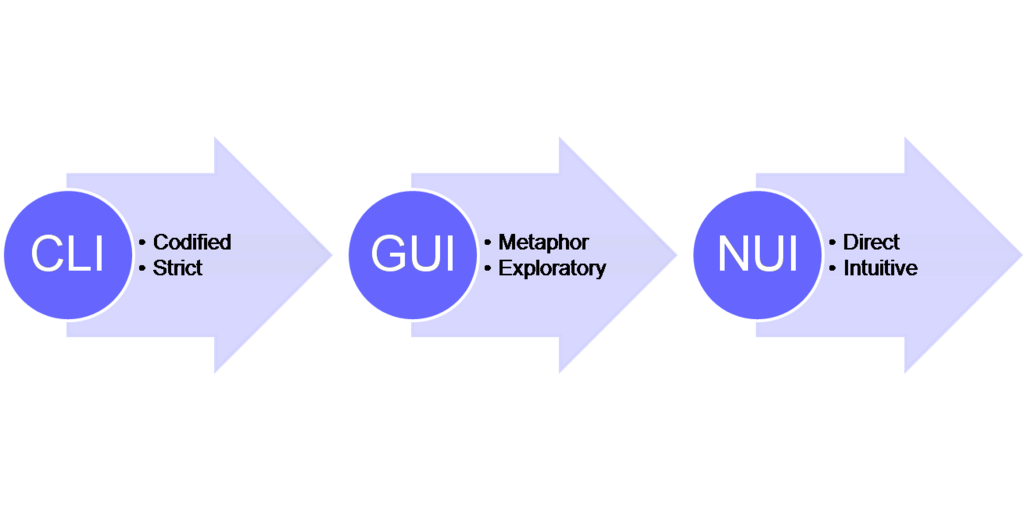
This shift was monumental. It replaced the need for memorization with the more intuitive actions of pointing, clicking, and dragging. Suddenly, computers became accessible. The digital world was no longer hidden behind a wall of code; it was a visual space you could explore.
The Rise of WIMP
The first widely successful GUIs were built on an interaction model so common that we now take it for granted. It's known as WIMP, which stands for Windows, Icons, Menus, and Pointer.
| Component | Description |
|---|---|
| Windows | Areas of the screen that contain distinct information, which can be resized and overlapped. |
| Icons | Small pictures that represent objects like files, folders, or applications. |
| Menus | Lists of commands and options that users can select from. |
| Pointer | A cursor on the screen, controlled by a mouse or trackpad, used to select and manipulate objects. |
This paradigm organized the digital space into a virtual desktop, a metaphor for a real-life office desk. Files were icons you could move around, programs ran in separate windows like sheets of paper, and a menu offered you a list of available actions. The pointer was your hand, allowing you to interact directly with these digital objects.
The WIMP model made computers feel less like alien machines and more like familiar tools. This user-friendly approach is the foundation upon which nearly all modern desktop and laptop experiences are built.
Understanding these foundational concepts is the first step toward designing effective and user-friendly digital products. They provide the basic vocabulary for talking about how we interact with technology.
What is the primary goal of Human-Computer Interaction (HCI)?
Before the widespread adoption of Graphical User Interfaces (GUIs), what was the dominant method for interacting with computers?
These early principles paved the way for the complex and intuitive interfaces we use every day, from our laptops to the touchscreens in our cars.