Human-Centered Decision Design in the Age of AI
Introduction to Decision Science
The Science of Choice
Every day is a series of choices. Some are small, like what to eat for breakfast. Others are huge, like changing careers. Decision science is the field that explores how we make these choices, both as individuals and in groups. It's not just about what we decide, but how we get there.
At its core, decision science tries to understand the processes behind our judgments. It blends ideas from psychology, economics, and statistics to create a clearer picture of our internal logic.
The Rational Ideal
Traditionally, economics assumed that people are perfectly rational decision-makers. This ideal person, sometimes called Homo economicus, has access to all relevant information, can process it instantly, and always chooses the option that gives them the best possible outcome. They are masters of optimization.
Rationality
noun
The quality of being based on or in accordance with reason or logic. In decision theory, it means choosing the option that maximizes one's own utility or benefit.
A purely rational choice means weighing every pro and con of every single option before making the single best selection. It's an exhaustive and perfect process.
Of course, this isn't how real life works. We rarely have all the information, and our brains don't have unlimited processing power. This is where a more realistic concept comes in.
Reality Bites: Bounded Rationality
Nobel laureate Herbert Simon introduced the idea of bounded rationality. He argued that our ability to be rational is limited, or “bounded,” by the information we have, our own cognitive limits, and the time available to make a decision.
Bounded Rationality
other
A concept that challenges the notion of perfect rationality, suggesting that decision-makers are limited by their cognitive abilities and the information available to them.
Instead of optimizing for the perfect choice, we often “satisfice.” This means we search for an option that is simply satisfactory, or good enough to meet our needs. Choosing the first restaurant you see that looks decent when you're hungry is satisficing. Spending hours researching every restaurant in a five-mile radius to find the absolute best one would be optimizing.
Mental Shortcuts
To cope with our bounded rationality, we rely on mental shortcuts called heuristics. These are simple, efficient rules of thumb that allow us to make judgments and solve problems quickly. They work well most of the time, but they can also lead to systematic errors in thinking known as cognitive biases.
Heuristic
noun
A mental shortcut or rule of thumb that simplifies decision-making.
Let's look at a few common examples.
Availability Heuristic: We judge the likelihood of an event by how easily examples come to mind. After seeing news reports about a plane crash, people might feel that flying is more dangerous than driving, even though statistics show the opposite is true. The dramatic images of the crash are more available in our memory.
Anchoring Bias: This is our tendency to rely too heavily on the first piece of information we receive. If a salesperson first quotes a high price for a car (the anchor), a slightly lower price might seem like a great deal, even if it's still above market value.
Confirmation Bias: We tend to seek out and favor information that confirms what we already believe. If you believe a certain political candidate is dishonest, you'll likely pay more attention to news stories that highlight their flaws and ignore those that praise them.
Individuals vs. Organizations
Individual decision-making is often driven by personal preferences, emotions, and the heuristics we just discussed. When you choose a movie, you're thinking about what you enjoy.
Organizational decision-making is more complex. A company choosing a new software system can't just go with what feels right. The process is usually more structured and involves multiple people, or stakeholders. They must consider budgets, long-term goals, company policies, and how the decision affects different departments.
Even so, organizations are made up of individuals. This means that cognitive biases can still influence group decisions. A team might suffer from “groupthink,” where the desire for harmony overrides a realistic appraisal of alternatives. Or, a powerful leader’s anchoring bias could sway the entire group’s decision.
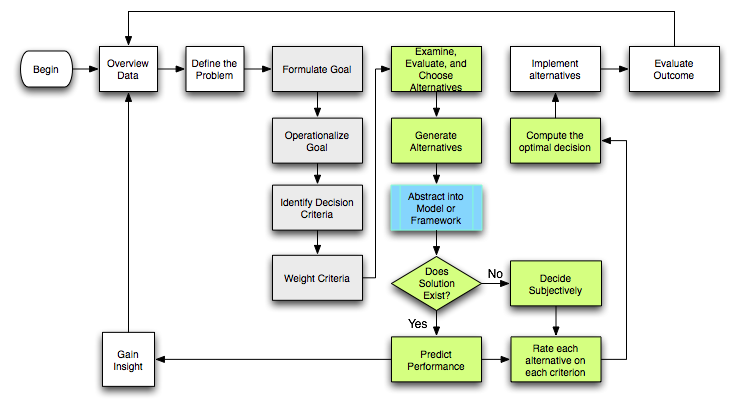
Frameworks and structured processes, like those used in business, are designed to minimize these biases and push decisions closer to the rational ideal. They force people to define goals, gather data, and evaluate options systematically.
Ready to test your understanding of these core concepts?
According to the concept of bounded rationality, human decision-making is limited by which of the following factors?
Which of the following scenarios is the best example of 'satisficing'?
Understanding these foundational ideas helps explain why people make the choices they do, both for good and for ill. It’s the first step in learning how to make better, more informed decisions.