Human Anatomy and Physiology Fundamentals
Introduction to Anatomy and Physiology
Structure Meets Function
Human anatomy is the study of the body’s structures. Think of it as creating a map of the body, identifying every part, from the largest organ down to the smallest cell. Physiology, on the other hand, is the study of how all those parts work. If anatomy is the map, physiology is the story of the traffic, the communication, and the energy that flows through that map.
Anatomy asks “what is it?” and “where is it?” Physiology asks “how does it work?” and “why?” The two are deeply connected. A bone is hard and strong (anatomy) because its function is to provide support and protection (physiology). The lungs have millions of tiny air sacs to maximize surface area (anatomy) so they can efficiently exchange oxygen and carbon dioxide (physiology). You can't truly understand one without the other.
Your study of anatomy and physiology will make more sense if you continually relate the form of the structures you are studying to their function.
From Cells to Systems
The human body is organized in layers of increasing complexity, like a set of Russian nesting dolls. It starts with the smallest unit of life and builds up to the whole person.
This hierarchy is: Cells → Tissues → Organs → Organ Systems → Organism.
Here's a quick breakdown:
- Cells: The fundamental units of life. Everything in the body is made of or by cells. Muscle cells, nerve cells, and bone cells are just a few examples.
- Tissues: Groups of similar cells that team up to perform a specific function. For example, many muscle cells working together form muscle tissue, which contracts to produce movement.
- Organs: A structure made of at least two different types of tissue that performs a specific, complex function. The heart, for instance, is an organ made of muscle tissue, nervous tissue, and connective tissue that work together to pump blood.
- Organ Systems: A group of organs that cooperate to accomplish a major task. The digestive system, which includes the stomach, intestines, liver, and pancreas, works to break down food and absorb nutrients.
Staying Stable
Your body is constantly working to maintain a stable, balanced internal environment. This process is called homeostasis. Think of it as your body's internal thermostat, cruise control, and autopilot all rolled into one.
No matter if it's hot or cold outside, your internal body temperature stays right around 98.6°F (37°C). After you eat a sugary snack, your body works to bring your blood sugar levels back to normal. These are both examples of homeostasis in action. It's a dynamic state of equilibrium, constantly adjusting to changes inside and outside the body. Nearly every disease is a result of the body's failure to maintain homeostasis.
Homeostasis is the body's ability to maintain relatively stable internal conditions even though the outside world changes continuously.
The Body's Map
To talk about the body accurately, we need a shared map and a set of directions. Anatomical terminology provides this, ensuring that when one person refers to a specific location, everyone else knows exactly what they mean. The starting point is the anatomical position: standing upright, feet parallel, with palms facing forward.
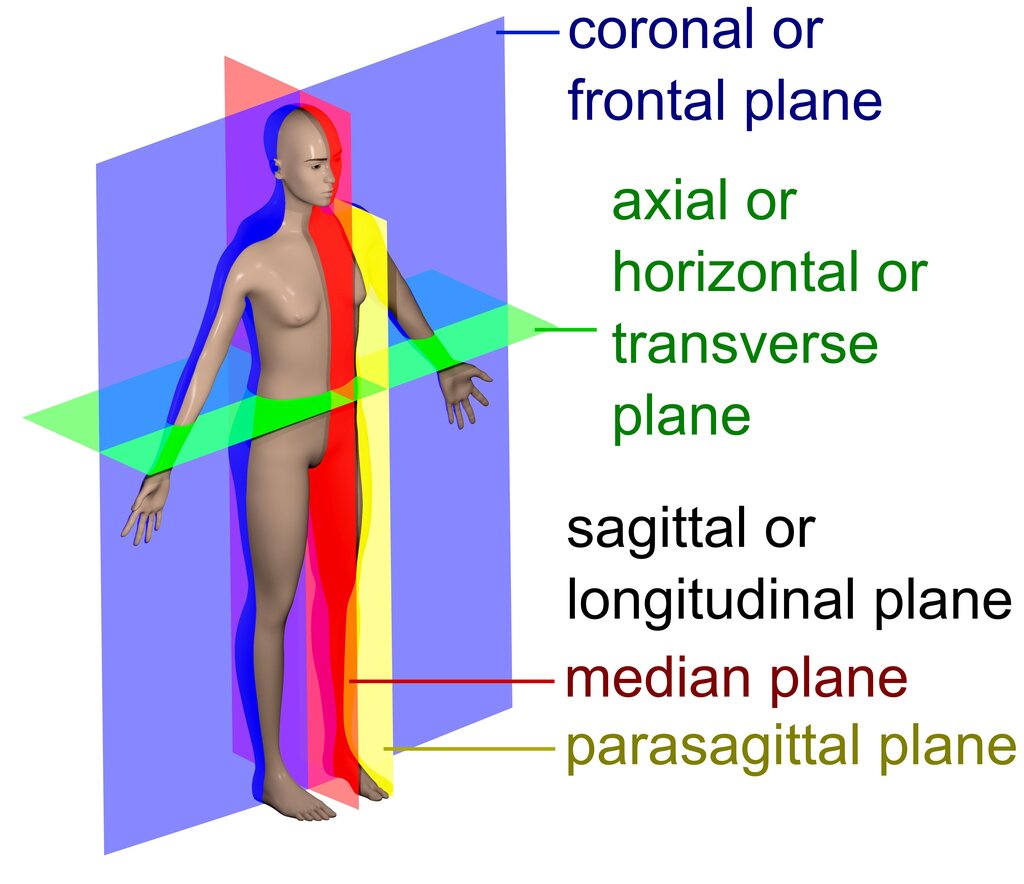
To create clear views, the body can be divided by imaginary flat surfaces called planes.
- Sagittal Plane: Divides the body vertically into left and right sections.
- Frontal (or Coronal) Plane: Divides the body vertically into front (anterior) and back (posterior) sections.
- Transverse (or Horizontal) Plane: Divides the body horizontally into upper (superior) and lower (inferior) sections.
| Term | Definition | Example |
|---|---|---|
| Superior | Toward the head | The heart is superior to the stomach. |
| Inferior | Away from the head | The stomach is inferior to the heart. |
| Anterior | Toward the front | The sternum is anterior to the spine. |
| Posterior | Toward the back | The spine is posterior to the sternum. |
| Medial | Toward the midline | The nose is medial to the eyes. |
| Lateral | Away from the midline | The eyes are lateral to the nose. |
These fundamental concepts—the link between structure and function, the levels of organization, the principle of homeostasis, and the language of anatomy—are the building blocks for understanding the incredible complexity of the human body.
A researcher studying the layered structure of the skin and the specific types of cells found in each layer is focusing on which discipline?
Which of the following correctly lists the levels of biological organization from simplest to most complex?