HTTP Fundamentals
Introduction to HTTP
The Web's Messenger
Every time you visit a website, you're using HTTP. It’s the protocol that makes the modern web work, acting as the messenger between your browser and the server that hosts the website you want to see.
HTTP
noun
Stands for Hypertext Transfer Protocol. It's a set of rules for transferring files, like text, images, and video, on the World Wide Web.
Think of a protocol as a language with a strict set of grammar rules. Both speakers must follow the rules to understand each other. HTTP provides these rules for a web browser and a web server. It defines how requests for information are structured and how the server's replies should be formatted. Without this shared language, the web would be a chaotic mess of miscommunication.
The Client and the Server
Web communication is a two-way street, but the roles are clearly defined. This is known as the client-server model.
The client is the device making the request. In most cases, this is your web browser, whether it's on your phone, laptop, or tablet. When you type a web address and hit Enter, your browser (the client) creates and sends an HTTP request out to the internet.
The server is a powerful computer that stores the website's files (HTML, CSS, images, etc.) and waits for requests. When a request from a client arrives, the server processes it, finds the correct files, and sends them back in an HTTP response. The client's browser then assembles these files into the webpage you see.
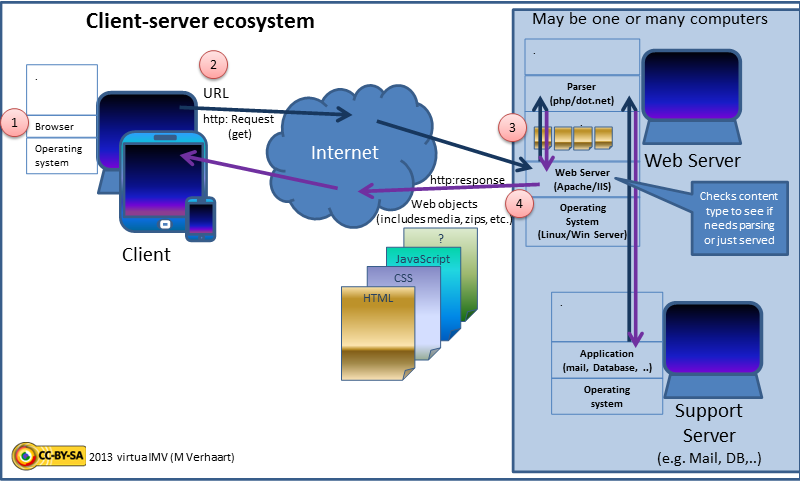
Imagine ordering a coffee. You (the client) make a specific request to the barista. The barista (the server) takes your order, prepares your drink, and serves it to you. You don't make the coffee yourself; you request it from someone who has the resources and is set up to fulfill that request. That's the essence of the client-server relationship.
A Stateless Protocol
One of the most important characteristics of HTTP is that it is stateless. This means each request is treated as a completely independent event. The server does not keep any memory or information about past client requests.
When you request a webpage, the server sends it and then completely forgets about you. If you click a link on that page a second later, you send a new request, and the server treats it as if it's never heard from you before. It has no memory of the first request.
Statelessness means the server holds no memory of previous interactions. Every transaction is executed as if it were the very first one.
This might seem inefficient, but it makes the system much simpler. The server doesn't need to store a history of conversations, which allows it to handle thousands of requests from different clients quickly. While this creates challenges for things like online shopping carts (where the server needs to remember what you're buying), other technologies like cookies were developed to work alongside HTTP to solve this problem.
Understanding HTTP is the foundation of modern web development, yet it's often overlooked.
Now let's check your understanding of these core concepts.
What is the primary role of the HTTP protocol?
In the client-server model, the web browser's role is that of the __________.
This request-and-response dialogue between clients and servers, governed by the rules of HTTP, is what makes browsing the web possible.