HSK-1 Chinese Vocabulary Mastery
Pinyin and Tones
Sounds You Already Know
Before you can speak a language, you need to understand its sounds. Mandarin Chinese might seem intimidating, but its sounds are written using a system called Pinyin. Pinyin uses the same Roman alphabet we use for English.
Think of it as a bridge. It connects the Chinese characters you'll eventually learn with the sounds you need to make. It isn't a separate language, but a tool for pronunciation. By learning Pinyin, you're learning to read and say any Mandarin word out loud, even without knowing its meaning yet.
Pinyin is the Romanization system for Chinese characters and is crucial for beginners to learn pronunciation and tones accurately.
Every Pinyin syllable is made of two parts: an initial and a final. An initial is the consonant sound at the beginning, like 'b' in 'bà'. A final is the vowel sound that follows, like 'a' in 'bà'. Some syllables only have a final. Once you can pronounce the initials and finals, you can pronounce any syllable in Mandarin.
The Music of Mandarin
There's one more piece to the puzzle: tones. Mandarin is a tonal language. This means the pitch of your voice when you say a syllable can completely change its meaning. It’s like the difference between saying "Wait" and "Wait?" in English. The notes change the meaning.
Mandarin has four main tones, plus a fifth neutral tone.
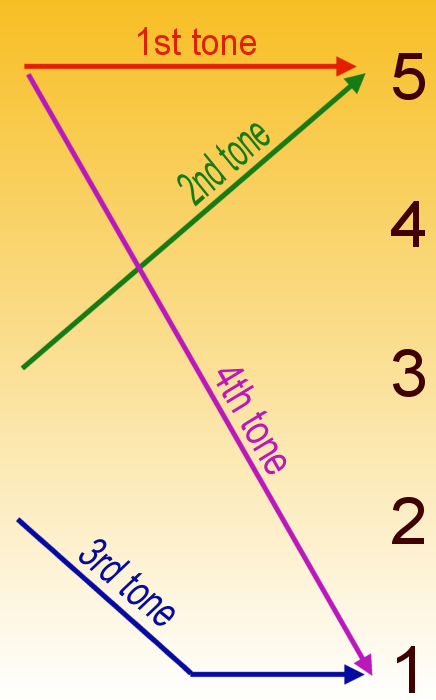
Let's look at the syllable 'ma' to see how this works.
First Tone (mā) This is a high, flat tone. Imagine a singer holding a high, steady note. Your voice starts high and stays there. The tone mark is a flat line above the vowel: mā.
mom
Second Tone (má) This tone rises. It sounds like you're asking a question, like "Huh?" Your voice starts at a medium pitch and goes up. The tone mark is a rising line: má.
hemp
Third Tone (mǎ) This is a dipping tone. Your voice starts in the middle, dips down, then rises back up. It’s the most complex tone. The mark is a small curve: mǎ.
horse
Fourth Tone (mà) This is a sharp, falling tone. Imagine making a firm, quick command, like "Stop!" Your voice starts high and drops quickly. The mark is a falling line: mà.
to scold
Neutral Tone (ma) There's also a neutral tone, which has no tone mark. It's short, light, and unstressed. You'll often find it at the end of words or in question particles.
(question particle)
Placing the Tone Marks
Tone marks are essential for reading Pinyin. They always go above a vowel. But what if a syllable has multiple vowels, like 'hao'?
There's a simple rule: the mark goes on the vowel that comes first in this sequence: a, o, e, i, u, ü. So for 'hao', the 'a' gets the mark (hǎo). For 'xue', the 'e' gets it (xué). The only exception is when 'i' and 'u' are together. In that case, the mark goes on the second vowel, like in 'jiu' (jiǔ).
Vowel order for tone marks: a > o > e > i > u > ü
Ready to test what you've learned?
What is the primary purpose of Pinyin?
A Mandarin syllable that is pronounced with a sharp, falling pitch, like a quick command, is using which tone?
Getting the tones right is a big step. With Pinyin as your guide, you now have the tools to pronounce any word in Mandarin.