HSC Science Essentials Bangladesh
Mechanics
The Rules of Motion
Mechanics is the branch of physics that explains how and why things move. It's the science behind a home run, a car accelerating, or a planet orbiting the sun. It all boils down to two key ideas. First, we need a language to describe motion itself. This is called kinematics. Then, we need to understand the causes of motion, which are forces. That's the realm of dynamics.
Mechanics is split into two parts: kinematics describes how objects move, and dynamics explains why they move.
Kinematics: The Language of Motion
Before we can understand why an object moves, we need to describe its movement precisely. Kinematics gives us the tools to do that. It’s not concerned with what causes the motion, just the motion itself. We track things like position, speed, and changes in speed.
Displacement
noun
The change in an object's position. It's a vector, meaning it has both a distance and a direction. It's not just how far you traveled, but also where you ended up relative to where you started.
Velocity
noun
The rate at which an object's position changes. Like displacement, it's a vector, so it includes direction. Speed is just the magnitude of velocity.
Acceleration
noun
The rate at which an object's velocity changes. You accelerate when you speed up, slow down, or change direction.
These three concepts are linked. Velocity is the change in displacement over time, and acceleration is the change in velocity over time. For an object moving with constant acceleration, we can predict its motion using a set of simple equations.
Dynamics: The Cause of Motion
While kinematics describes motion, dynamics explains it. The central character in dynamics is force, which is simply a push or a pull. The rules that govern how forces affect motion were laid out by Isaac Newton more than 300 years ago, and they form the foundation of classical mechanics.
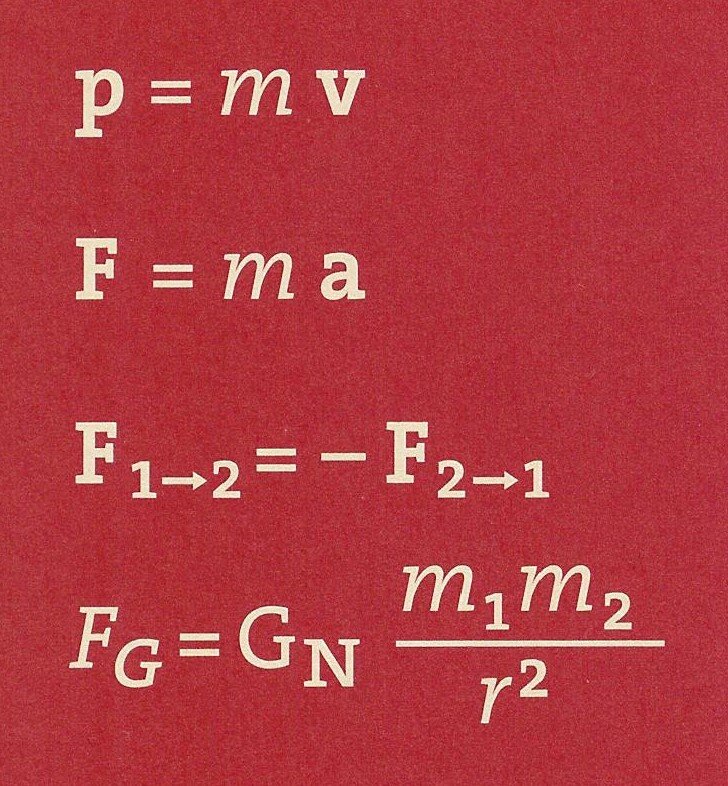
Newton's First Law: The Law of Inertia An object at rest will stay at rest, and an object in motion will stay in motion with the same velocity, unless acted upon by an external force. This property of resisting changes in motion is called inertia.
This means things don't just start or stop moving on their own. If a hockey puck is sliding on frictionless ice, it will keep sliding forever. In the real world, friction is a force that slows things down.
Newton's Second Law: Force Equals Mass Times Acceleration This is the most famous of the three laws. It connects force, mass (how much "stuff" an object has), and acceleration with a simple formula.
This law tells us a few things. To accelerate an object, you need to apply a net force. The more massive the object, the more force you need to get the same acceleration. It’s easier to push an empty shopping cart than a full one.
This diagram shows the forces acting on a block being pushed. The net force is the sum of all forces. If the applied force is greater than friction, the block will accelerate to the right.
Newton's Third Law: Action and Reaction For every action, there is an equal and opposite reaction. This means forces always come in pairs. If you push on a wall, the wall pushes back on you with the same amount of force.
This can seem counterintuitive. If the forces are equal and opposite, how does anything move? The key is that the forces act on different objects. A rocket pushes hot gas out (action), and the gas pushes the rocket forward (reaction). The force from the gas acts on the rocket, causing it to accelerate.
Work, Energy, and Power
Force and motion are intimately connected to the concepts of work and energy. In physics, these words have very specific meanings.
Work
noun
Done when a force causes an object to move a certain distance. If you push a box across the floor, you are doing work. If you push on a wall and it doesn't move, you've done no work in the physics sense.
Energy is the capacity to do work. It comes in many forms, but in mechanics, we focus on two: kinetic and potential energy.
-
Kinetic Energy (KE) is the energy of motion. Anything that is moving has kinetic energy. The faster it moves or the more mass it has, the more kinetic energy it has.
-
Potential Energy (PE) is stored energy. Gravitational potential energy is stored in an object due to its height. A book held above the ground has potential energy because if you let it go, gravity will do work on it and it will fall.
One of the most important ideas in all of physics is the Conservation of Energy. Energy cannot be created or destroyed, only transformed from one form to another. Think of a roller coaster. At the top of the first hill, it has maximum potential energy and very little kinetic energy. As it goes down the hill, the potential energy is converted into kinetic energy, and it speeds up. The total mechanical energy (KE + PE) remains constant, ignoring friction.
Finally, power is how quickly work is done, or how fast energy is transferred.
A powerful engine can do a lot of work in a short amount of time. Lifting a heavy box quickly requires more power than lifting it slowly, even though the total work done is the same.
Which of the following questions would be answered by the field of kinematics, rather than dynamics?
An astronaut in deep space, far from any gravitational influence, throws a wrench. What will happen to the wrench after it leaves their hand?
These principles of kinematics, dynamics, and energy form the bedrock of mechanics and help us understand the motion of everything around us.