HPE Alletra Storage Systems Explained
Introduction to Storage Concepts
Where Data Lives
How computers access data isn't always as simple as pulling a file from a local hard drive. In professional environments, storage is a resource that needs to be shared, managed, and protected. The way systems connect to this storage is called the storage architecture. Let's look at the three main approaches.
Direct-Attached Storage (DAS) is the simplest model. It's storage connected directly to a single computer. Think of the internal hard drive in your laptop or an external USB drive. It's fast and straightforward but not easily shared.
Network-Attached Storage (NAS) is a dedicated device on a standard office network that serves files. Multiple users can access it at the same time. It's like a shared folder that everyone in the office can use. NAS systems manage their own file system and present data as files and folders.
Storage Area Network (SAN) is a more advanced approach. It's a dedicated, high-speed network that connects servers to a shared pool of storage. To the server, the SAN storage looks just like a local drive. This method provides block-level access, which is very efficient for applications like databases. Instead of requesting a file, the server requests raw blocks of data, giving it more control.
Keeping Data Safe with RAID
Physical drives fail. It's not a matter of if, but when. Relying on a single drive for important data is risky. To solve this, we use RAID.
RAID
noun
A technology that combines multiple physical disk drives into one or more logical units for the purposes of data redundancy, performance improvement, or both.
RAID stands for Redundant Array of Independent Disks. The basic idea is to spread data across several drives in different ways, called RAID levels. Some levels focus on speed (striping data across drives), while others focus on safety (mirroring data), and some do both.
A common level is RAID 5, which provides a good balance of performance and protection. It stripes data across multiple drives but also calculates and stores parity information. If one drive fails, the system can use the parity data on the remaining drives to rebuild the lost information. This allows the system to keep running without losing any data.
Connecting to Storage
For high-performance systems, especially SANs, a standard Ethernet network might not be fast or reliable enough. This is where specialized protocols come in. The two most common are Fibre Channel and iSCSI.
Fibre Channel
noun
A high-speed data transfer protocol providing in-order, lossless delivery of raw block data. It primarily runs on dedicated fiber optic cabling.
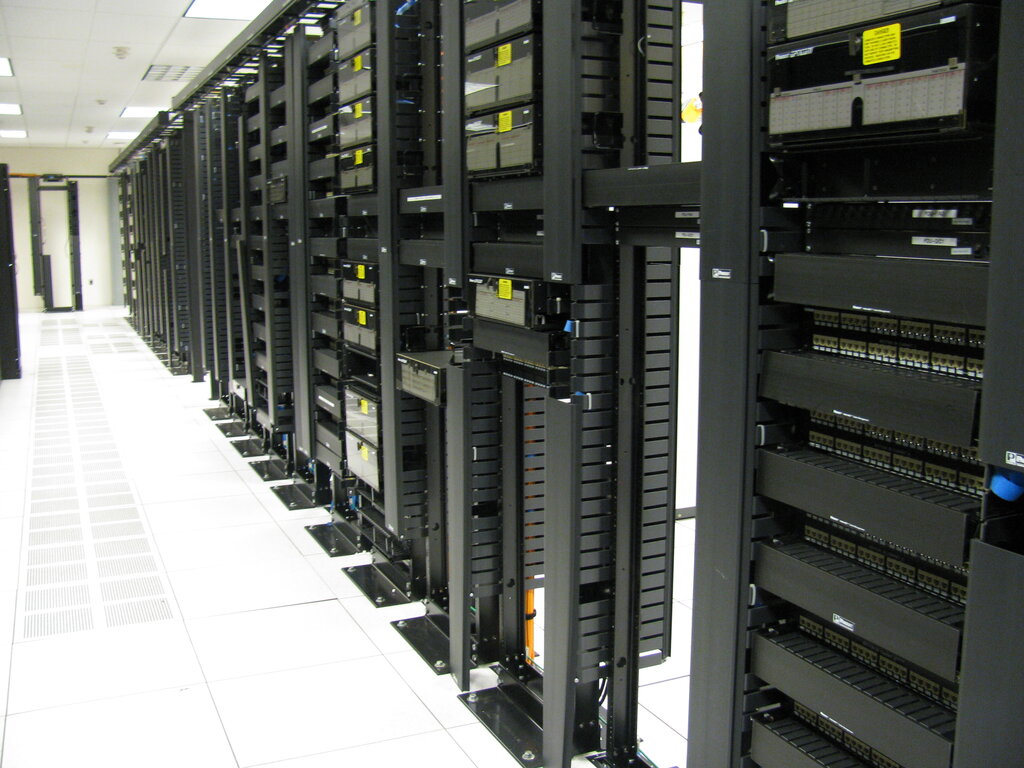
Fibre Channel (FC) is the gold standard for SANs. It was designed from the ground up for storage traffic and runs on its own dedicated network with special switches and cables. This isolation means it's extremely fast and reliable, as it doesn't have to compete with other network traffic like emails or web browsing.
iSCSI
noun
A protocol that allows SCSI commands to be sent over standard TCP/IP networks, enabling block-level storage access using common Ethernet hardware.
The main drawback of Fibre Channel is its cost and complexity. It requires specialized hardware and expertise. An alternative is iSCSI (Internet Small Computer System Interface). iSCSI wraps up storage commands and sends them over a standard Ethernet network. This lets organizations build a SAN using the same switches and cables they already use for their regular computer network, making it a more affordable and simpler option.
| Feature | Fibre Channel (FC) | iSCSI |
|---|---|---|
| Network | Dedicated, special hardware | Standard Ethernet |
| Performance | Very high, low latency | Good, but can be impacted by network traffic |
| Cost | High | Lower |
| Complexity | More complex to manage | Simpler, uses existing network skills |
Understanding these core ideas of architecture, data protection, and connectivity is the first step in working with any enterprise storage system.
A small business needs a simple way to create a shared folder that all employees on their office network can access. Which storage architecture is the most suitable for this purpose?
True or False: A key advantage of using iSCSI for a SAN is that it can operate over existing standard Ethernet networks, making it more cost-effective than Fibre Channel.