How Retrieval-Augmented Generation Works
Introduction to RAG
Giving AI an Open Book
Large language models (LLMs) are incredibly powerful. They can write essays, generate code, and summarize complex topics. But they have a fundamental weakness: they only know what they were taught during their training. Their knowledge is frozen in time and limited to the data they've already seen.
This leads to a few problems. An LLM might not know about recent events, or it might confidently invent facts if it doesn't know the real answer, a behavior often called "hallucination." It also can't access private or specialized information, like your company's internal documents or the latest medical research.
Think of a standard LLM as a brilliant student taking a closed-book test. They can only rely on what they've memorized. What if we could give them an open book? That's the core idea behind Retrieval-Augmented Generation, or RAG.
RAG
noun
An AI framework that enhances a large language model's response by first retrieving relevant, up-to-date information from an external knowledge source and providing it as context.
RAG turns a closed-book test into an open-book one. It connects the LLM to an external knowledge source, like a database, a collection of documents, or even the live internet. When you ask a question, the RAG system doesn't just pass it to the LLM. It first retrieves relevant information and then augments the original question with this new context. The LLM then uses this freshly supplied information to generate a much more accurate and relevant answer.
How RAG Works
The process is straightforward. Let's say you ask a chatbot powered by RAG, "What were our company's sales figures for the last quarter?" An ordinary LLM would have no idea. But a RAG system follows a specific workflow.
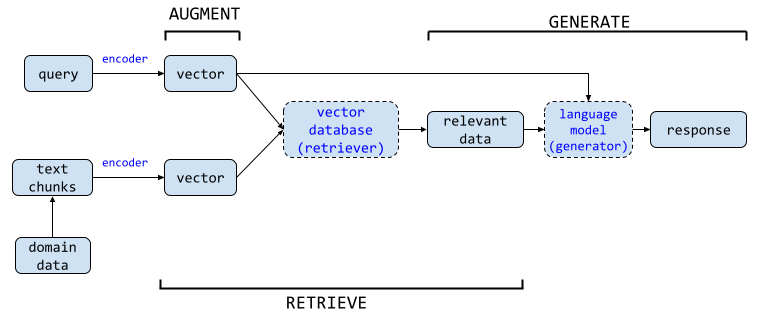
First, the system takes your query and uses a retriever to search its connected knowledge base. In this case, it would search internal company sales reports. The retriever's job is to find the most relevant snippets of information. It might pull up a paragraph from the quarterly report saying, "Q3 sales reached $1.2 million, a 15% increase over the previous quarter."
Next, this retrieved information is combined with your original question into a new, expanded prompt. The system essentially tells the LLM: "Using the following context: 'Q3 sales reached $1.2 million, a 15% increase over the previous quarter,' please answer the user's question: 'What were our company's sales figures for the last quarter?'"
Finally, the LLM, now called a generator, uses this rich context to craft a precise answer. It's no longer guessing or relying on old data. It's synthesizing the exact information it was just given. The result is an accurate, timely, and verifiable response.
The core components are simple: a knowledge base to store information, a retriever to search it, and a generator (the LLM) to create an answer based on what's found.
Why It Matters
RAG is more than just a clever trick. It's a practical solution to some of the biggest challenges facing AI today. By grounding LLMs in factual, external data, RAG makes them more reliable and trustworthy. It reduces hallucinations and allows them to provide answers based on current or proprietary information.
This opens the door for powerful, specialized applications. Imagine AI assistants that can help doctors by referencing the latest medical journals, or legal tools that can instantly cite relevant case law. For businesses, it means creating internal chatbots that can actually help employees navigate complex documentation. RAG makes LLMs not just knowledgeable, but contextually aware.
| Feature | Standard LLM | RAG-Enabled LLM |
|---|---|---|
| Knowledge Source | Internal training data only | Internal data + External source |
| Knowledge Cutoff | Yes (stuck in the past) | No (can access live data) |
| Source Citing | Cannot cite sources | Can cite sources from retrieval |
| Hallucination Risk | High | Low |
| Use with Private Data | Not possible | Ideal for this task |
Ready to check your understanding of these core concepts?
What is a fundamental weakness of standard large language models (LLMs) that Retrieval-Augmented Generation (RAG) is designed to solve?
In the RAG architecture, what is the specific role of the 'retriever' component?