How Large Language Models Work
Introduction to NLP
Teaching Computers to Speak Human
Every time you ask a smart speaker for the weather, use autocorrect, or see an email land in your spam folder, you're interacting with Natural Language Processing, or NLP. It’s a field of artificial intelligence that gives computers the ability to understand, interpret, and generate human language.
Think of it as building a bridge between how we communicate and how computers process information. Humans are messy communicators. We use slang, irony, and rely on shared context. Computers, on the other hand, thrive on precise, structured data. NLP is the toolkit we use to translate our fluid, often chaotic language into a format a machine can work with.
The ultimate goal of NLP is to read, decipher, understand, and make sense of human languages in a manner that is valuable.
It's a huge field, covering everything from simple tasks like identifying the parts of speech in a sentence to complex challenges like understanding the sentiment of a movie review or translating a novel from one language to another.
The Three Layers of Language
To understand language, a computer needs to analyze it on multiple levels. Linguists often break this down into three key areas: syntax, semantics, and pragmatics. NLP systems tackle all three.
syntax
noun
The grammatical structure of a sentence. It's about how words are arranged to form valid sentences.
Syntax is the set of rules that govern sentence structure. For example, in English, a basic sentence follows a subject-verb-object pattern, like "The cat chased the mouse." The sentence "Chased the cat the mouse" is syntactically incorrect. NLP models first need to parse a sentence to understand its grammatical blueprint.
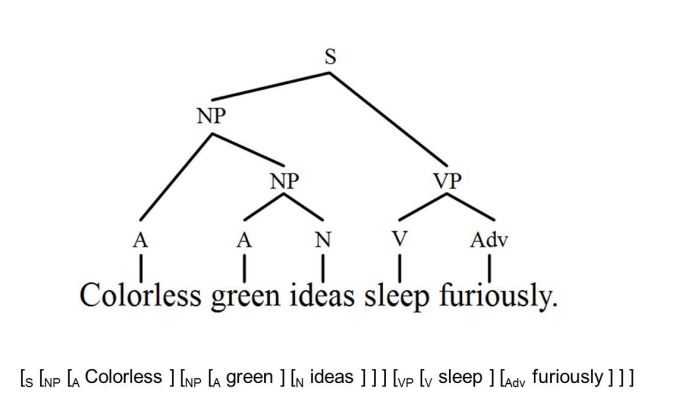
Once the structure is clear, the next step is semantics, which deals with meaning. The sentence "The cat chased the mouse" has a clear meaning because we know what cats, mice, and chasing are. But the famous sentence by linguist Noam Chomsky, "Colorless green ideas sleep furiously," is syntactically perfect but semantically nonsensical. An NLP system must learn the relationships between words to figure out what a sentence actually means.
Finally, there's pragmatics. This is the highest level of understanding, where context is everything. It's about figuring out the intended meaning, which often goes beyond the literal words.
If someone asks, "Do you have the time?" they aren't just asking if you possess time. Pragmatics helps a machine understand they're asking for the current time.
Why Language Is So Hard for Machines
If understanding language seems complex, that's because it is. Human language is filled with challenges that programmers and researchers have been trying to solve for decades. Three of the biggest hurdles are ambiguity, context, and variability.
| Challenge | Description | Example |
|---|---|---|
| Ambiguity | A word or phrase can have multiple meanings. | "I saw a man on a hill with a telescope." Who has the telescope? You or the man? |
| Context | Meaning changes depending on the situation. | The word "run" means something different in "I'm going for a run," "The water will run," and "The play had a long run." |
| Variability | There are infinite ways to express the same idea. | "I need to buy milk," "I'm heading out for milk," and "Milk is on my shopping list" all convey the same intent. |
Early NLP systems in the 1950s and 60s tried to solve these problems by using complex, handcrafted rules. A linguist would literally write a grammar book for the computer. This approach was brittle and couldn't handle the sheer messiness of real-world language.
Later, statistical methods took over. Instead of being given rules, models learned patterns by analyzing massive amounts of text. This was a huge step forward and forms the basis of the powerful language models we use today. These models learn syntax, semantics, and even a bit of pragmatics by identifying statistical relationships in the data they're trained on.
Let's check your understanding of these fundamental concepts.
What is the primary goal of Natural Language Processing (NLP)?
The sentence "Colorless green ideas sleep furiously" is grammatically correct but makes no logical sense. This sentence primarily demonstrates a failure in which level of linguistic analysis?
Understanding these core ideas of NLP is the first step. It provides the foundation for how more advanced systems, like the large language models we'll explore next, are able to perform such amazing linguistic feats.