How Earth Spins: Day and Night
Invisible Axis
Earth’s Invisible Spin
The Earth isn't just floating in space. It's constantly spinning. Imagine a line running straight through the center of the planet, connecting the North Pole to the South Pole. This imaginary line is called an axis. Earth spins around this axis, much like a spinning top.
If you could look at the Earth from above the North Pole, you would see it spinning counter-clockwise. This movement from west to east is why the sun appears to rise in the east and set in the west every day. Every 24 hours, the Earth completes one full spin on its axis of rotation.
As every planet revolves around the Sun, it rotates on its axis, and only the orientation of that axis matters.
A Tilted Planet
Now, here's a crucial detail. Earth's axis isn't perfectly straight up and down. It's tilted. If you picture a line going straight up from Earth's path around the sun, our axis is leaning over by 23.5 degrees. This might not seem like much, but this axial tilt is one of the most important things about our planet. It’s what gives us our seasons.
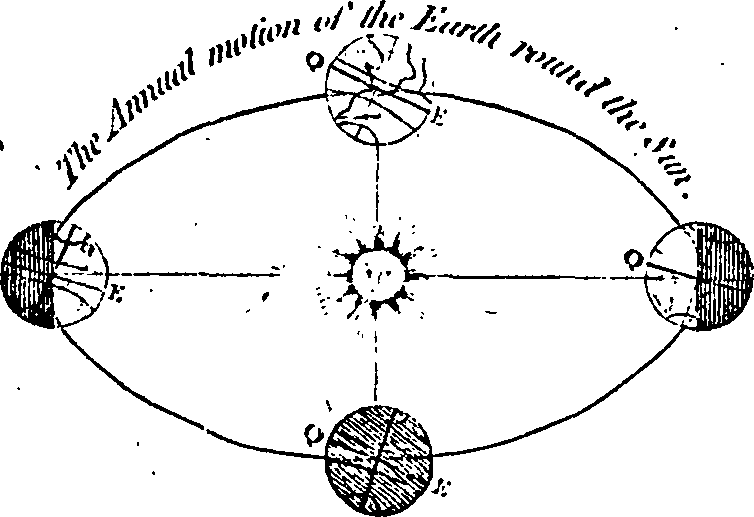
Think of it like this: as Earth journeys around the Sun, the tilt means that for part of the year, the Northern Hemisphere is angled more towards the Sun. Later in the year, the Southern Hemisphere gets its turn. This constant tilt is the reason why it's winter in Australia when it's summer in India.
This tilt isn't perfectly stable, either. Over very long periods of time, it wobbles slightly in a cycle called precession—like a spinning top that's starting to slow down. This slow wobble has gradual effects on Earth's long-term climate patterns.
Ready to check your understanding?
What is the primary reason we experience seasons on Earth?
If you were to look down on the Earth from above the North Pole, in which direction would it appear to be spinning?
The simple fact that our planet spins on a tilted axis is fundamental to life as we know it, dictating the rhythm of day and night and the cycle of the seasons.