How AI Video Generators Think
Denoising and Diffusion
From Noise to Art
If you've ever explored a world in Minecraft, you've seen a kind of procedural magic at work. The game doesn't store a massive, pre-built map. Instead, it generates mountains, caves, and rivers on the fly using an algorithm. A key ingredient in this recipe is something called , a type of structured randomness that creates natural-looking textures and landscapes from a mathematical starting point.
AI image generation starts with a similar idea, but instead of structured randomness, it begins with pure, chaotic noise, like the static on an old TV screen. The entire process is about teaching an AI to find a beautiful, coherent picture hidden within that chaos. It’s a two-step dance: first, you destroy an image, and then you learn how to rebuild it.
The Two-Step Dance
The first step is called forward diffusion. This is the destructive part. Imagine taking a clear photograph and slowly adding tiny specks of random noise, like grains of sand. You keep adding more and more noise, step by step, until the original image is completely lost in a sea of static. At the end of this process, all you have is a canvas of random pixels. The original photo is gone.
This might seem pointless, but the AI is watching this entire destruction process. It studies how a clean image becomes noisy at every single stage. By doing this over and over with millions of different images, it learns the relationship between a noisy image and a slightly less noisy one.
This training prepares it for the second, more creative step: reverse diffusion. This is where the magic happens. We give the AI a canvas of pure static and ask it to reverse the process it just watched. It has to clean up the noise, one small step at a time, to create a brand new image. This process is also known as denoising.
denoising
verb
The process of removing noise from a signal or data. In AI image generation, it refers to the model's step-by-step procedure of refining a noisy image into a clear one.
Guiding the Chaos
But how does the AI know what to create from the static? It could be anything. That's where your text prompt comes in.
The prompt acts as a guide for the denoising process. When you type "a photorealistic cat wearing a tiny hat," you're giving the AI a target. At each step of cleaning up the noise, the AI looks at the prompt and asks itself, "Does this mess of pixels look a little more like 'a cat wearing a hat' than it did a moment ago?" If the answer is yes, it keeps that change and moves to the next step. If no, it tries something else.
This is an iterative process of refinement. The AI makes thousands of tiny adjustments, gradually shaping the random noise into an image that matches your description. It’s like a sculptor chipping away at a block of marble, except the block is pure static and the chisel is guided by your words.
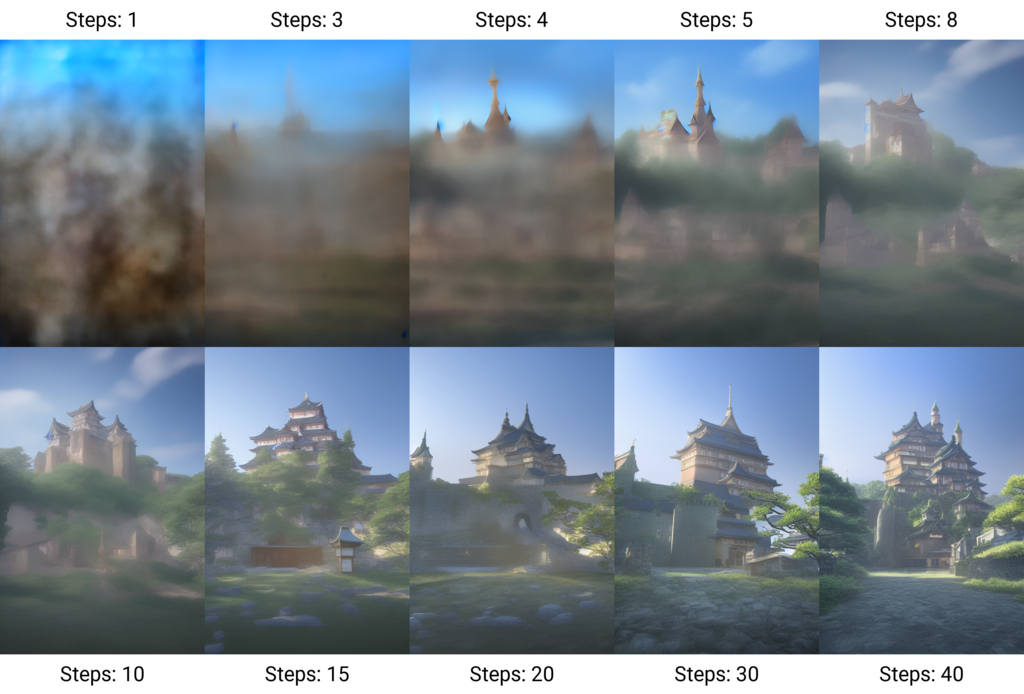
Each pass makes the image slightly clearer and more defined. Early on, you might see vague shapes and colors. As the process continues, these shapes sharpen into recognizable objects until, finally, a coherent image emerges from the static. This foundational loop of adding and removing noise is the engine behind all modern AI image and video generation.
Let's check your understanding of these core concepts.
What is the starting point for an AI image generator before it begins the creation process?
The primary purpose of the 'forward diffusion' stage is to train the AI by systematically destroying an image with noise.
Now that we've covered the basics of how an image is born from noise, we can move on to the next step.