Household Electricity Explained
Introduction to Electricity
The Building Blocks of Electricity
At the heart of all things electric is a fundamental property of matter called charge. You've seen its effects if you've ever felt a shock from a doorknob after walking across a carpet. This tiny spark is the result of moving charges.
Everything is made of atoms, and atoms are made of even smaller particles. Two of the most important are protons, which have a positive (+) charge, and electrons, which have a negative (-) charge. Most of the time, objects have a balanced number of protons and electrons, making them neutral.
When an object gains extra electrons, it becomes negatively charged. When it loses electrons, it becomes positively charged. These charges interact in a simple, predictable way: like charges repel each other, while opposite charges attract.
This attraction and repulsion is the force that makes electricity possible. But for it to be useful, we need to get those charges moving in a controlled way.
Making Charges Move
Static charge is interesting, but the real power comes from moving charges. To understand how we get them to flow, it helps to think of electricity like water in a system of pipes.
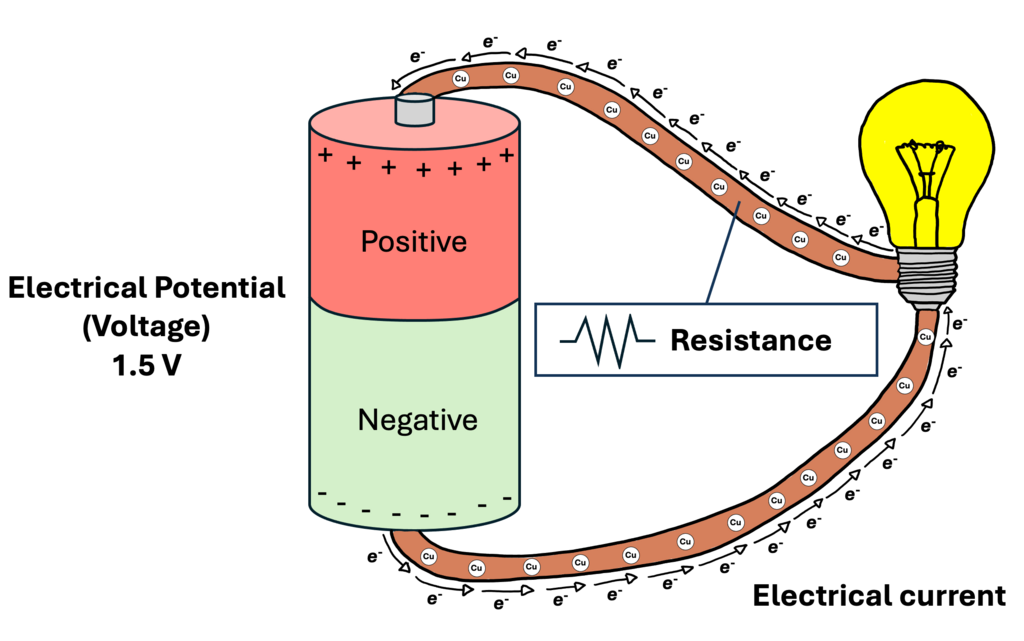
Three key concepts work together: voltage, current, and resistance. They are the foundation of every electrical circuit.
Voltage
noun
The electrical pressure or force that pushes electric charges through a circuit. It's the potential difference between two points.
In our water analogy, voltage is like the water pressure. A water tower creates high pressure, pushing water through pipes. A battery does the same for electrons, creating an electrical pressure that makes them want to move.
Current
noun
The rate of flow of electric charge. It's the number of electrons passing a point in a circuit per second.
Current is like the flow rate of the water. It’s how much water is moving through the pipe at any given moment. A wide-open faucet has a high current, while a dripping faucet has a very low current.
Resistance
noun
A measure of the opposition to current flow in an electrical circuit. It's like electrical friction.
Resistance is like a narrow section or a clog in the pipe. It restricts the flow of water. In a circuit, materials like copper have very low resistance, letting current flow easily. Materials like rubber have very high resistance, stopping the flow almost completely. This is why wires are made of copper and coated in rubber or plastic.
The Law of Flow
Voltage, current, and resistance aren't just related by an analogy; they have a precise mathematical relationship. This relationship was discovered by Georg Ohm and is now known as Ohm's Law. It’s one of the most fundamental principles in electronics.
Ohm's Law states that the voltage across a circuit is equal to the current flowing through it multiplied by the resistance.
Where:
- V is voltage, measured in volts (V).
- I is current, measured in amperes, or amps (A).
- R is resistance, measured in ohms (Ω).
This simple formula lets us calculate any one value if we know the other two. For example, if a 12-volt car battery is connected to a headlight with a resistance of 3 ohms, we can find the current:
The headlight draws 4 amps of current.
More push (voltage) means more flow (current). More friction (resistance) means less flow (current).
Two Types of Current
Just as water can flow steadily from a tap or slosh back and forth in a tub, electric current can flow in two different ways: direct current (DC) and alternating current (AC).
Direct Current (DC) is like a one-way street. Electrons flow steadily in a single direction, from the negative terminal to the positive terminal of a power source like a battery.
Anything that runs on batteries uses DC power. This includes your phone, laptop, and flashlight. The flow is constant and predictable.
Alternating Current (AC) is like a tide that constantly reverses. The electrons flow back and forth, switching direction many times per second.
The electricity that comes out of the wall sockets in your home is AC. This type of current is better for sending power over long distances, which is why our power grids are built on it. Large appliances like your refrigerator, washing machine, and television all run on AC power.
These core ideas, from the behavior of a single electron to the laws governing entire circuits, form the basis of how we generate, transport, and use electrical energy.