Hotel Financial Modeling Mastery
Hotel Industry Overview
Hotels Unpacked
The hotel industry isn't a monolith. It's a spectrum of properties, each catering to different guests and financial goals. At one end, you have budget hotels, like a Motel 6 or a Holiday Inn Express. They offer basic, clean accommodations with few frills. Their goal is to attract travelers who are price-conscious and just need a place to sleep.
In the middle are mid-scale hotels, such as a Hilton Garden Inn or a Courtyard by Marriott. These offer more amenities, like on-site restaurants, fitness centers, and business services. They strike a balance between comfort and cost, appealing to business travelers and families.
At the high end are luxury hotels—think Four Seasons or The Ritz-Carlton. These properties provide premium experiences with extensive services, fine dining, spas, and meticulous attention to detail. Their guests expect top-tier service and are willing to pay for it.
| Tier | Guest Profile | Price Point | Key Feature |
|---|---|---|---|
| Budget | Price-sensitive travelers | Low | Basic, clean lodging |
| Mid-Scale | Business travelers, families | Moderate | More amenities, comfort |
| Luxury | High-income individuals | High | Exceptional service, premium experience |
How these hotels are run also varies. Some are owner-operated, where the person who owns the building also manages the day-to-day business. Others are part of a franchise, where the owner pays a fee to use a brand name like Marriott or Hyatt and benefit from their marketing and reservation systems. A third model is a management contract, where the owner hires a separate company to run the hotel entirely.
Measuring Success
To understand how well a hotel is doing, we don't just look at its total profit. The industry uses specific Key Performance Indicators, or KPIs, to get a clear picture of financial health. These metrics help managers, owners, and investors compare performance across different properties and over time.
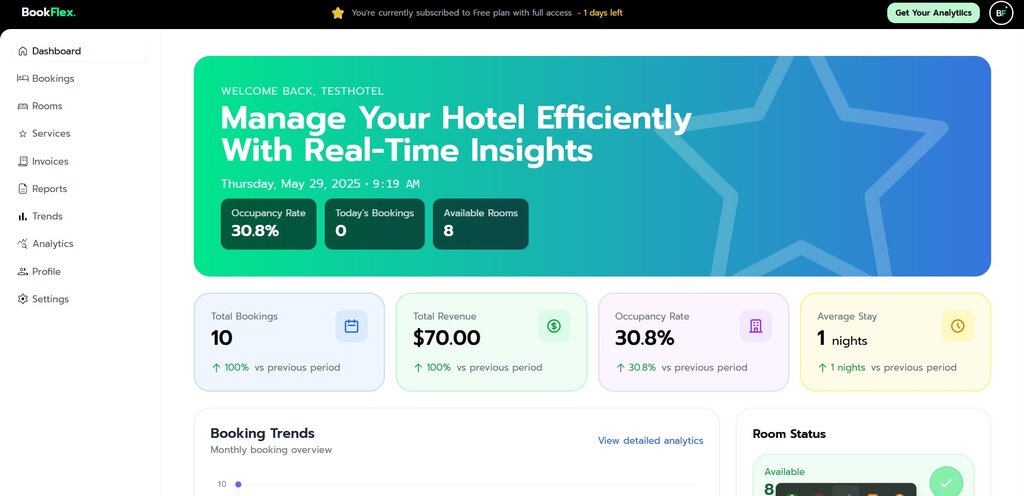
The three most important KPIs in the hotel business are Occupancy Rate, Average Daily Rate (ADR), and Revenue Per Available Room (RevPAR).
Occupancy Rate
noun
The percentage of occupied rooms in a hotel at a given time.
A high occupancy rate is generally a good sign, showing strong demand. If a hotel has 100 rooms and 80 are booked on a particular night, its occupancy rate is 80%.
Next is the Average Daily Rate, or ADR. This tells you the average price paid per room sold. It's a straightforward measure of how much revenue is being generated from each booked room, before taxes and fees.
ADR is calculated by dividing the total room revenue by the number of rooms sold. It reflects the hotel's pricing power.
While Occupancy and ADR are useful, they don't tell the whole story on their own. A hotel could have a 100% occupancy rate by charging only $10 per night, which isn't a successful strategy. Likewise, a high ADR means little if only a few rooms are sold.
This is where RevPAR comes in. It's often considered the most important KPI because it combines both occupancy and rate into a single metric.
RevPAR
noun
Revenue Per Available Room. It measures a hotel's ability to fill its rooms at an average rate.
RevPAR shows how much revenue is earned for every single room in the hotel, whether it's occupied or not. This gives a holistic view of performance.
You can also calculate it by multiplying the two other KPIs together.
By tracking these three metrics, anyone can quickly assess a hotel's performance. They form the foundation for making smarter decisions about pricing, marketing, and operations.
Ready to test your knowledge?
A hotel that offers on-site restaurants and fitness centers to strike a balance between comfort and cost for business travelers and families would best be classified as which type of property?
Which of the following describes a franchise model for a hotel?