Hot Air Balloon Aerodynamics and Materials
Introduction to Buoyancy
The Upward Push
Anything placed in a fluid, whether it's a liquid or a gas, feels an upward force. This force is called buoyancy. It's the reason a beach ball pops back to the surface when you try to push it underwater. The ancient Greek mathematician Archimedes figured this out more than two thousand years ago.
Archimedes' principle states that the upward buoyant force on a submerged object is equal to the weight of the fluid that the object displaces. Think about dropping an ice cube into a full glass of water. Some water spills out. If you could weigh that spilled water, its weight would be exactly the same as the buoyant force pushing up on the ice cube.
This same principle applies to air. It's easy to forget, but the air around us is also a fluid. It has weight and exerts pressure. When a hot air balloon sits on the ground, it pushes a huge volume of air out of the way. That displaced air pushes back, creating a buoyant force on the balloon.
Lighter Than Air
For an object to float, the buoyant force pushing up on it must be greater than the gravitational force (its weight) pulling it down. A rock sinks in water because it's much denser than water; the weight of the water it displaces is not enough to overcome the rock's own weight.
A hot air balloon gets around this problem by filling its enormous envelope with, well, hot air. Heating a gas makes its molecules move faster and spread farther apart. This makes the hot air inside the balloon much less dense than the cooler, denser air outside of it.
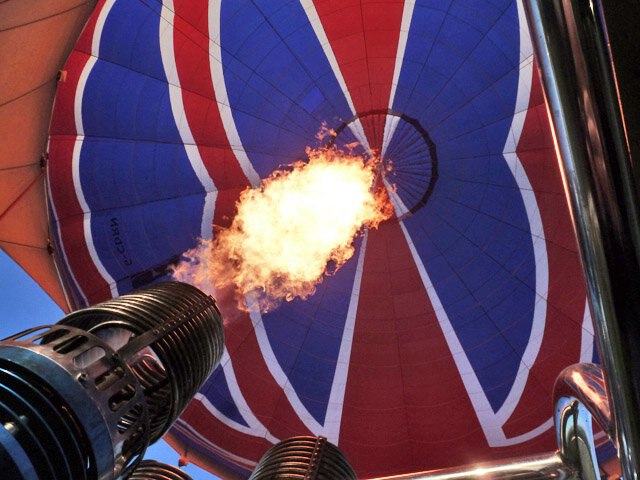
Because the air inside is less dense, a large volume of it weighs less than the same volume of the surrounding air. The balloon is so large that it displaces a tremendous amount of cooler, heavier air. The weight of this displaced air is what generates the powerful upward buoyant force.
When this buoyant force becomes greater than the total weight of the balloon, including the fabric, the basket, the fuel tanks, and the passengers, the balloon lifts off the ground.
The Balance of Forces
A balloon's flight is a constant balancing act between two forces: its total weight pulling it down and the buoyant force pushing it up.
- Weight (Gravity): This is the combined weight of everything that makes up the balloon, plus the less-dense hot air inside. It's a downward force.
- Buoyant Force: This is the weight of the cooler, denser ambient air that the balloon's envelope displaces. It's an upward force.
For the balloon to rise, the buoyant force must be greater than the weight.
The pilot can control the altitude by managing the temperature inside the envelope. Firing the burner heats the air, making it even less dense. This increases the buoyant force and causes the balloon to climb. Letting the air cool makes it denser, decreasing the buoyant force and allowing the balloon to descend.
Two main factors, therefore, affect the buoyant force. The first is the volume of the balloon's envelope. A larger envelope displaces more air, creating a greater potential buoyant force. The second is the temperature difference between the air inside and outside the balloon. A greater temperature difference creates a larger density difference, which results in more lift.
A larger balloon or hotter air inside creates more lift. A smaller balloon or cooler air creates less lift.
Now you're ready to test your understanding of buoyancy.
According to Archimedes' principle, what is the upward buoyant force on an object submerged in a fluid equal to?
Why does heating the air inside a hot air balloon cause it to rise?
This simple principle of buoyancy, understood for centuries, is what makes the gentle and majestic flight of a hot air balloon possible.