Horseback Riding Fundamentals
Horse Behavior and Safety
The World Through a Horse’s Eyes
To understand how to act around a horse, you first need to understand how they experience the world. Horses are prey animals. This single fact shapes everything about their behavior. Their instincts are wired for survival, constantly scanning for danger. Unlike predators, their eyes are on the sides of their head, giving them a wide, nearly 360-degree panoramic view to spot threats from almost any angle.
This comes with a trade-off. They have two major blind spots: one directly behind them and a smaller one right in front of their nose. If you suddenly appear in one of these spots, you can startle them simply because they didn't see you coming. Their hearing is also incredibly sensitive. A horse can swivel its ears independently, like two fuzzy satellites, to pinpoint the source of a sound without even turning its head. A plastic bag rustling in the wind might sound like nothing to you, but to a horse, it could be a predator hiding in the bushes.
A calm, predictable environment helps a horse feel secure. Sudden noises and movements trigger their natural flight response.
Approaching a Horse
Knowing how a horse perceives the world makes approaching one much more straightforward. The goal is to be predictable and non-threatening. Never walk up to a horse from directly behind. They can't see you, and their primary defense mechanism is to kick first and ask questions later.
The best approach is from the front and to the side, aiming for their shoulder. This way, they can see you coming with one eye, and as you get closer, they can turn their head slightly to get a good look with both eyes. Speak to them in a calm, low voice as you approach. This lets them know you're there and that you aren't a threat. Let them see and hear you long before you're close enough to touch them.
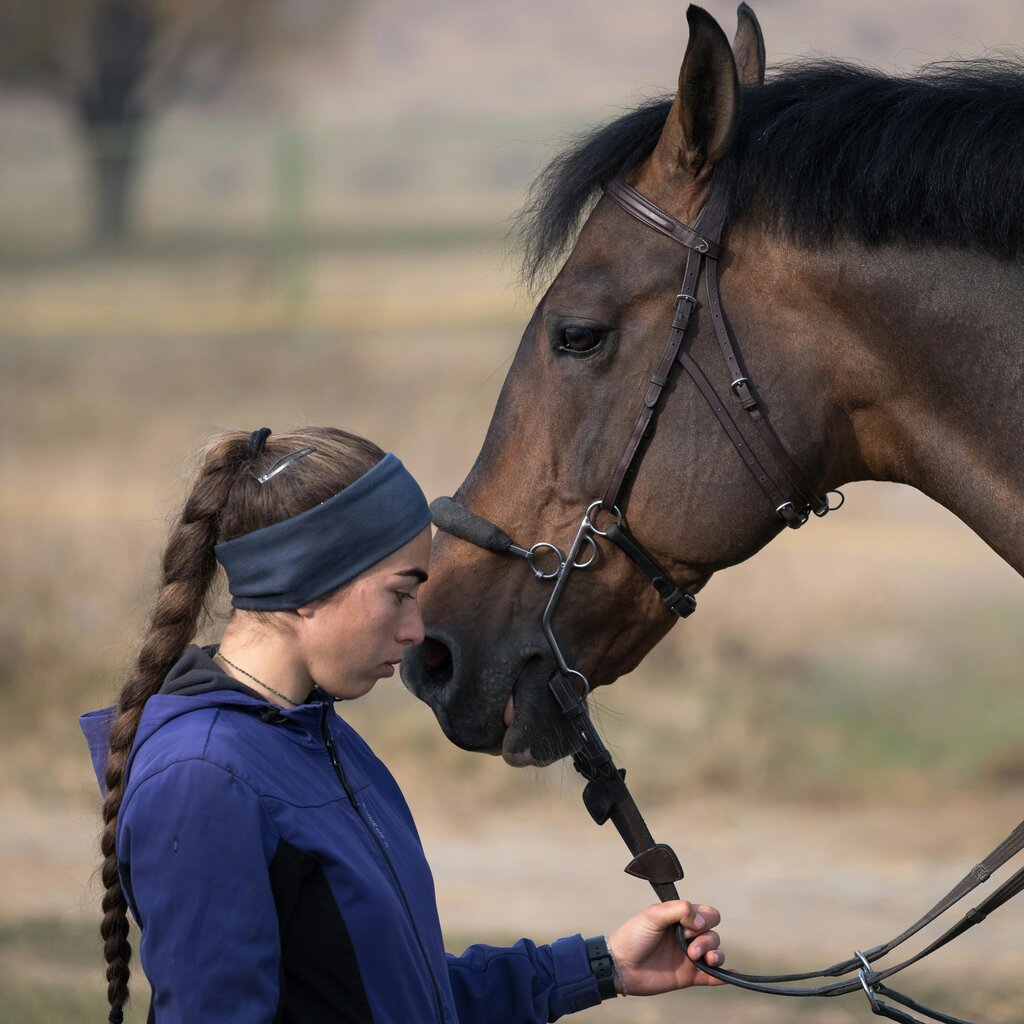
Once you're near their shoulder, you can reach out a hand for them to sniff. Most horses are curious and will appreciate the chance to check you out. When leading a horse with a rope, walk beside their head and shoulder area. Don't pull from far in front of them or try to push them from behind. Staying near their shoulder keeps you in their line of sight and out of the way if they suddenly move forward or backward.
Reading the Signs
Horses communicate constantly through body language. Learning to read these signals is key to understanding how a horse is feeling and what it might do next. Their ears are one of the most expressive parts of their body.
| Body Part | Relaxed / Curious | Anxious / Aggressive |
|---|---|---|
| Ears | Softly forward or to the side | Pinned back flat against the head |
| Eyes | Soft, calm expression | Wide, showing the whites |
| Muzzle | Loose, soft lips | Tight, pinched, or wrinkled |
| Tail | Carried naturally, gentle swishing | Tucked down tight or whipping back and forth |
A relaxed horse might have one ear swiveled back, listening to you, while the other points forward. This is normal. But when both ears are pinned flat against their neck, it's a clear warning sign. The horse is angry or scared and is telling you to back off. Similarly, if you see the whites of a horse’s eyes, it's a sign of fear or high stress. A tightly clamped tail means they are nervous or tense, while a tail whipping around can signal irritation.
Basic Safety Practices
Beyond reading their mood, a few simple rules can prevent most common accidents. Always wear sturdy, closed-toe shoes around horses. A hoof stepping on your foot can cause serious injury, and sandals offer zero protection.
Safety is one aspect that should always be considered, especially with horses.
When you need to walk behind a horse, do one of two things. Either walk far enough away that you'd be out of range if they were to kick, or walk very close, placing a hand on their rump as you pass. If you're right up against them, they can't build up enough power to deliver a serious kick. It's the space a few feet behind them that is the most dangerous.
If you need to tie a horse, always use a quick-release knot. A horse that panics while tied can injure itself badly if it can't get free. Tie them to a sturdy, fixed object like a strong fence post, and keep the rope high and relatively short so they can't get a leg tangled in it. These simple habits create a safer environment for both you and the horse.
What is the safest way to approach a horse for the first time?
If a horse pins its ears flat against its neck, it is most likely feeling: