Hormones and Women's Health
Hormonal Regulation
The Hormonal Orchestra
The menstrual cycle is directed by a precise and elegant conversation between the brain and the ovaries. Think of it as a hormonal orchestra. The conductor, the first-chair musicians, and the star soloists all have to be perfectly in sync. This intricate performance is managed by three key players: the hypothalamus, the pituitary gland, and the ovaries.
This communication network is often called the Hypothalamic-Pituitary-Ovarian (HPO) axis. It's the command center for reproduction. Let's break down how each part plays its role.
The Conductor in the Brain
Deep within the brain lies the hypothalamus. Its job is to kick off the entire process. The hypothalamus acts like the orchestra's conductor, setting the tempo by releasing a crucial hormone in periodic bursts, or pulses.
This hormone is called Gonadotropin-releasing hormone, or GnRH for short. GnRH doesn't travel far. Its sole job is to deliver a message to its neighbor, the pituitary gland, telling it when to act.
The hypothalamus releases GnRH in pulses, signaling the pituitary gland to start its work.
The pituitary gland, a small pea-sized structure at the base of the brain, receives the GnRH signal. In response, it releases two of its own hormones into the bloodstream. These are the orchestra's first-chair musicians, carrying the conductor's instructions to the rest of the body.
These two hormones are:
- Follicle-Stimulating Hormone (FSH): As its name suggests, FSH travels to the ovaries and stimulates the growth of ovarian follicles. Each follicle is a small sac containing an immature egg.
- Luteinizing Hormone (LH): LH also travels to the ovaries, where it will play a key role in the final maturation of the egg and trigger its release.
The Ovaries Take the Stage
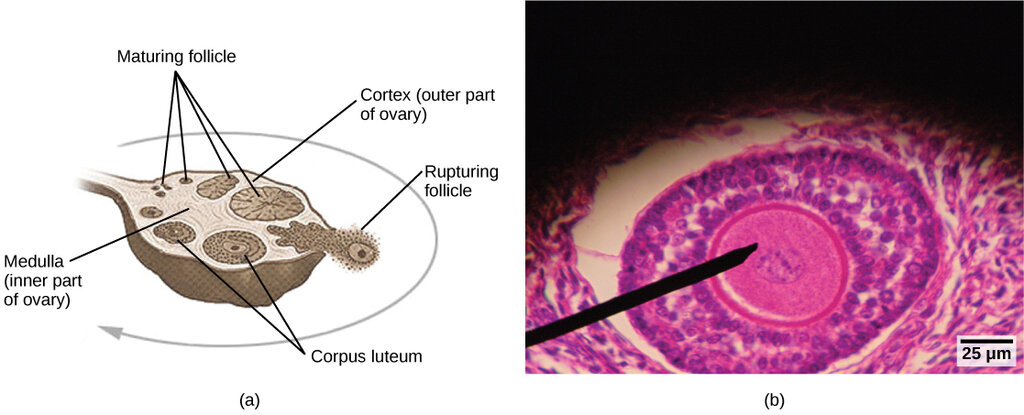
When FSH and LH arrive at the ovaries, they signal the star soloists to begin their performance. The growing follicles in the ovaries start producing their own hormones, primarily estrogen.
As the follicles grow under the influence of FSH, they produce more and more estrogen. This rising estrogen level is the main event of the first half of the menstrual cycle. It signals the uterus to prepare for a potential pregnancy and also communicates back to the brain.
This communication back to the brain is a critical part of the system. The entire HPO axis is regulated by feedback loops, much like a thermostat controls the temperature in a room.
Initially, estrogen provides negative feedback. It tells the hypothalamus and pituitary, "Okay, that's enough FSH and LH for now." This keeps the hormone levels from getting too high, too quickly.
But then, something fascinating happens. As one follicle becomes dominant and grows large, the estrogen it produces reaches a very high peak. Once estrogen stays above a certain threshold for a day or two, it flips the switch. Instead of inhibiting the pituitary, it suddenly does the opposite.
This is a positive feedback loop. The high estrogen level now tells the pituitary, "It's go time!" The pituitary responds with a massive surge of LH. This LH surge is the direct trigger for ovulation—it causes the dominant follicle to rupture and release its mature egg.
After ovulation, the ruptured follicle transforms into a structure called the corpus luteum, which produces another hormone, progesterone. Progesterone, along with estrogen, will then provide strong negative feedback to the brain, preventing the release of more FSH and LH for the rest of the cycle.
This elegant system of rising and falling hormones, controlled by constant feedback, ensures that follicles develop and ovulation occurs at just the right time, every cycle.
What is the primary role of the hypothalamus in the menstrual cycle?
A sudden, massive surge in which hormone is the direct trigger for ovulation?
This hormonal conversation is the foundation of the entire menstrual cycle, dictating the changes that occur in the ovaries and uterus.