Honors Physics 1 Analysis
Two-Dimensional Kinematics
Splitting Motion in Two
Motion in the real world rarely happens in a straight line. A thrown baseball, a car turning a corner, or a satellite orbiting the Earth all move in two or three dimensions. To analyze this kind of movement, we don't need entirely new physics. Instead, we can use a powerful trick: breaking the motion down into independent, one-dimensional pieces.
The key is to treat the horizontal (x-axis) and vertical (y-axis) components of motion separately. Imagine a cannonball fired from a cliff. Its horizontal movement is governed by its initial speed, while its vertical movement is controlled entirely by gravity. The crucial insight is that gravity only acts downward. It doesn't care how fast the cannonball is moving sideways. This principle of component independence is the foundation of all two-dimensional kinematics.
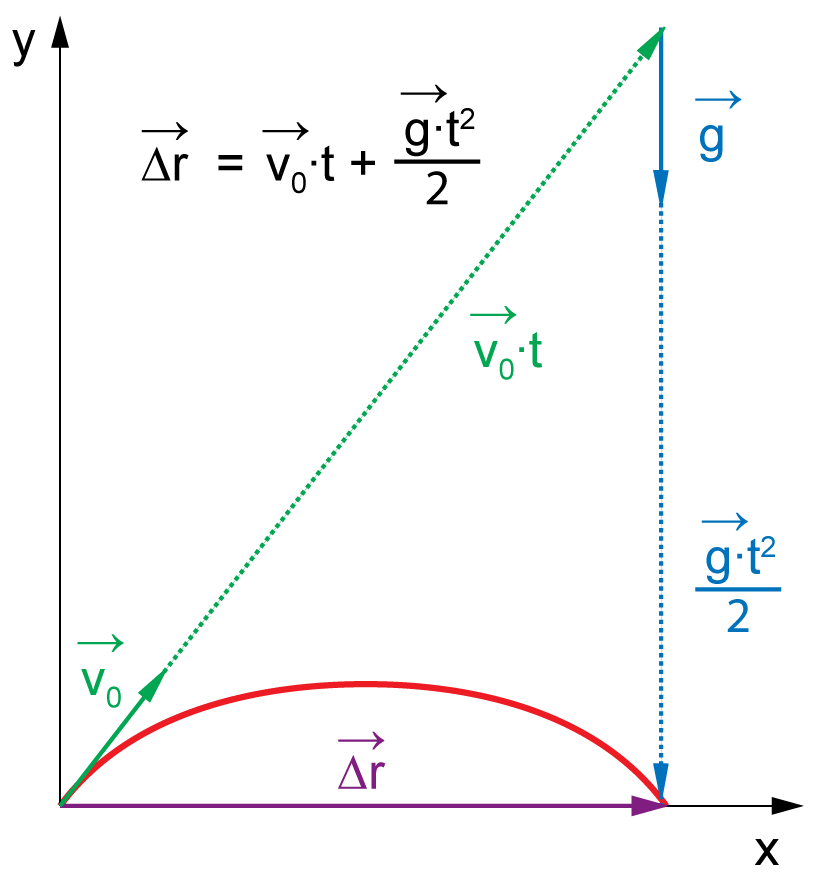
The most important concept in projectile motion is that when air resistance is ignored, horizontal and vertical motions are independent, meaning that they don’t influence one another.
To work with these components, we use vectors. An object's velocity is a vector quantity, possessing both magnitude (speed) and direction. We can break any 2D vector down into its x and y components using trigonometry. If a projectile is launched with an initial velocity at an angle above the horizontal, its components are:
Analyzing Projectile Motion
With the motion split into two parts, we can apply the familiar one-dimensional kinematic equations to each. For a typical projectile problem where we ignore air resistance, the situation is beautifully simple.
Horizontal Motion: There are no forces acting in the x-direction (ax = 0). This means the horizontal velocity is constant throughout the flight.
Vertical Motion: The only force is gravity, which causes a constant downward acceleration, , where .
This leads to our set of equations for projectile motion at any time :
| Horizontal (x) | Vertical (y) | |
|---|---|---|
| Acceleration | ||
| Velocity | ||
| Position |
Notice that time, , is the common variable linking the two sets of equations. The time the projectile spends in the air is the same for both its horizontal and vertical journeys. We can use this fact to solve for key characteristics like maximum height, time of flight, and range.
Uneven Ground and Relative Velocity
Things get more interesting when a projectile is launched and lands at different heights—for instance, throwing a ball from a cliff down to the beach. To find the time of flight in these cases, you often need to solve the vertical position equation, which is a quadratic equation for time: . You will typically get two solutions for ; one is usually negative and represents a time before the launch, so it can be discarded as physically meaningless.
Another layer of complexity comes from relative velocity—the idea that motion is measured differently by observers who are themselves in motion. For example, if you are on a train moving at 20 m/s and you throw a ball forward at 5 m/s, someone standing on the ground sees the ball moving at 25 m/s. In two dimensions, we use vector addition to solve these problems.
To solve relative velocity problems, you break each velocity vector into its x and y components, add the components separately, and then use the Pythagorean theorem and trigonometry to find the resultant vector's magnitude and direction. For instance, if a boat is trying to cross a river, its final path is the vector sum of its own velocity and the velocity of the river's current.
Ready to test your understanding? This quiz will cover vector components, projectile motion, and relative velocity.
What is the foundational principle that allows us to analyze two-dimensional motion by separating it into horizontal and vertical parts?
A projectile is launched with an initial velocity at an angle above the horizontal. Ignoring air resistance, what is the acceleration of the projectile in the horizontal (x) direction?
By mastering the independence of motion components, you can solve a huge range of physics problems, from the simple arc of a thrown stone to the complex path of a riverboat.