Homeostasis Regulation Explained
Introduction to Homeostasis
The Body's Balancing Act
Your body is a finely tuned machine, constantly working to keep everything running smoothly. Think about it: whether you're hiking in the cold or relaxing on a hot day, your internal body temperature stays remarkably stable, right around 37°C (98.6°F). This ability to maintain a stable internal environment, no matter what's happening outside, is called homeostasis.
Homeostasis
noun
The tendency of a system, especially the physiological system of higher animals, to maintain internal stability, owing to the coordinated response of its parts to any situation or stimulus that would tend to disturb its normal condition or function.
It’s not just about temperature. Your body is always managing dozens of other variables, like the amount of sugar in your blood, your water levels, and your blood's pH balance. Why is this so important? Because the cells in your body are picky. They need conditions to be just right to function. If things get too far out of whack, your cells can't do their jobs, and you can get sick.
Keeping Things in Check
So what kinds of things does your body work so hard to regulate? Here are a few of the big ones:
| Variable | Why It's Regulated | Normal Range |
|---|---|---|
| Body Temperature | Enzymes, the proteins that speed up chemical reactions, work best in a narrow temperature range. | ~37°C (98.6°F) |
| Blood Glucose | Cells need a steady supply of glucose for energy, but too much can damage organs over time. | 70-100 mg/dL |
| Blood pH | The acidity of your blood affects everything from oxygen transport to protein function. | 7.35-7.45 |
Maintaining these levels is a constant, automatic process. You don't have to think about making your heart beat faster to circulate more oxygen or telling your kidneys to retain water when you're dehydrated. Your body just does it.
The Feedback Loop
How does your body know when to make these adjustments? It uses a system called a feedback loop. Think of the thermostat in your house. You set it to a desired temperature (the set point). If the room gets too cold, the thermostat (the sensor) detects this change and signals the furnace (the effector) to turn on. Once the room warms up to the set point, the thermostat signals the furnace to turn off. This is a perfect example of a negative feedback loop.
In a negative feedback loop, the body's response counteracts the original stimulus, bringing the system back to its stable set point.
Almost all homeostatic control mechanisms in the body are negative feedback loops. They ensure that small changes don't become large, dangerous ones. The system has three main parts:
- Sensor (or Receptor): Detects a change in the internal environment.
- Control Center: Processes the information from the sensor and determines the appropriate response.
- Effector: Carries out the response to bring the variable back to the normal range.
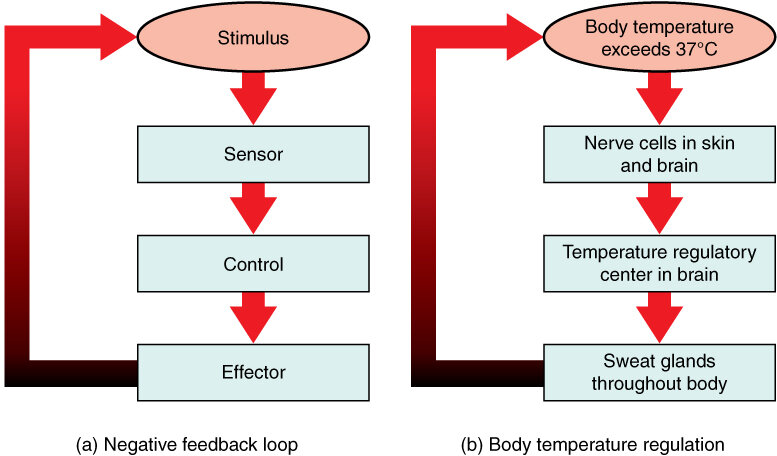
Let’s go back to body temperature. If you get too hot, temperature sensors in your skin and brain send signals to your brain's temperature control center. This center then activates effectors, like your sweat glands, which produce sweat. As the sweat evaporates, it cools your skin, bringing your body temperature back down. The system then shuts off until it's needed again. It's a simple, elegant system for maintaining balance.
What is the primary goal of homeostasis?
If your blood sugar drops, a sensor detects this and signals the pancreas to release glucagon, which raises blood sugar. In this example of a negative feedback loop, what is the 'effector'?
This constant process of monitoring and adjusting is the essence of homeostasis, keeping you stable and healthy from the inside out.