Home Surfing Drills for Better Waves
Fundamentals of Surfing Fitness
The Foundation of Surfing Fitness
Riding a wave looks effortless, but it’s a full-body workout. Surfing demands a unique blend of strength, coordination, and agility that starts long before you hit the water. It isn't about brute force; it's about building a body that can work with the ocean's power, not against it.
To prepare for surfing, you don't need to spend hours lifting heavy weights. Instead, the focus is on functional fitness. This means training your body for the specific movements you'll perform on the board. The three pillars of this fitness are a strong core, sharp balance, and good flexibility. Mastering these will make learning to surf faster, safer, and a lot more fun.
Your Core Is Your Engine
When you think of your core, you might picture six-pack abs. But in surfing, your core is much more than that. It’s the entire group of muscles in your midsection—front, back, and sides. This includes your abdominals, obliques, lower back, and hips. Think of it as a sturdy link between your upper and lower body.
This muscular corset is the source of all power and stability on a surfboard. Every movement originates here. When you paddle, your core keeps you stable on the board, allowing your arms and back to work efficiently. When you pop up to your feet, it’s a powerful, explosive movement driven by your core. And once you're riding a wave, every turn and adjustment starts from your center, transferring energy out to your limbs and down to the board.

A weak core forces other muscles to compensate, leading to wasted energy and poor technique. By building core strength, you create a solid platform for every other move you make.
A strong core is the foundation of good balance.
Balance Is Everything
A surfboard on water is an incredibly unstable surface. Balance is the skill that allows you to control that instability. But it's not about standing perfectly still, like a statue. Surfing requires dynamic balance—the ability to constantly adjust your body's position in response to a changing environment.
The surface of a wave is always moving, and your board shifts beneath you. Your body has to make thousands of tiny, split-second adjustments to stay upright. These corrections come from your nervous system telling your muscles to fire in just the right way. This constant communication is what keeps you centered on the board and in control.
Good balance is what allows you to feel the wave and respond to it, guiding your board where you want it to go. It’s the difference between fighting the board and flowing with the water. The good news is that balance is a trainable skill. Drills on solid ground can dramatically improve your stability when you're out on the ocean.
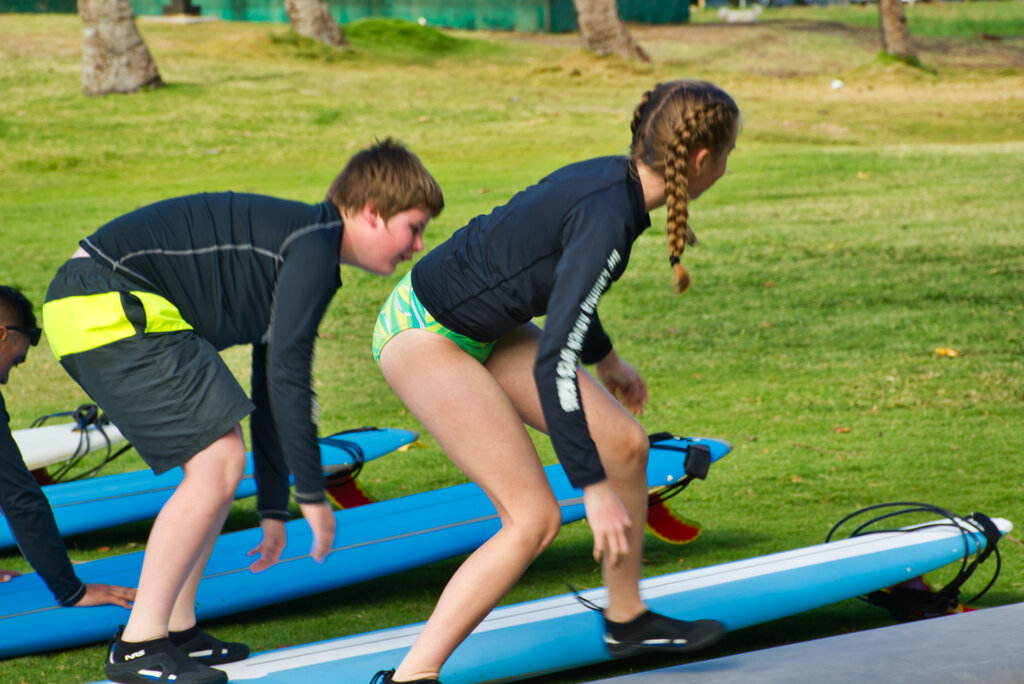
Flexibility for Flow and Prevention
Flexibility might be the most overlooked aspect of surf fitness, but it’s just as critical as strength and balance. In surfing, you’re constantly twisting, bending, and extending your body in ways that aren't typical in daily life.
Good flexibility, particularly in your hips, shoulders, and spine, allows for a greater range of motion. This translates directly to better performance. A fluid, powerful pop-up requires flexible hips and a supple back. Deep, carving turns are only possible if your torso can twist freely. Without flexibility, your movements become stiff and restricted.
Beyond performance, flexibility is your best defense against injury. The dynamic and sometimes unpredictable nature of surfing can put a lot of strain on your joints and muscles. Flexible muscles are less likely to be pulled or torn. Spending time on your flexibility will not only help you surf better but also keep you in the water for years to come.
Think of flexibility as unlocking your body's potential. It allows you to move with more freedom and power, turning rigid motions into fluid, graceful maneuvers.
These three elements—core strength, balance, and flexibility—work together. A strong core improves your balance. Good balance makes your movements more efficient. And flexibility allows you to access that strength and balance through a full range of motion. Together, they form the physical foundation for everything you'll do on a surfboard.