Home Network Security Essentials
Home Network Basics
Your Home Network's Key Players
Think of your home network as a small, efficient office. For everything to run smoothly, you need a few key players managing the flow of information. The three main roles are the router, the switch, and the wireless access point.
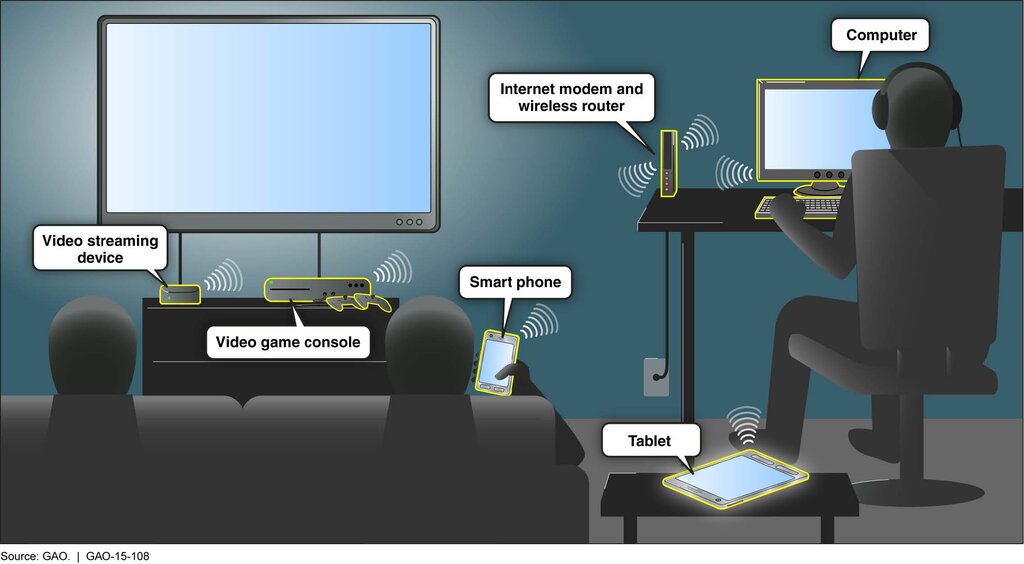
The Router: The Office Manager The router is the gateway between your home network and the wider internet. It's like the office manager who handles all incoming and outgoing mail. When you browse a website, your request goes through the router, out to the internet, and the router makes sure the website's data comes back to the right device. It also acts as a basic security guard, using a firewall to block unwanted traffic from entering your network.
The Switch: The Mailroom Sorter A switch connects all your wired devices, like a desktop computer, a gaming console, or a smart TV. Imagine an internal mailroom that knows exactly which desk to deliver each piece of mail to. When one device sends information to another on the same network, the switch ensures it goes directly to the intended recipient, rather than broadcasting it to every device. This keeps communication fast and efficient. Most home routers have a built-in switch with several Ethernet ports on the back.
The Access Point: The Wireless Announcer The wireless access point (AP) is what creates your Wi-Fi network. It broadcasts the network signal, allowing wireless devices like laptops, smartphones, and tablets to connect without cables. In most homes, the AP is also built directly into the router. This all-in-one device (router, switch, and AP) is what we commonly just call a "Wi-Fi router."
In short: the router talks to the internet, the switch talks to wired devices, and the access point talks to wireless devices. Most home setups use a single device that does all three jobs.
Every Device Needs an Address
Just like every house on a street needs a unique address for the mail carrier to find it, every device on your network needs a unique address to send and receive data. This is called an IP address.
IP Address
noun
A unique string of numbers separated by periods that identifies each computer using the Internet Protocol to communicate over a network.
Your router acts as a post office for your local network, assigning a private IP address to each device that connects. These usually look something like 192.168.1.101. This address is only used within your home network. When you access the internet, your router uses its own public IP address—the one your Internet Service Provider (ISP) gives you—to communicate with the outside world.
This separation of your home network from the public internet creates a natural boundary. The system that defines this boundary is called a subnet. For most home networks, you're operating on a single, simple subnet. The subnet is defined by a subnet mask, often 255.255.255.0. This mask tells the router which part of the IP address identifies the network (the neighborhood) and which part identifies the specific device (the house).
The Language of the Internet
For all these devices to communicate successfully, they need to speak the same language. The set of rules for communication over the internet is called the TCP/IP protocol suite. It’s named after its two most important protocols: the Transmission Control Protocol (TCP) and the Internet Protocol (IP).
Computer networking is simply connecting computers and devices so they can share information.
Think of sending a large, valuable item through the mail. You wouldn't just stick a stamp on it. You'd break it down into smaller, manageable pieces, pack each one in a numbered box, and address each box. TCP/IP works in a similar way.
IP (Internet Protocol) is responsible for addressing. It's like writing the 'to' and 'from' addresses on each box. IP ensures that packets of data are sent to the correct destination IP address.
TCP (Transmission Control Protocol) is responsible for reliability. It takes a large chunk of data (like a web page or an email) and breaks it into smaller packets. It numbers these packets so they can be reassembled in the correct order at the destination. TCP also checks to make sure every packet arrives. If one gets lost along the way, TCP requests for it to be sent again. This guarantees that you receive the full, uncorrupted file.
| Protocol | Job | Analogy |
|---|---|---|
| IP (Internet Protocol) | Addressing | Writing the destination address on an envelope. |
| TCP (Transmission Control Protocol) | Reliability & Ordering | Numbering the pages of a letter and checking they all arrived. |
Together, TCP and IP form the backbone of most internet communication. When you stream a video, send an email, or browse a website, you are using TCP/IP to ensure the data gets from the server to your screen reliably and accurately.
What is the primary role of a router in a home network?
A device that connects your desktop computer and smart TV using Ethernet cables is a __________, while the device that allows your smartphone to connect without a cable is a ___________.
Understanding these core components and protocols is the first step in managing and securing your home network.