Home Knife Sharpening Essentials
Knife Anatomy
The Anatomy of a Knife
Before you can master using a knife, you need to know its parts. Understanding the anatomy of your knife helps you choose the right one for the job, use it correctly, and eventually, keep it sharp. Each component has a specific purpose that contributes to the knife's overall performance.
Let's break down these parts, starting with the blade.
The Business End
The blade is the workhorse of the knife. It’s more than just a single piece of metal; it has several distinct sections.
- Tip and Point: The tip is the front quarter of the blade, used for detailed or delicate cutting. The point is the very end of the tip, essential for piercing.
- Edge: This is the sharp cutting surface. A well-maintained edge is what makes a knife effective. It runs from the point to the back of the blade.
- Heel: The rear part of the edge, closest to the handle. It's the widest and strongest part of the blade, perfect for tasks that need more pressure, like chopping through tough vegetables.
- Spine: The top, unsharpened side of the blade. It's the thickest part and gives the blade its strength. You can safely press on the spine with your other hand to apply extra force.
The Core and Handle
The handle is just as important as the blade. It determines how the knife feels in your hand and how you control it. But the handle's construction reveals a lot about the knife's quality.
The handle, sometimes called the scales, is the part you grip. It can be made from wood, plastic, or composite materials. Inside the handle is the tang, which is the section of the blade that extends into it. The tang is critical for a knife's durability and balance.
A knife with a full tang has the steel from the blade running all the way to the end of the handle. This makes it stronger and better balanced than a knife with a partial tang.
The bolster is the thick band of steel where the blade meets the handle. Not all knives have one, but it serves a few purposes: it adds weight for better balance, strengthens the knife, and acts as a finger guard to prevent your hand from slipping onto the blade.
Balance and Feel
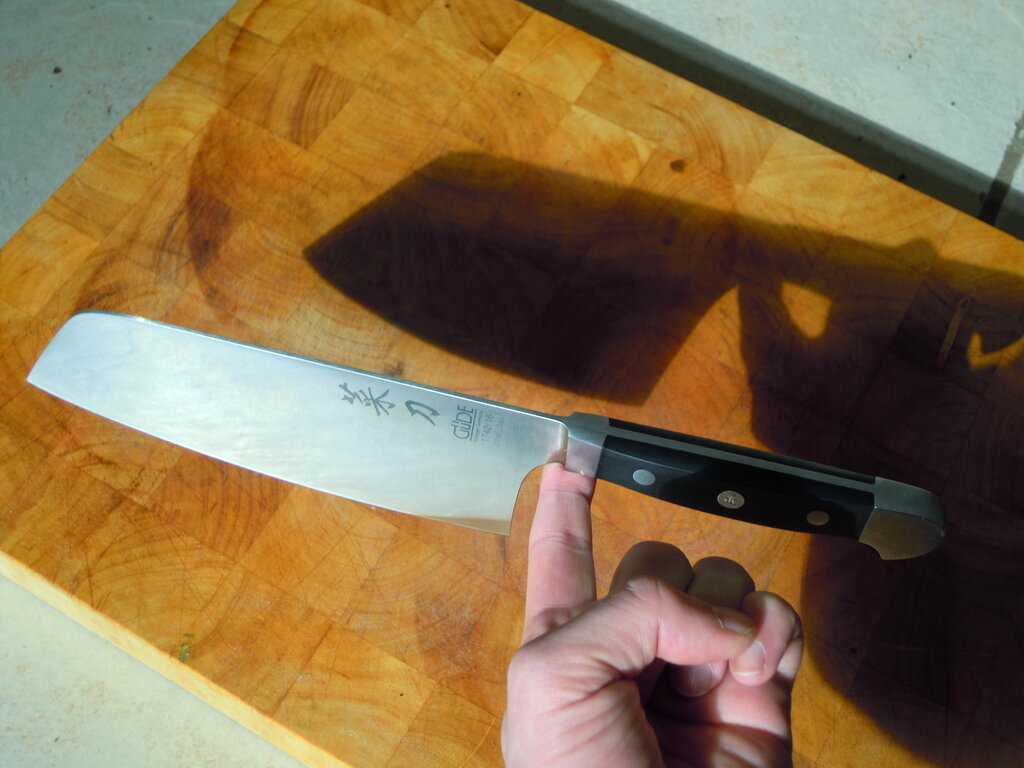
A well-made knife should feel like an extension of your hand. This comes down to balance and weight distribution. The balance point is where the knife rests evenly if you place your finger under it, typically right around the bolster.
A balanced knife is safer and less tiring to use because it requires less effort to control. A blade-heavy knife will want to chop downward, while a handle-heavy knife can feel clumsy. A neutral balance gives you the most control for a variety of tasks, from precise slicing to powerful chopping.
Understanding these parts is the first step toward becoming proficient in the kitchen. Now that you know what you're holding, you can better appreciate how it works.