Home Electricity Explained
Electricity Basics
What is Electricity?
At its heart, electricity is simply the movement of tiny charged particles. In the wires of our homes and devices, these particles are usually electrons. Think of a copper wire as a tube packed with these electrons, ready to move.
But they don't move on their own. They need a push. This is where the core concepts of electricity come into play. We can understand them with a simple analogy: imagine water flowing through a pipe.
The Key Players
Three fundamental properties work together to make electricity happen: voltage, current, and resistance.
Voltage
noun
The pressure or force that pushes electric charge through a circuit.
Voltage, measured in volts (V), is the electrical pressure. In our analogy, voltage is like the water pressure in the pipe. The higher the pressure, the greater the force pushing the water along.
Current
noun
The rate of flow of electric charge past a point.
Electric current, measured in amperes or amps (A), is the actual flow of electrons. It's like the amount of water flowing through the pipe. A higher current means more electrons are moving past a certain point every second.
Resistance
noun
A measure of the opposition to current flow in an electrical circuit.
Resistance, measured in ohms (Ω), is anything that slows down the flow of current. In our water pipe, this could be a narrow section or some gunk stuck inside. All materials have some resistance. Conductors like copper have very low resistance, while insulators like rubber have extremely high resistance.
So, to recap the analogy:
- Voltage (V) is the water pressure.
- Current (I) is the flow rate of the water.
- Resistance (R) is how narrow the pipe is.
The Fundamental Rule
These three concepts don't act independently. They're linked by a simple and powerful rule discovered by Georg Ohm in the 1820s. It’s now known as Ohm's Law, and it's the cornerstone of circuit analysis.
Ohm's Law states that the current flowing through a conductor is directly proportional to the voltage across it and inversely proportional to its resistance.
Mathematically, it's expressed as:
This means if you increase the voltage (pressure), the current (flow) increases. If you increase the resistance (narrow the pipe), the current decreases. You can rearrange the formula to solve for any of the variables:
Power and Circuits
There's one more key player: power. Electrical power is the rate at which electrical energy is used. When you pay your electricity bill, you're paying for the energy you've consumed, which is power used over time. The unit for power is the watt (W).
Power is calculated by multiplying voltage and current:
This relationship tells us that a high-power device might use a high voltage, a high current, or both.
All these elements come together in an electrical circuit. A circuit is simply a closed loop that allows current to flow. The most basic circuit has three parts:
- A voltage source, like a battery, to provide the push.
- A load, like a light bulb, which has resistance and does useful work (like creating light).
- Conductors, like wires, to connect everything and form a path.
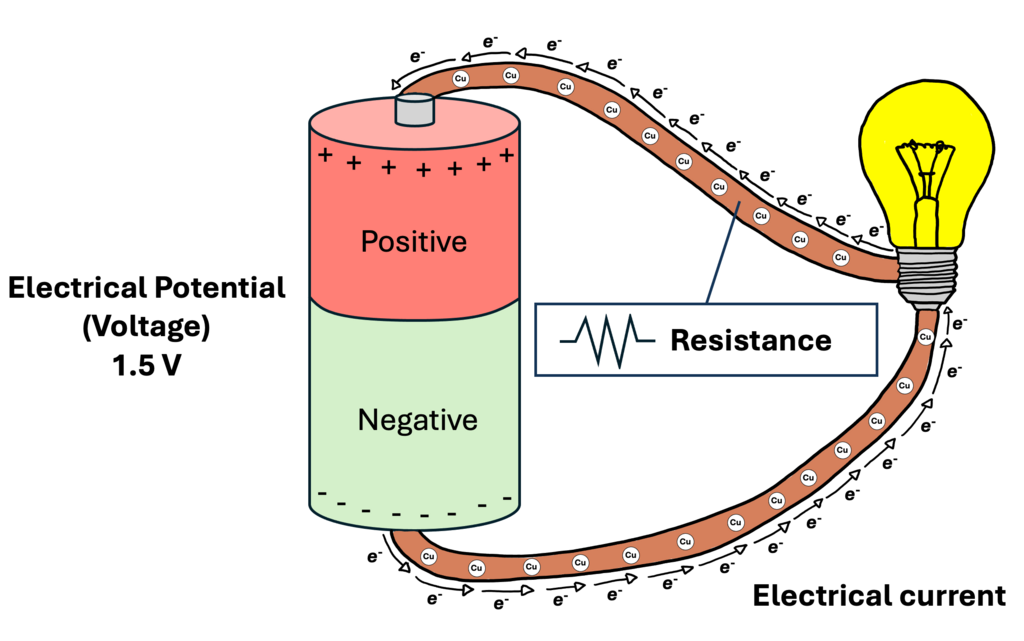
When the path is complete, current flows from the voltage source, through the load, and back to the source. If there's a break anywhere in the loop, it becomes an open circuit, and the current stops flowing instantly.
Using the water pipe analogy for electricity, what does resistance represent?
According to Ohm's Law, if you keep the voltage in a circuit constant but double the resistance, what happens to the current?
Now that we've covered the essentials, you have the foundational knowledge to understand how electricity works.