Home Electrical Systems Explained
Electrical Basics
The Building Blocks of Electricity
To understand how electricity works in your home, we need to start with three core ideas: voltage, current, and resistance. The easiest way to think about them is to imagine water flowing through a pipe.
Voltage is like the water pressure. A taller water tower creates more pressure, pushing the water out with more force. Similarly, higher voltage pushes electricity with more force.
Current is the rate of water flow. It's how much water is moving through the pipe at any given moment. In electricity, current is the flow of electric charge.
Resistance is like a narrow section in the pipe that slows the water down. It’s the opposition to the flow of current. A thick, clean pipe has low resistance, while a thin, rusty pipe has high resistance.
Voltage
noun
The difference in electric potential energy between two points, which causes electric charges to flow. It's measured in Volts (V).
Current
noun
The rate at which electric charge flows past a point in a circuit. It's measured in Amperes, or Amps (A).
Resistance
noun
A measure of the opposition to current flow in an electrical circuit. It's measured in Ohms (Ω).
Ohm's Law
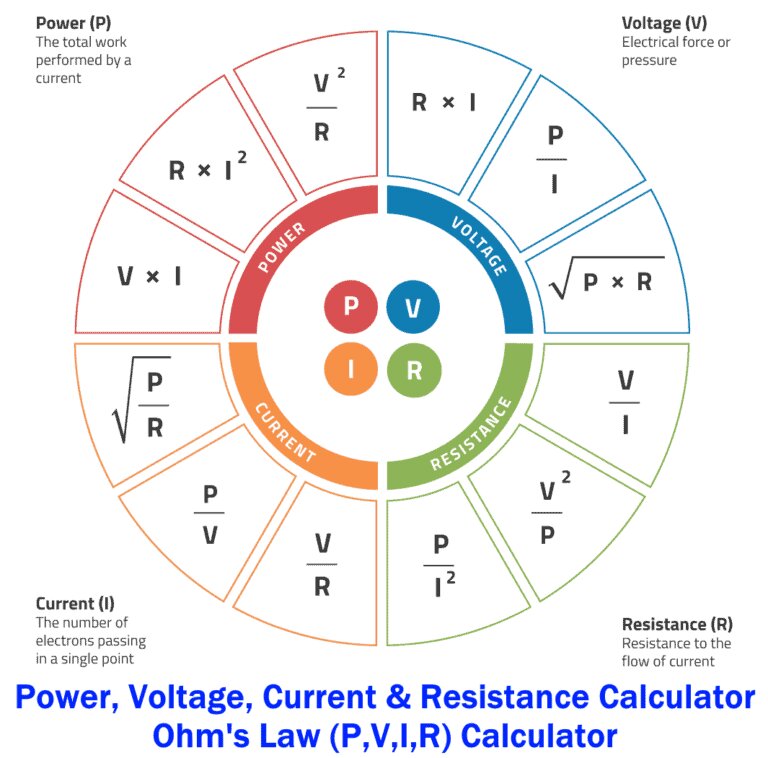
These three concepts are not independent. They are linked by a fundamental rule of electricity called Ohm's Law. It states that the current flowing through a conductor is directly proportional to the voltage across it and inversely proportional to the resistance.
In simple terms, if you increase the voltage (pressure), you get more current (flow). If you increase the resistance (constriction), you get less current.
Here, is voltage, is current, and is resistance. You can rearrange this formula to solve for any of the variables. For example, to find current, you would use .
Let's say you have a simple circuit with a 12-volt battery and a light bulb with a resistance of 3 ohms. To find the current, you would calculate: . So, 4 amps of current would flow through the bulb.
Electrical Power
Power is the rate at which electrical energy is used. When you get your electricity bill, you're paying for the power you've consumed over time. Power is measured in Watts (W).
Calculating power is straightforward. It’s the product of voltage and current.
Let's use our previous example. The light bulb has 12V across it and a current of 4A flowing through it. Its power consumption would be: .
By combining the power formula with Ohm's Law, you can also calculate power if you only know voltage and resistance () or current and resistance ().
Types of Circuits
All electrical components, from outlets to light fixtures, are connected in circuits. The two basic types are series and parallel circuits. Homes almost exclusively use parallel circuits, but it's helpful to understand both.
Series Circuits
In a series circuit, components are connected end-to-end, creating a single path for the current to flow. Think of old-fashioned Christmas lights: if one bulb burns out, the entire string goes dark because the path is broken.
In a series circuit, the current is the same through every component. The total resistance is the sum of all individual resistances, and the voltage is divided among the components.
Parallel Circuits
In a parallel circuit, components are connected on separate branches. The current splits to flow through each branch and then recombines. This is how your home is wired. You can turn on a lamp in the living room without affecting the toaster in the kitchen because they are on different branches.
In a parallel circuit, the voltage is the same across every branch. The total current is the sum of the currents in each individual branch. If one device is turned off or breaks, the others continue to work.
Using the analogy of water flowing through a pipe, what does electrical resistance represent?
According to Ohm's Law, if you increase the voltage in a circuit while keeping the resistance constant, what happens to the current?
Understanding these basic principles is the first step to safely and effectively managing your home's electrical system.