Home Electrical Installation Basics
Electrical Basics
The Language of Electricity
To understand how the lights turn on in your home, we first need to learn a few basic terms. Think of electricity like water flowing through pipes. This simple analogy helps make sense of the key concepts.
Voltage
noun
The pressure that pushes electric charge through a circuit.
In our water analogy, voltage is the water pressure. The higher the pressure, the more forcefully the water is pushed through the pipes. Similarly, higher voltage pushes electricity with more force.
Current
noun
The rate at which electric charge flows past a point in a circuit.
Current is like the flow rate of the water. It’s how much water is moving through the pipe at any given moment. A higher current means more electricity is flowing.
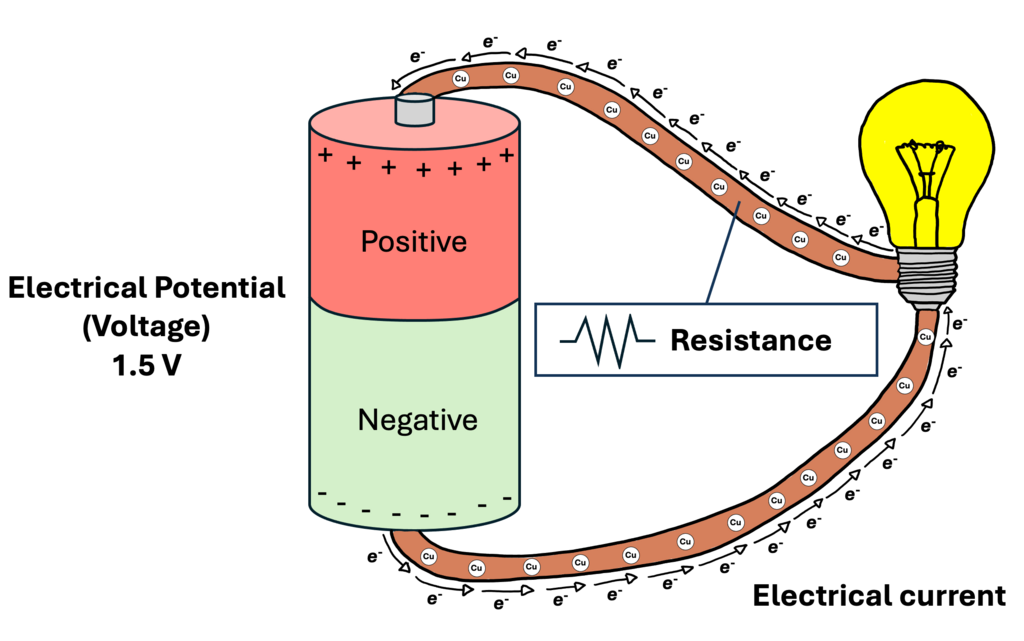
Resistance
noun
A measure of the opposition to current flow in an electrical circuit.
Resistance is like the width of the pipes. A narrow pipe restricts water flow more than a wide one. In an electrical circuit, components like light bulb filaments create resistance, slowing down the current.
Voltage pushes, current flows, and resistance opposes.
These three concepts work together to create power, which is the rate at which electrical energy is used. When you see the wattage on a light bulb, you're seeing how much power it consumes. Power (P) is calculated by multiplying voltage (V) by current (I).
For example, a device that draws 2 amps of current from a 120-volt outlet uses 240 watts of power ().
From Power Plant to Your Home
Electricity isn't just waiting inside your walls. It has to be generated and sent to you. Most electricity is made in power plants where a fuel source (like coal, natural gas, or nuclear energy) creates heat to boil water. The resulting steam spins a turbine, which is connected to a generator.
A generator is essentially a machine with magnets and coils of wire. As the turbine spins the coils within a magnetic field, it generates an electrical current. This is the same basic principle that powers a bicycle light from the motion of the wheel, just on a massive scale.
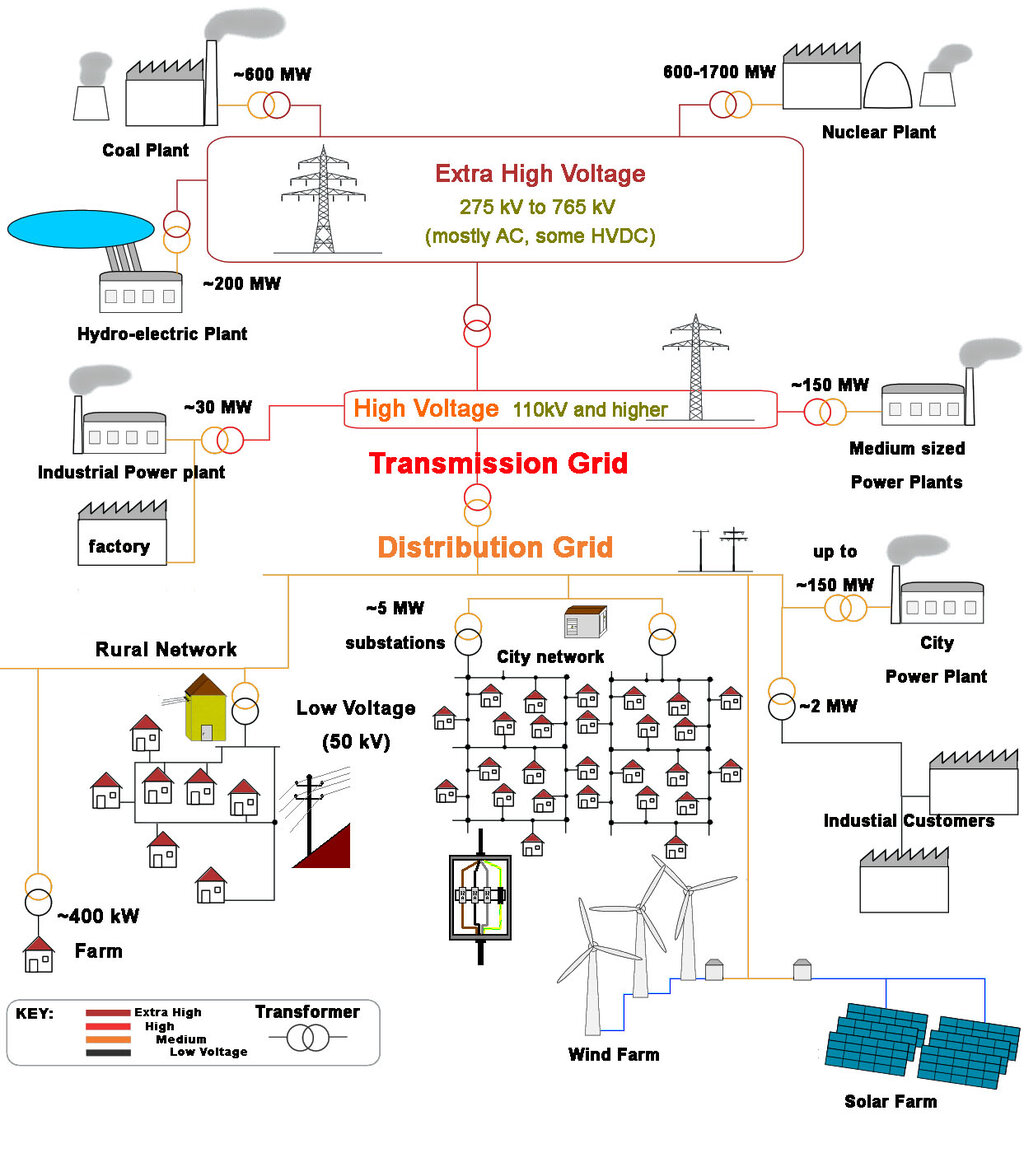
Once generated, this electricity travels across the country through a network called the power grid. To send it over long distances efficiently, its voltage is increased dramatically, sometimes to hundreds of thousands of volts. This is like using extremely high pressure to send water through a very long pipe, which reduces energy loss along the way.
As the electricity gets closer to your neighborhood, a series of substations and transformers step the voltage down to safer levels. The final transformer, often a green box in your yard or a cylinder on a utility pole, reduces the voltage to the standard level used by your home's outlets.
The Two Flavors of Current
Not all electrical current is the same. There are two main types: direct current (DC) and alternating current (AC).
Direct current (DC) is electricity that flows in only one direction. Think of it as a steady, one-way street. Batteries are the most common source of DC power, used in everything from your phone to your car.
Alternating current (AC), on the other hand, is what comes out of your wall sockets. In AC, the current rapidly changes direction, flowing back and forth. In North America, it switches direction 60 times every second (60 Hertz).
The main reason we use AC for our homes and businesses is that its voltage can be easily changed using a device called a transformer. This makes it perfect for the power grid, allowing electricity to be transmitted at high voltage for efficiency and then easily converted to a lower, safer voltage for use in your home.
So while DC powers your portable gadgets, AC is the workhorse that brings power into our buildings.
Using the analogy of electricity as water flowing through pipes, what does electrical resistance represent?
A device is plugged into a standard 120-volt outlet and draws 0.5 amps of current. How much power does it consume?
These core principles are the foundation for understanding any electrical system, from a simple flashlight to the complex wiring in your house.