Home Combat Mastery and Defensive Tactics
Footwork in Confined Spaces
Fighting in a Phone Booth
Your fighting stance is solid in an open room, but a real-world confrontation rarely happens in a wide-open space. It happens in a narrow hallway, a cluttered kitchen, or a cramped bedroom. The principles of a good base still apply, but your movement must adapt. The goal is to move with power and stability, even when you only have a few feet of clearance.
Forget wide, circling footwork. In a confined space, every step must be deliberate and efficient. Your feet stay close to the ground, and your movements become smaller and more direct. It's less like boxing and more like navigating a crowded room without spilling your drink—every motion is controlled and purposeful.
The L-Step and Pivot
To change your angle without crossing your feet or losing balance, use the L-step. It's a simple, two-part movement. If you want to move to your left, your left foot takes a short step left. Then, your right foot steps either forward or backward to re-establish your stance. The path your feet trace forms an 'L' shape. This technique allows you to sidestep an incoming threat while simultaneously creating a new line of attack for yourself.
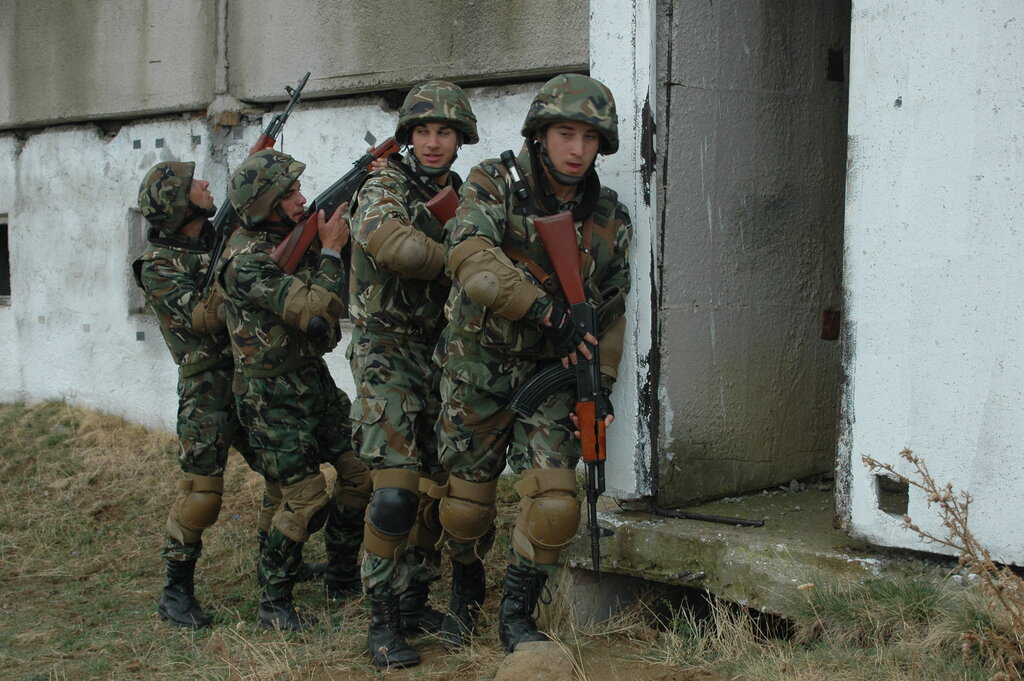
Combine the L-step with a pivot to handle corners and furniture. A pivot is simply a turn on the balls of your feet. By executing a quick L-step and then pivoting, you can slice around a doorway or use a refrigerator as cover. This is the foundation of moving through a building safely. You're not just moving; you're constantly adjusting your position relative to the obstacles and the threat.
Weaponizing Your Environment
Walls and furniture are not just obstacles; they are tools. A wall isn't just something you might bump into. You can brace a hand against it to maintain balance during a rapid turn or push off it to generate explosive power for a sudden change in direction. This is called wall-assisted stabilization. It turns a limitation into an advantage.
In a narrow corridor, you're forced into linear movement—forward or backward. Use short, shuffling steps to maintain your base. Avoid long strides that leave you off-balance. If you need to turn around completely in a hallway, use a tight pivot. Practice backing up without looking, getting a feel for the space behind you through your sense of and by trailing a hand along the wall.
When navigating around corners or through doorways, the technique of is essential. Instead of stepping blindly into an open area, you slowly move in an arc, exposing yourself as little as possible while gaining vision of what's ahead. Each small step of the 'pie' reveals more of the room, allowing you to see a threat before they see you. This methodical approach is far safer than rushing in.
| Drill | Objective | Execution |
|---|---|---|
| Hallway Shuffle | Maintain a stable base during linear movement. | In a hallway, shuffle forward and backward in your stance. Practice quick pivots to turn 180 degrees. |
| Furniture Weave | Integrate obstacles into your movement. | Set up chairs in a living room. Use L-steps and pivots to move around them, treating them as cover. |
| Wall Push-Off | Use surfaces to generate power and change direction. | Stand near a wall. Practice pushing off it to move explosively to the opposite side of the room. |
| Corner Pie | Safely clear a blind corner. | At a doorway, slowly arc around the frame, taking small steps to reveal the room incrementally. |
Start practicing these drills slowly. The goal is smooth, balanced movement, not speed. As you get more comfortable, you'll find that your home, which once seemed like a cage, has become a dynamic environment you can use to your advantage.