Home-Based Nature Schooling Essentials
Macro-Environment Design
Designing the Outdoor Classroom
You can turn any patch of green into a powerful learning environment. It’s not about having the perfect space, but about seeing the potential in the space you have. The goal is to design an environment that supports a child's natural rhythms, allowing them to shift between states of high-energy excitement and calm, focused engagement. This starts with seeing your backyard or local park through a new lens: as a landscape of possibilities.
Think of it as zone mapping for emotional states. Instead of just seeing a 'play area,' identify specific zones that cater to different needs of the nervous system. A child in a sympathetic state (fight-or-flight, high energy) needs a space for large, powerful movements. A child shifting into a parasympathetic state (rest-and-digest, calm) needs a space that feels safe and contained. Your job is to intentionally design these zones.
Stocking Your Space
Once you have your zones, you need to resource them. This is where loose parts theory comes in. Loose parts are materials that can be moved, carried, combined, redesigned, lined up, and taken apart and put back together in multiple ways. They have no specific set of directions and empower creativity. Forget purpose-built plastic toys; think sticks, stones, buckets, ropes, tarps, logs, and tires.
A 'loose parts cache' is simply a designated spot where these materials are stored. It could be a wooden crate, a corner of the deck, or a space under a bush. The key is that children know where to find the tools for their imagination. This collection invites complex inquiry. A simple tarp, a rope, and a few branches can become a den, a boat, a stretcher, or a pulley system. This kind of play is rich with problem-solving and collaboration.
Children spend the majority of the day immersed in various outdoor settings where time is unhurried and there is space for independent reflection, collaborative creation and risky play.
When stocking these caches, think about variety in texture, weight, and size. Include natural items like pinecones and seed pods alongside manufactured items like pipes and fabric scraps. This variety stimulates more complex and imaginative play.
Working with the Land
A good outdoor classroom design works with the existing landscape, not against it. Start by doing a physical site assessment. Where does the sun hit in the morning versus the afternoon? Identifying these micro-climates is crucial for year-round use. A sunny spot might be perfect for a winter morning but unbearable in summer. A shady, cool area under a large tree could be your go-to quiet zone on a hot day.
Notice the topography. A small slope isn't an obstacle; it's a place for rolling, sliding, and studying erosion. A dip in the ground that collects water after rain isn't a problem; it's a temporary pond for muddy play and ecological observation. Use these natural features as anchors for your zones.
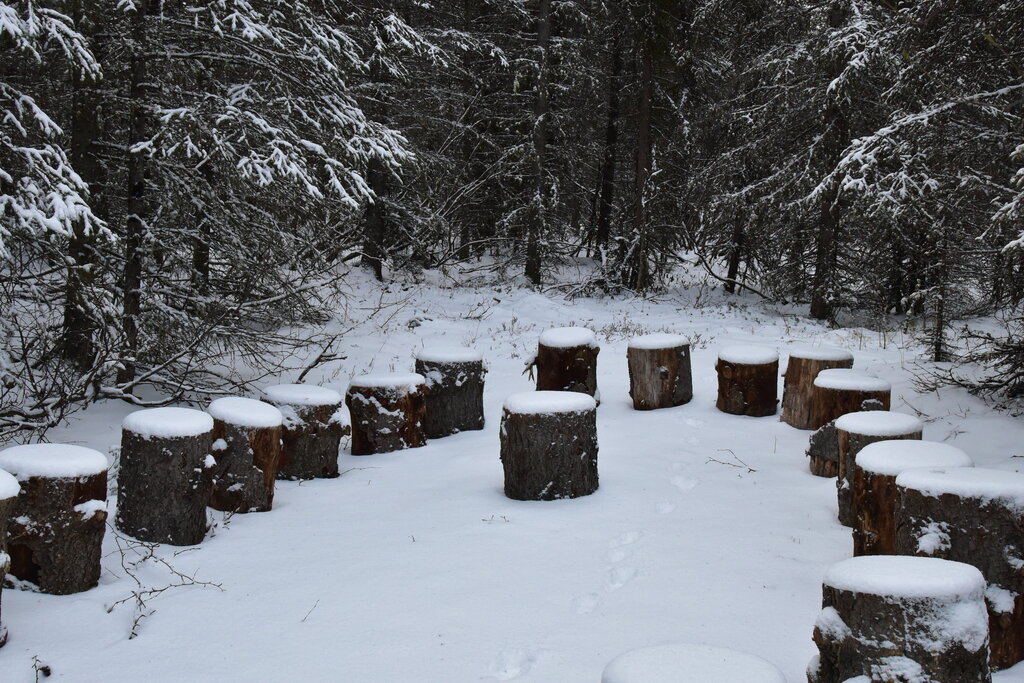
Boundaries are also important, but they don't have to be fences. Natural boundaries feel less restrictive and encourage respect for the space. A line of stones, a fallen log, a row of potted plants, or a change in ground texture (like from grass to woodchips) can effectively signal the edge of a zone. These 'soft' boundaries guide movement and use without creating a sense of confinement. They teach children to read environmental cues, a skill that is fundamental to outdoor literacy.
Finally, assess for safety and engagement simultaneously. This isn't about eliminating all risks. It's about understanding them. Identify hazards like sharp objects, unstable structures, or toxic plants, and mitigate them. But also look for features that invite healthy risk-taking: trees with low, strong branches for climbing, logs for balancing, or gentle slopes for tumbling. The goal is a space that is as safe as necessary, not as safe as possible. This balance empowers children to test their own limits and build resilience.
What is the primary purpose of "zone mapping" in an outdoor learning environment?
Which of the following best exemplifies a well-stocked "loose parts cache"?
By mapping zones, stocking them with open-ended materials, and working with the natural features of your space, you create an environment that truly supports child-led learning and regulation.