History of India
Ancient Urbanism
Cities Without Kings
The Indus Valley Civilization (IVC) presents a fascinating puzzle. While contemporary civilizations in Mesopotamia and Egypt built grand palaces and tombs for powerful monarchs, the IVC's cities, like Mohenjo-daro and Harappa, show a different kind of order. Their ruins reveal an astonishing level of standardization across a vast territory, yet lack the typical monuments dedicated to kings or gods.
Cities with populations in the tens of thousands, complex traditions of craftsmanship, dense trade networks, stunning skill in hydraulic engineering, and even a written script defined the world of the Indus Valley Civilization.
Instead of a centralized monarchy, evidence points toward a more decentralized power structure. The uniformity in brick size, urban layout, and systems of weights and measures suggests a common ideology or a powerful network of ruling elites. Many scholars theorize that these elites were not kings but influential merchant guilds or committees of priests and traders who governed through economic and religious influence rather than absolute authority. This model would explain the focus on functional, public works over personal monuments.
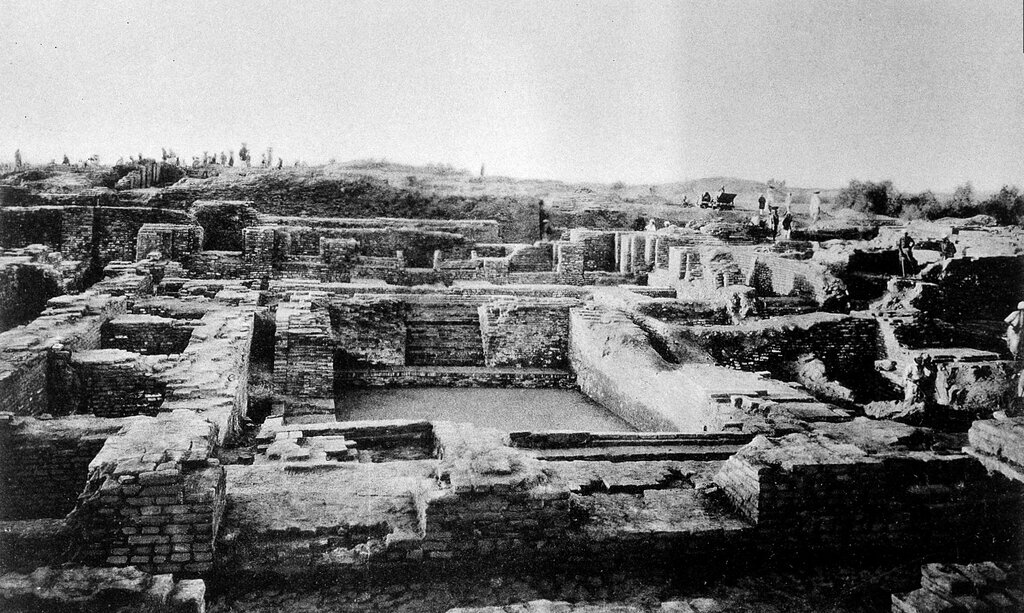
These cities were marvels of engineering. Streets were laid out in a grid pattern, and houses were equipped with some of the world's earliest sanitation systems, featuring private toilets connected to a city-wide network of covered drains. This emphasis on public health and civic organization is a hallmark of the IVC's unique approach to urbanism.
An Engine of Early Globalization
The IVC was not an isolated culture. It was a major player in an international trade network that stretched thousands of kilometers. Harappan seals, beads, and pottery have been found in Mesopotamia (modern-day Iraq), while Mesopotamian texts mention a trading partner named Meluhha, which most scholars identify as the Indus region.
The Sumerian name for the Indus Valley Civilization.
This long-distance maritime trade was a sophisticated operation. Indus sailors likely mastered the monsoon winds of the Arabian Sea, using their predictable seasonal shifts to sail to the Persian Gulf and back. They exported goods like carnelian beads, timber, copper, and possibly cotton textiles, returning with silver, wool, and other materials.
This trade required advanced technology. The Harappans were skilled metallurgists, producing high-quality bronze tools and ornaments. Their knowledge of water management extended beyond city drains to include reservoirs and irrigation canals, which were essential for sustaining agriculture in a semi-arid environment. The standardization of weights and measures, found consistently across hundreds of sites, was crucial for fair and efficient commerce.
The Great Decline
Around 1900 BCE, this thriving urban culture began to decline. Cities were gradually abandoned, writing fell out of use, and the standardized system of weights and measures disappeared. The cause of this collapse is still debated, but evidence points to a combination of environmental and economic factors rather than a single catastrophic event like an invasion.
| Theory of Decline | Primary Evidence |
|---|---|
| Climate Change | Paleoclimatic data shows a significant weakening of the summer monsoon, leading to prolonged drought and reduced agricultural output. |
| Shifting Rivers | Geological surveys indicate that major rivers like the Ghaggar-Hakra (often identified with the mythical Sarasvati river) dried up, while the Indus shifted its course, disrupting trade routes and rendering cities uninhabitable. |
| Economic Disruption | The decline of trade with Mesopotamia around the same time may have crippled the economic power of the merchant elites, leading to a breakdown of social order. |
It's likely that these factors were interconnected. A weaker monsoon would have made the population more vulnerable to changes in river courses. As agricultural surplus dwindled and trade routes were disrupted, the authority of the governing bodies may have eroded, leading to a gradual breakdown of the urban system.
The end of the IVC was not the end of civilization in South Asia, but a transformation. As the great cities of the Indus basin faded, populations gradually shifted eastward toward the more reliable rainfall and fertile plains of the Ganges basin. This migration set the stage for the next major phase of Indian history, the Vedic Period, laying the groundwork for the societies that would emerge there.
Let's test your understanding of this complex ancient civilization.
Based on archaeological evidence, what type of governing structure is most likely to have existed in the Indus Valley Civilization?
Which feature was a distinctive characteristic of Indus Valley cities like Mohenjo-daro and Harappa?
The Indus Valley Civilization offers a compelling model of a complex society that thrived not through the power of kings, but through organization, trade, and sophisticated engineering.