History of Animation
Optical Devices
From Toys to Theatre
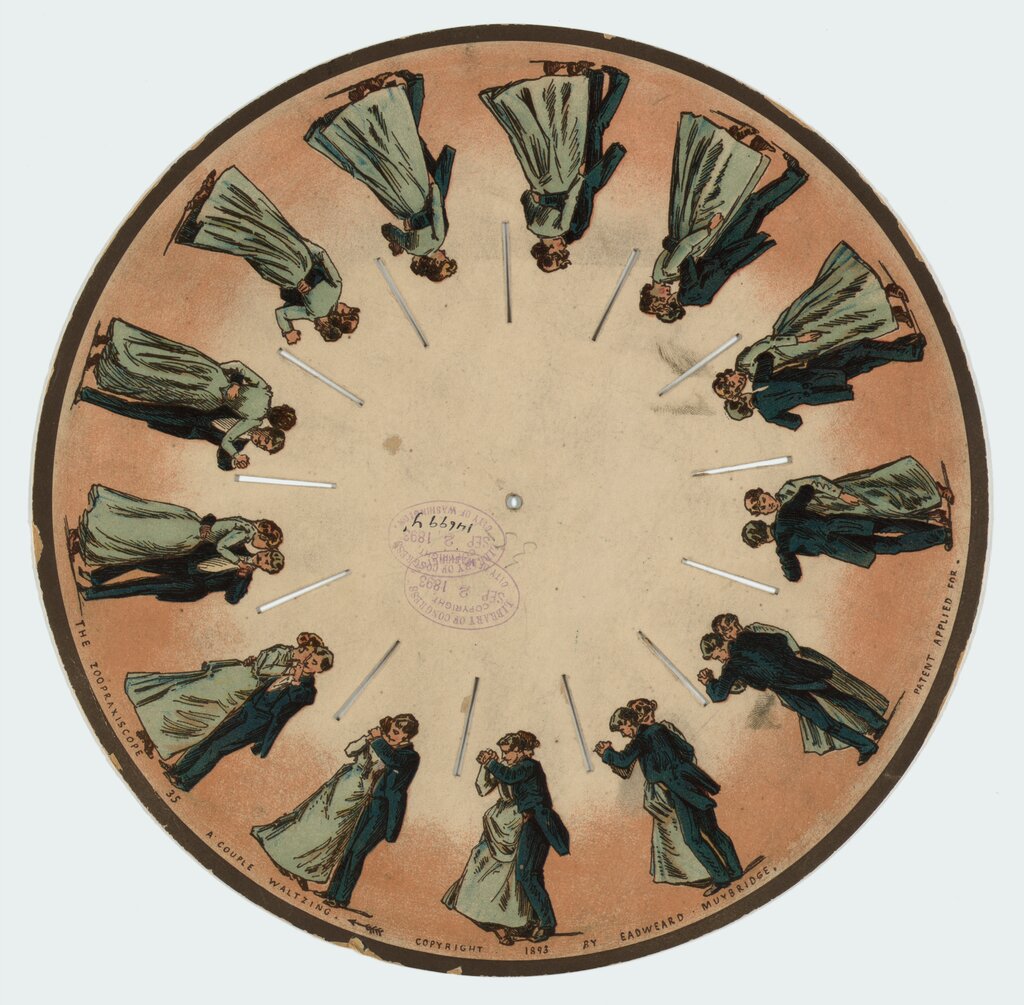
Your brain's ability to smooth a series of still images into fluid motion, known as persistence of vision, was the secret behind a wave of 19th-century optical toys. These devices weren't just novelties; they were the first steps in engineering motion for mass consumption. The earliest popular devices, like the Phenakistiscope and the Zoetrope, both relied on a similar principle: a sequence of drawings on a spinning surface viewed through narrow slits. The slits act as a shutter, ensuring the eye sees each image for only a fraction of asecond in its correct position. This creates a clear illusion of movement, rather than a continuous blur.
The problem with these slit-based viewers was darkness. The slits severely limited the amount of light reaching the eye, resulting in a dim and somewhat flickery image. The breakthrough came from a Frenchman named Charles-Émile Reynaud. He invented the Praxinoscope in 1877, which replaced the Zoetrope's viewing slits with an inner drum of mirrors. As the outer cylinder turned, each image was reflected in a central mirror, appearing stationary for a moment directly in front of the viewer. This design produced a much brighter, clearer, and more stable moving image, making it a significant improvement.
The First Animated Theatre
Reynaud wasn't content with a tabletop toy. He wanted to project his animations for a paying audience. In 1888, he patented his masterpiece: the Théâtre Optique. This wasn't just a bigger Praxinoscope. It was a revolutionary system that combined the mirror drum with a projector. More importantly, instead of using short paper strips in a loop, Reynaud painted his images onto long, flexible bands of gelatin squares held together by cloth strips. These bands were perforated at the edges, allowing a mechanism of sprockets to advance them, one frame at a time. This was a critical leap forward. It marked the first use of perforated film strips for projection, a mechanical standard that would define cinema for the next century.
With his Théâtre Optique, Reynaud opened the first public cinema in 1892 at the Musée Grévin in Paris, years before the Lumière brothers' famous screening. He projected hand-painted animated stories, complete with custom musical scores composed by Gaston Paulin. Each show consisted of a single continuous reel containing hundreds of individually painted images, telling a complete narrative story that could last up to 15 minutes. This was a world away from the simple, repetitive loops of the Zoetrope.
The End of an Era
Despite his initial success, Reynaud's system had a fatal flaw: his animations were painstakingly hand-painted. Each of his films, like Pauvre Pierrot, required a monumental effort. When photography-based moving pictures arrived, they offered a way to capture reality far more quickly and cheaply. The Cinématographe, which could both record and project live-action film, made the Théâtre Optique obsolete almost overnight. Reynaud's business collapsed, and in a fit of despair, he smashed his unique machines and threw most of his precious hand-painted films into the Seine river. Only two have survived.
Reynaud's work represents the crucial bridge between the optical toy and the narrative film. His use of perforated strips and projection for storytelling established the core mechanics that cinema would build upon.
The shift from cyclic loops to linear stories was profound. Devices like the Zoetrope could only show a brief action that repeated endlessly. Reynaud's perforated bands allowed for a true narrative with a beginning, middle, and end. While his method was ultimately unsustainable, his vision of projecting animated stories for an audience set the stage for the entire art form to come.
What scientific principle is responsible for the brain's ability to perceive a series of still images as continuous motion?
What was the key innovation of Charles-Émile Reynaud's Praxinoscope that made it an improvement over the Zoetrope?
These early devices show a clear progression, with each invention solving a problem of the one before it, paving the way for the age of cinema.