Histopathology in Indian Diagnostic Markets
Modern IHC Automation
The Shift to Automation
For decades, immunohistochemistry (IHC) was a meticulous, hands-on craft. Technicians would carefully pipette reagents, time incubations, and wash slides manually. While effective in small batches, this process is prone to variability. The slightest change in timing, temperature, or reagent volume can alter the final stain, making it difficult to compare results between different slides or even different labs. As the demand for diagnostic testing grew, particularly in oncology, the need for a faster, more consistent method became urgent. This pressure sparked a transition towards automation, fundamentally changing the workflow of the modern histopathology lab.
| Feature | Manual IHC | Automated IHC |
|---|---|---|
| Cost per Slide (High-Volume) | ~₹1000 – ₹1200 | ~₹630 – ₹750 (~37% cheaper) |
| Technician Time per Slide | Varies | Reduced by 15-20% |
| Consistency & Reproducibility | Low to moderate | High |
| Potential for Human Error | High | Low |
| Reagent Usage | Inefficient, high waste | Optimised, minimal waste |
| Throughput | Low | High |
The table above paints a clear picture. While the initial investment in an automated stainer is significant, the long-term operational savings are substantial. Automation drastically reduces the potential for human error and ensures that every slide is processed under identical conditions. This standardisation is not just a matter of efficiency; it's a clinical necessity. For critical biomarkers like HER2 in breast cancer, the intensity of the stain directly influences treatment decisions. A faint, poorly executed manual stain could lead to a false negative, denying a patient a potentially life-saving targeted therapy. Automated systems eliminate this ambiguity, delivering crisp, reproducible results that pathologists can interpret with confidence.
Automation Platforms and Workflows
The market for IHC automation is dominated by a few key players. Systems like the Ventana BenchMark series (from Roche) and the DAKO Autostainer Link (now part of Agilent) are common sights in high-volume laboratories. These machines are not just simple staining robots; they are sophisticated platforms that manage everything from baking the slide to applying the final counterstain.
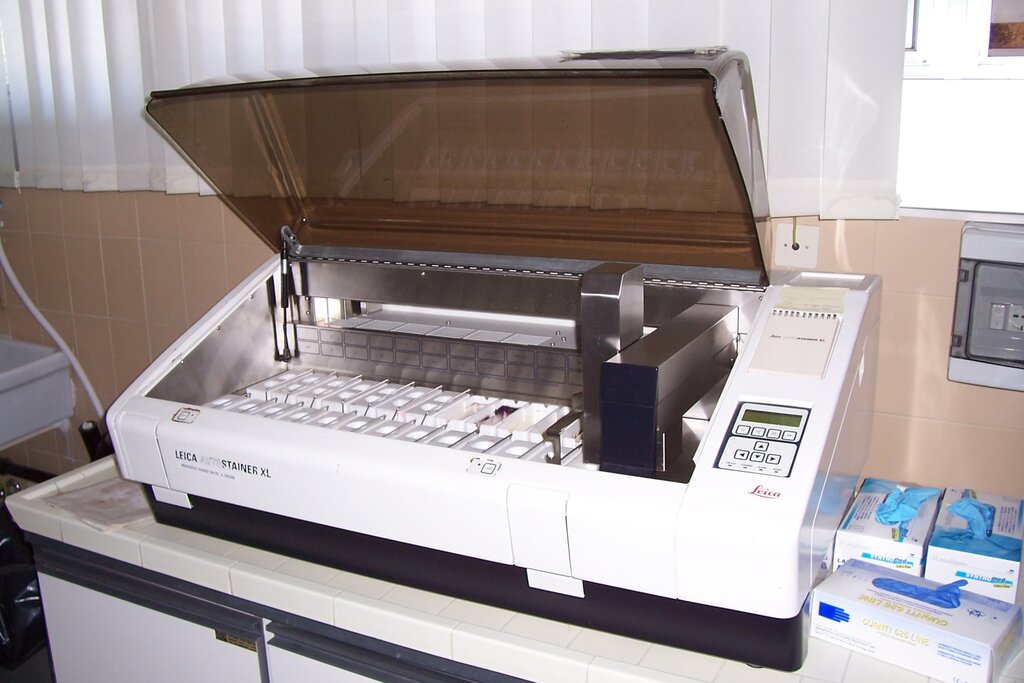
Automation in IHC isn't an all-or-nothing proposition. Labs can adopt 'partial' or 'full' automation. Partial automation might involve a machine that only handles the primary antibody incubation and detection steps, leaving pre-treatment and finishing to technicians. Full automation, however, integrates almost the entire workflow. A technician simply loads the slides and reagents, selects the protocol, and walks away. The machine handles deparaffinisation, antigen retrieval, blocking, incubation with multiple antibodies, and counterstaining. This 'walk-away' capability frees up highly skilled technicians to focus on more complex tasks, like slide preparation, quality control, and developing new assays.
Beyond saving time, automation brings significant economic advantages through smarter reagent handling. Automated systems use precise micro-volumes for each step, drastically cutting down on the consumption of expensive primary antibodies. They also track reagent inventory, lot numbers, and expiration dates, which simplifies quality control and reduces waste. For large diagnostic chains in India, these efficiencies are critical. They allow labs to process hundreds or even thousands of IHC tests per day at a lower cost per slide, making advanced diagnostics more accessible and affordable across the country.
As pathology transitions from analog microscopy to digital platforms, software-driven analytics is emerging as a differentiating layer within the IHC ecosystem.
The rapid pace of adoption speaks for itself. Diagnostic chains across India are aggressively shifting away from manual, technician-dependent workflows. The combination of cost savings, improved standardisation, and higher throughput makes automation not just an option, but a strategic necessity for any laboratory looking to compete and provide state-of-the-art diagnostic services.
Let's review the key aspects of modern IHC automation.
What was the primary drawback of the traditional, manual method of immunohistochemistry (IHC)?
According to the text, why is the standardisation provided by automation clinically critical for biomarkers like HER2?
By embracing automation, labs not only improve their efficiency but also enhance the quality and reliability of their diagnostic results, which ultimately benefits patient care.