Hirschberg's Algorithm for Sequence Alignment
Introduction to Sequence Alignment
Finding Similarities in Code
Imagine you have two slightly different versions of the same recipe. To figure out what changed, you’d line them up side-by-side and compare them, ingredient by ingredient, step by step. In biology, we do something similar with the genetic code.
Sequence Alignment
noun
The process of arranging DNA, RNA, or protein sequences to identify regions of similarity that may be a consequence of functional, structural, or evolutionary relationships between the sequences.
Living organisms store their instructions in long strings of molecules: DNA, RNA, and proteins. By aligning these sequences, we can pinpoint similarities and differences. A high degree of similarity often suggests that two sequences share a common ancestor or perform a similar job within the cell. This is a foundational technique in bioinformatics, the field that uses computation to make sense of biological data.
To create the best alignment, algorithms might introduce gaps (represented by dashes) into one of the sequences. This accounts for insertions or deletions of genetic material that may have happened over evolutionary time.
Global vs. Local
Not all alignments are created equal. Depending on what we're looking for, we might use one of two main approaches: global or local.
A global alignment forces the alignment to span the entire length of both sequences. Think of it like comparing two complete books from cover to cover to find the overall similarity. This method is most useful when you're comparing two sequences that are already known to be closely related and of similar length.
A local alignment, on the other hand, doesn't try to match the whole sequence. Instead, it finds the regions that have the highest similarity, regardless of what the rest of the sequences look like. This is like finding one identical paragraph within two very different books. This is perfect for finding small, conserved patterns or domains within long, diverse sequences.
Choosing the right method depends entirely on the biological question you're asking.
| Feature | Global Alignment | Local Alignment |
|---|---|---|
| Goal | Maximize score across entire sequences | Find best matching subsequence |
| Use Case | Comparing similar sequences of equal length | Finding conserved domains or motifs |
| Analogy | Comparing two full novels | Finding a shared paragraph in two books |
Why Does Alignment Matter?
Sequence alignment is more than just a pattern-matching puzzle. It's a powerful tool for discovery.
Inferring Function: If a newly discovered protein sequence aligns well with a known protein (like an enzyme that digests sugar), we can hypothesize that the new protein has a similar function. This is a common first step in understanding the role of a new gene.
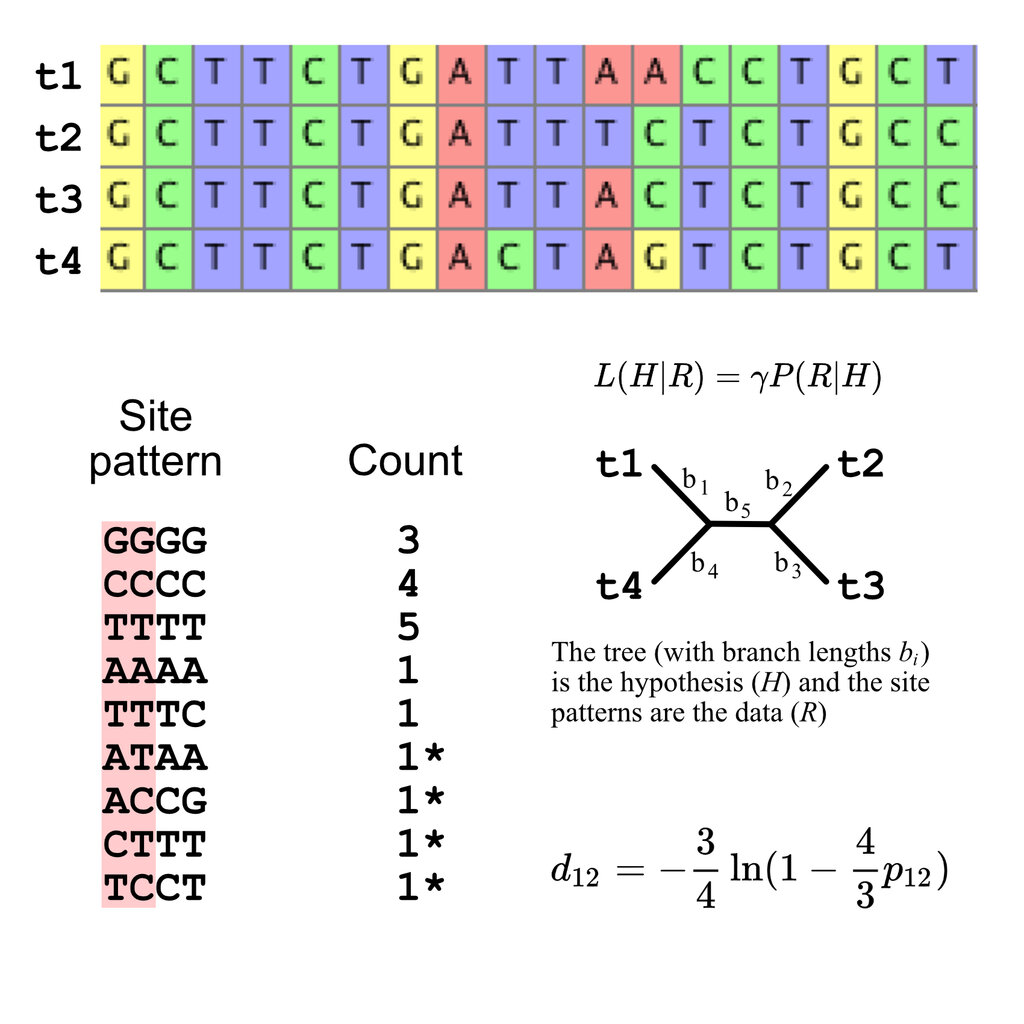
Mapping Evolutionary History: The degree of similarity between sequences from different species can tell us how closely related they are. Sequences from humans and chimpanzees are highly similar, reflecting a recent common ancestor. Sequences from humans and yeast are less similar, reflecting a much more distant relationship. By comparing many sequences, scientists can build phylogenetic trees that map the evolutionary history of life.
Predicting Structure: In proteins, the sequence of amino acids dictates how the protein folds into a complex three-dimensional shape. This shape determines its function. If two protein sequences are similar, it's likely they fold into similar structures. By aligning an unknown protein to one with a known structure, we can make an educated guess about its shape.
In essence, sequence alignment allows us to use what we know about one molecule to learn about another.
This fundamental technique unlocks insights into gene function, disease, and the vast evolutionary tree connecting all living things.
When performing a sequence alignment, what is the primary purpose of introducing a gap (represented by a dash)?
You are comparing a newly discovered, very long protein sequence against a large database to find any small, conserved functional domains it might share with other proteins. Which alignment strategy is most appropriate for this task?