Hindi and Hinglish Conversation Basics
Hindi Script and Sounds
The Devanagari Script
Hindi is written in a script called Devanagari. At first glance, it might look intricate, but it's remarkably logical. One of its key features is the horizontal line that runs along the top of the letters, connecting them into words.
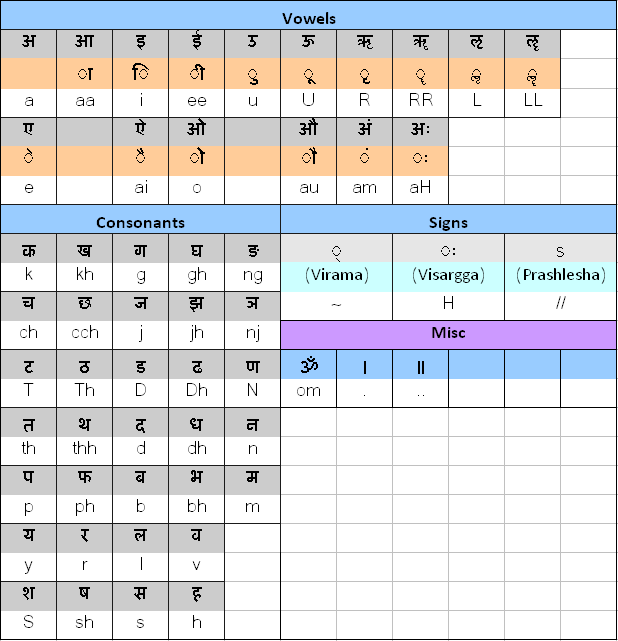
Devanagari is an abugida. This means that its writing system is based on consonant-vowel pairs. Each consonant character has an inherent vowel sound, usually an 'a' sound (like the 'u' in 'but'). Vowels can also be written as separate letters, or as marks that attach to consonants to change their sound.
Unlike the English alphabet where vowels and consonants are separate letters, Devanagari's consonants come with a built-in vowel.
Vowels (स्वर)
Hindi has 11 vowels. They come in two forms: a full, independent letter used when a vowel starts a word or follows another vowel, and a dependent form, called a mātrā (मात्रा), which attaches to a consonant.
| Independent | Dependent (मात्रा) | Attached to क | Pronunciation (like in...) |
|---|---|---|---|
| अ | (none) | क | but |
| आ | ा | का | father |
| इ | ि | कि | pin |
| ई | ी | की | feet |
| उ | ु | कु | put |
| ऊ | ू | कू | rule |
| ऋ | ृ | कृ | river (rolled 'r') |
| ए | े | के | cafe |
| ऐ | ै | कै | cat |
| ओ | ो | को | go |
| औ | ौ | कौ | caught |
Notice that the first vowel, अ (a), has no mātrā. That's because its sound is already inherent in every consonant. You only add a mātrā when you want to change that default vowel sound.
Consonants (व्यंजन)
There are 33 core consonants in Hindi. They are organized very scientifically based on where in the mouth they are produced. For example, some sounds are made at the back of the throat, while others are made using the teeth or lips.
Let's look at the first few consonants. Remember, each one has the default 'a' (अ) sound attached.
| Consonant | Transliteration | Pronunciation (similar to...) |
|---|---|---|
| क | ka | cat |
| ख | kha | back hand (aspirated k) |
| ग | ga | go |
| घ | gha | doghead (aspirated g) |
| च | ca | chat |
| छ | cha | churchhill (aspirated ch) |
| ज | ja | jam |
| ट | ṭa | top (with tongue curled back) |
| त | ta | three (in some accents, no air) |
| द | da | that |
| प | pa | pin |
| ब | ba | bat |
| म | ma | mom |
One important symbol is the halant (्). It's a small diagonal stroke placed under a consonant to remove its inherent 'a' vowel sound. So, क् is just the sound 'k', without any vowel.
Forming Syllables
Now, let's combine consonants and vowels to make syllables. This is where the mātrās become essential. We take a consonant, like म (ma), and add different mātrās to change its sound.
| Syllable | Combination | Pronunciation |
|---|---|---|
| म | म + अ (inherent) | ma |
| मा | म + ा | mā |
| मि | म + ि | mi |
| मी | म + ी | mī |
| मु | म + ु | mu |
| मू | म + ू | mū |
| मे | म + े | me |
| मो | म + ो | mo |
By stringing these syllables together, you form words. For example, the word for 'name' in Hindi is नाम.
name
It's made of two syllables: न (na) + ा (ā) = ना (nā), and म (ma). Together, they form नाम (nām).
What is a key characteristic of an abugida writing system like Devanagari?
What is the name for the dependent vowel marks that attach to consonants to change their sound?