High Sensitivity Explained
Introduction to High Sensitivity
What Is High Sensitivity?
Have you ever felt like your senses are turned up a little louder than everyone else's? Maybe you notice subtleties in your environment that others miss, or you feel emotions, both good and bad, with a powerful intensity. If so, you might be a Highly Sensitive Person (HSP).
This isn't a disorder or a weakness. It's a personality trait known formally as Sensory Processing Sensitivity.
Sensory Processing Sensitivity
other
An innate trait involving a high level of sensitivity to external and internal stimuli, including social and emotional cues.
Think of it like having a finely tuned nervous system. Just as a high-fidelity microphone picks up more subtle sounds, an HSP's brain processes information and reflects on it more deeply. This trait is quite common, appearing in about 20% of the population. It's found in equal numbers among men and women.
The Biology Behind It
High sensitivity is rooted in biology. Research suggests that the brains of HSPs are wired differently. Key areas related to awareness, empathy, and self-control show more activity. This heightened neural response means HSPs take in more sensory information from their surroundings and process it more thoroughly.
This deep processing is a hallmark of the trait. It's not just about noticing more, but about thinking more deeply about what's been noticed.
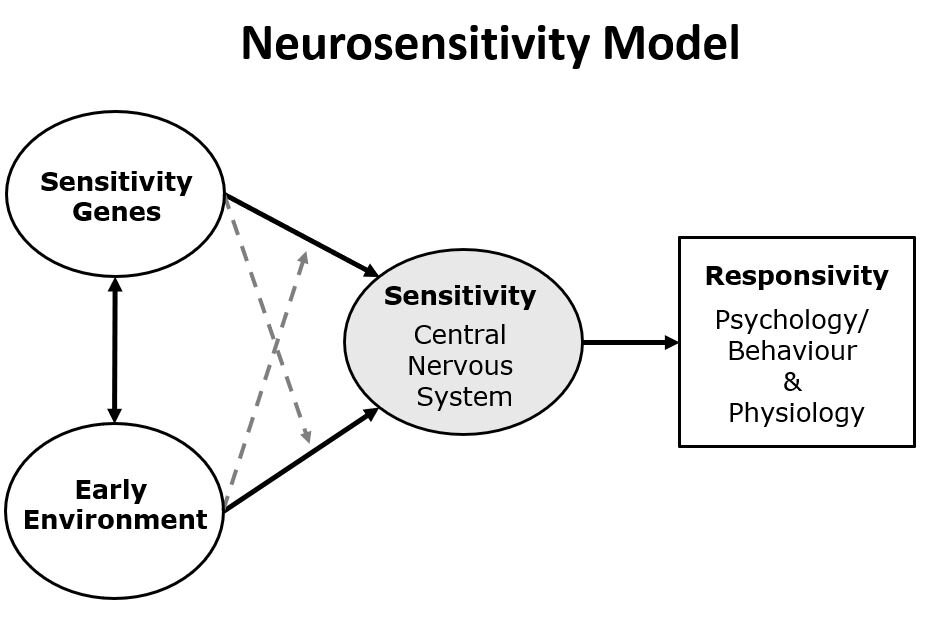
Genetics and environment both play a part. Specific gene variations are linked to SPS, affecting how the brain uses certain neurotransmitters. These genetic predispositions, combined with early life experiences, shape the development of a more sensitive central nervous system.
Common Misconceptions
High sensitivity is often confused with other traits, but it's distinct. Let's clear up two of the most common mix-ups: introversion and neuroticism.
High Sensitivity vs. Introversion: While about 70% of HSPs are introverts, that means 30% are extroverts. The key difference is the reason for their behavior. An introvert prefers less social stimulation to conserve energy. An HSP, whether an introvert or extrovert, might avoid highly stimulating situations because they feel overwhelming or overarousing, not necessarily because they dislike socializing.
High Sensitivity vs. Neuroticism: Neuroticism is a personality trait characterized by a tendency toward negative emotions like anxiety, worry, and sadness. High sensitivity, on the other hand, is a neutral trait. HSPs feel all emotions more deeply, including positive ones like joy, curiosity, and compassion. A difficult upbringing can make an HSP more prone to anxiety, but the trait itself is not defined by negativity.
Understanding these distinctions is key. High sensitivity is a fundamental way of experiencing the world, with its own unique biological basis.
What is the formal, scientific term for the trait of being a Highly Sensitive Person (HSP)?
The trait of high sensitivity is rooted in biology, with HSPs' brains showing more activity in areas related to awareness and empathy.