High School Geometry Essentials
Basic Geometric Elements
The Building Blocks of Space
All of geometry, from the simplest triangle to the most complex three-dimensional shape, is built from just a few basic ideas. These are the fundamental ingredients we use to describe the world around us: points, lines, and planes.
Point
noun
A specific location in space. It has no size, no width, no length, and no depth.
Think of a point as a single dot. It doesn't take up any room, but it marks a precise position. We usually represent points with a dot and name them with a capital letter.
Next, we have lines. A line is a straight path that extends forever in two opposite directions. It has one dimension: length. It has no thickness.
A fundamental rule in geometry is that through any two points, there is exactly one line. You can't draw two different straight lines that both pass through the same two points.
We can name a line by any two points on it (like line or ) or sometimes with a single lowercase letter.
From lines, we get two related concepts:
- Line Segment: A part of a line that consists of two endpoints and all the points between them. It has a specific length. (Segment or )
- Ray: A part of a line that starts at one endpoint and extends infinitely in one direction. (Ray or )
Expanding into a New Dimension
If a line has one dimension, a plane has two: length and width. A plane is a perfectly flat surface that extends forever in all directions. Think of a tabletop or a wall that goes on without end. Just as two points define a line, three points that are not on the same line define a plane.
Plane
noun
A flat, two-dimensional surface that extends infinitely far.
Points that lie on the same line are called collinear. Points or lines that lie in the same plane are called coplanar.
Where Elements Meet
The most interesting parts of geometry happen when these elements interact, or intersect. Understanding how they cross is key to solving geometric problems.
- The intersection of two different lines is a single point.
- The intersection of a line and a plane (where the line is not lying in the plane) is also a single point.
- The intersection of two different planes is a line.
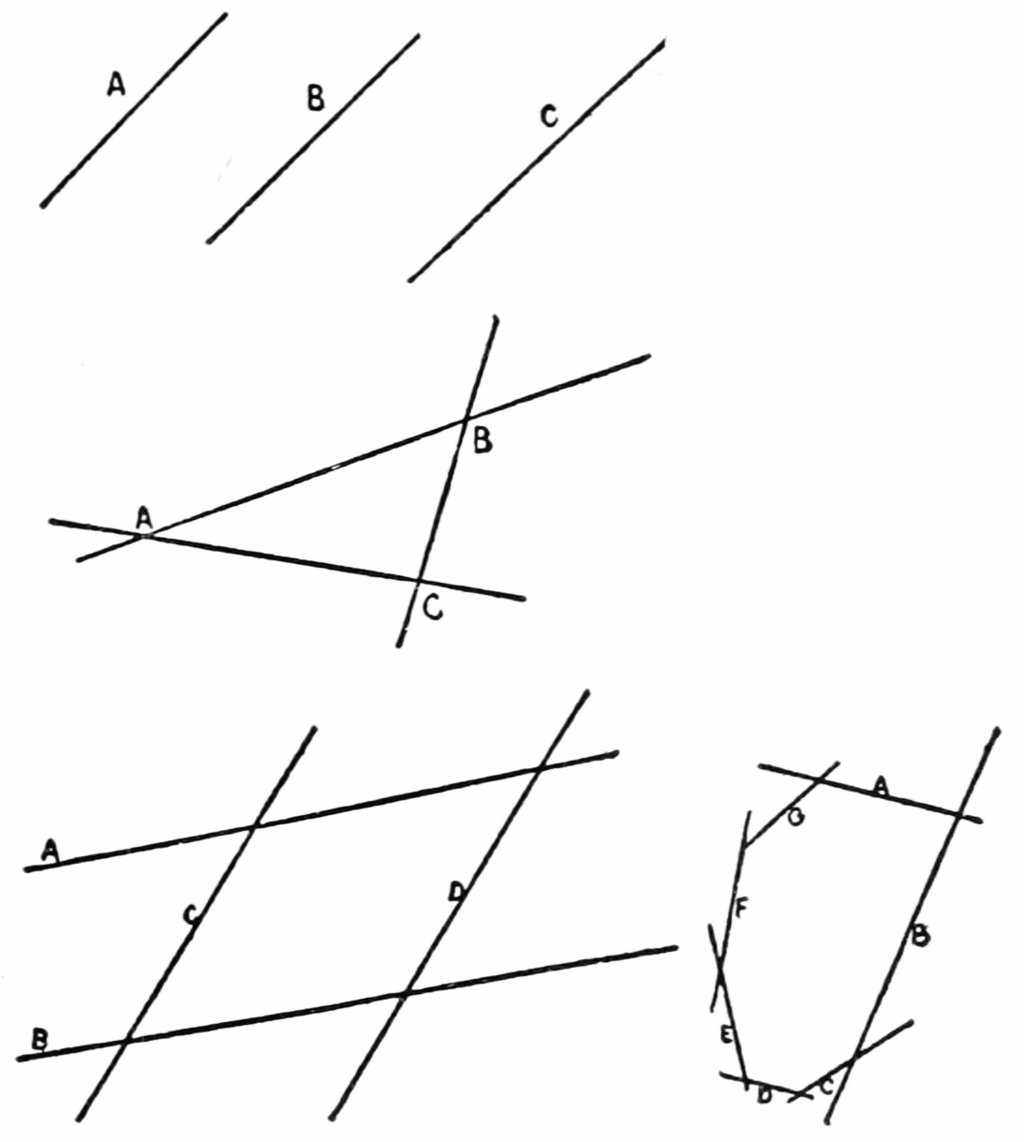
Imagine a wall and the ceiling of a room. Both are parts of planes. Where they meet, they form a straight line. Now, imagine a flagpole standing on the ground. The pole (a line) meets the ground (a plane) at a single point.
These three elements—points, lines, and planes—are the undefined terms of geometry. We don't formally define them, but we use them to build definitions for everything else. They are the simple, powerful foundation for the entire world of shapes and space.
Which geometric figure is a part of a line that has two endpoints and a definite length?
What is formed by the intersection of two distinct planes?