High School Astronomy Basics
Introduction to Astronomy
A Look Back in Time
For thousands of years, humans have looked to the sky and wondered about the lights they saw. Early civilizations, from the Babylonians to the Egyptians, were keen observers. They mapped the stars, tracked the seasons, and predicted eclipses. Their work was often tied to agriculture, navigation, and religion, but it laid the groundwork for modern astronomy.
For a long time, the prevailing view, championed by the Greek philosopher Ptolemy, was that Earth was the center of the universe. This geocentric model seemed to make sense; after all, we see the Sun, Moon, and stars revolving around us every day. It was a complex but elegant system that dominated Western thought for over 1,400 years.
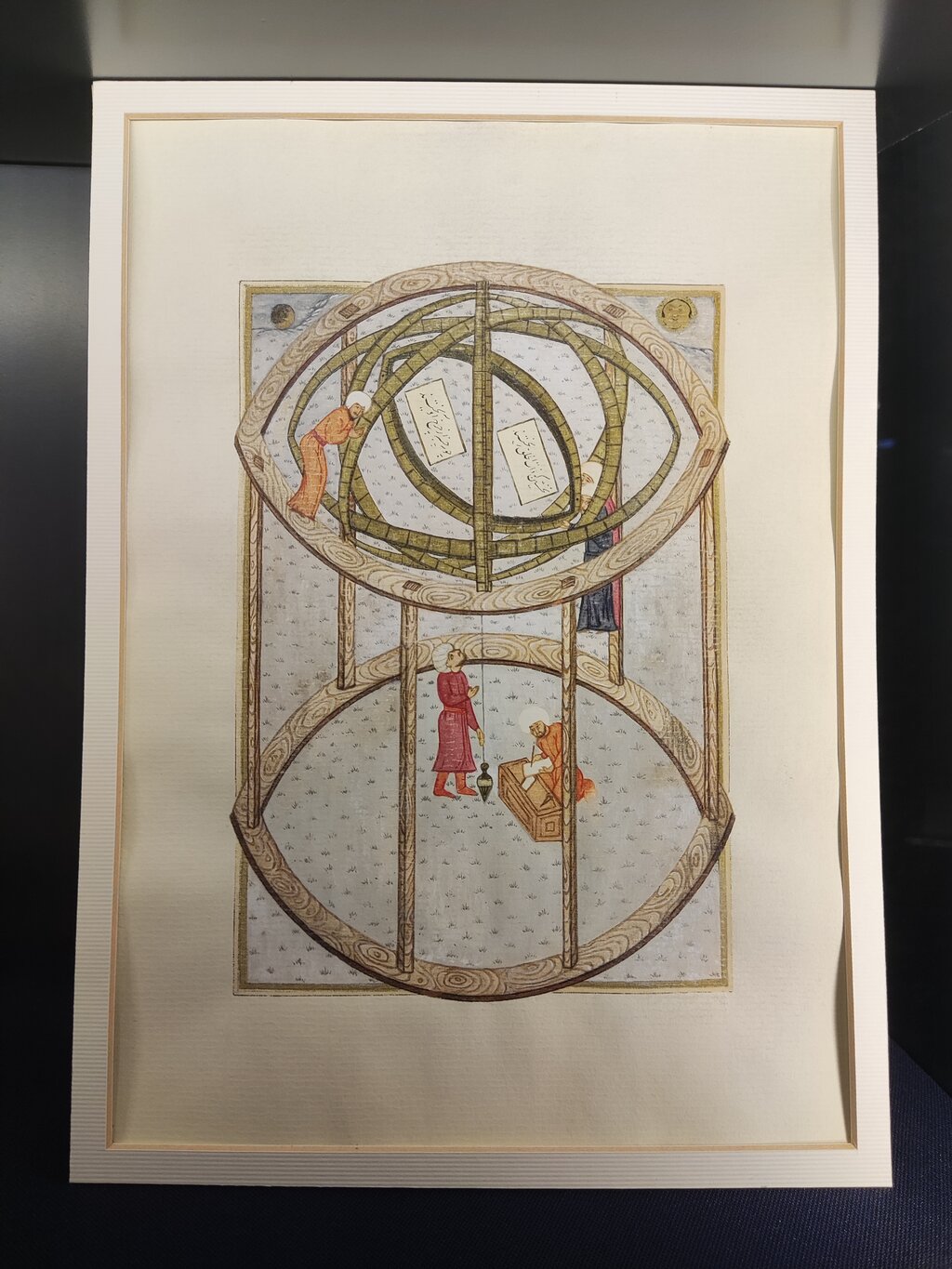
The script began to flip during the Renaissance. In the 16th century, Nicolaus Copernicus proposed a radical new idea: a heliocentric model, with the Sun at the center. This theory was simpler, but it took time to catch on. It was the observations of astronomers like Galileo Galilei, who used one of the first telescopes to see the moons of Jupiter and the phases of Venus, that provided powerful evidence against the old model. Later, Isaac Newton’s laws of motion and universal gravitation explained why the planets moved as they did, giving the heliocentric model a firm physical foundation.
How We Know What We Know
Astronomy is a unique science. Unlike a chemist who can mix chemicals in a lab, an astronomer can't put a star in a test tube. Instead, astronomers rely on observation and deduction. The universe is the laboratory, and light is the primary source of information. This process follows the scientific method.
The scientific method in astronomy works like this: an observation sparks a question, which leads to a testable hypothesis. The hypothesis makes a prediction, which astronomers then try to verify with more observations. If the observations match the prediction, the hypothesis is supported. If not, it's time for a new hypothesis.
A classic example is the discovery of Neptune. In the 19th century, astronomers noticed that Uranus wasn't moving as predicted by Newton's laws. Its orbit had a wobble. Some thought Newton's laws were wrong, but others hypothesized that the gravity of an unknown, more distant planet was pulling on Uranus. Mathematicians calculated the location of this hypothetical planet. When astronomers pointed their telescopes to that spot in the sky, there it was: Neptune. Observation led to a hypothesis, which made a testable prediction, which was then confirmed.
Tools of the Trade
For most of human history, the only tool for astronomy was the naked eye. The invention of the telescope in the early 17th century revolutionized the field, allowing us to see details that were previously invisible. Today’s telescopes are much more powerful and come in many forms.
Modern optical telescopes are often placed on high mountains, far from city lights and above much of Earth’s blurry atmosphere. But the atmosphere blocks more than just our view; it also blocks certain types of light, like X-rays and most infrared and ultraviolet light. To see the universe in these wavelengths, we must go to space. Space telescopes like the Hubble Space Telescope and the James Webb Space Telescope have given us breathtaking images and invaluable data by observing the cosmos from above the atmosphere.
One of the most powerful techniques astronomers use is spectroscopy. By splitting light from a star or galaxy into its constituent colors, like a prism creating a rainbow, we can see a unique barcode of dark lines. These lines correspond to different chemical elements, telling us what the object is made of, how hot it is, and how fast it’s moving—all from billions of miles away.
Our Cosmic Address
When we look up at the night sky, we're seeing just a tiny fraction of a universe that's vast beyond imagination. Understanding our place in it requires thinking on scales far larger than we're used to.
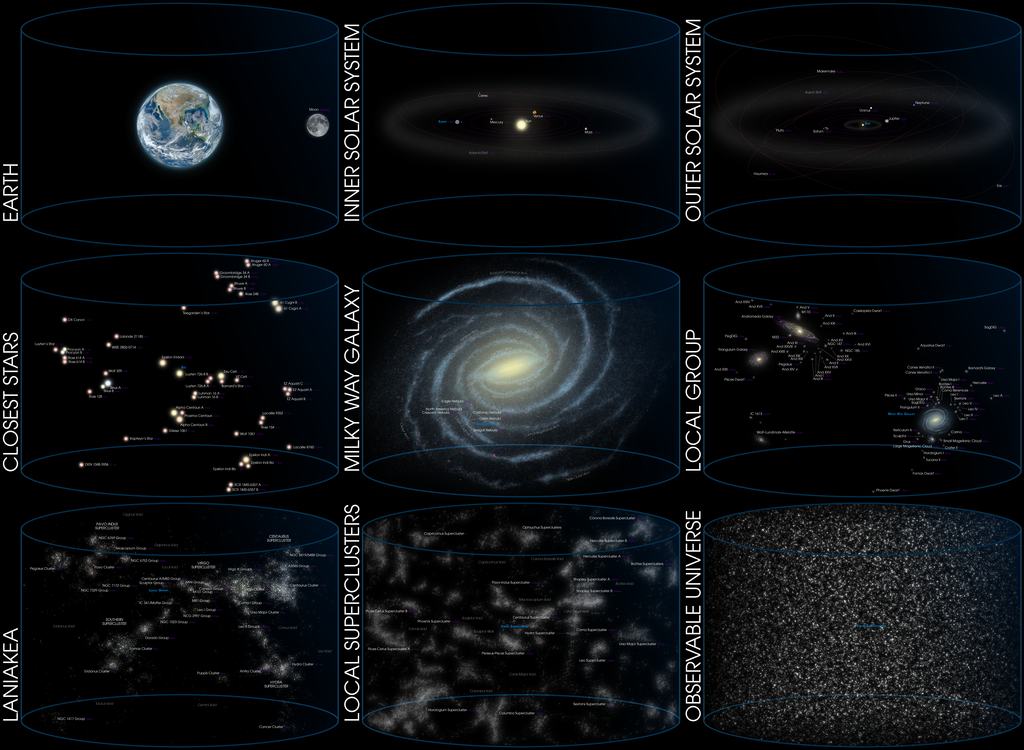
We live on Earth, a planet orbiting a star we call the Sun. Our Sun is one of hundreds of billions of stars in the Milky Way Galaxy, a giant spiral disk of stars, gas, and dust. But our galaxy isn't alone. It’s part of a small cluster of galaxies called the Local Group, which also includes the Andromeda Galaxy.
The Local Group is, in turn, just one member of an even larger structure called the Laniakea Supercluster. And on the grandest scales, superclusters are not scattered randomly but are arranged in a vast, web-like structure of filaments and voids, often called the Cosmic Web. This is the largest known structure in the universe.
Ready to test your knowledge?
The geocentric model of the universe, which placed Earth at the center, was the dominant theory for over 1,400 years. Who is the ancient Greek philosopher most associated with championing this model?
The discovery of Neptune is a classic example of the scientific method in action. When astronomers observed a wobble in Uranus's orbit, what did this observation represent?
This journey through the cosmos is just beginning. By understanding the history, methods, and structure of the universe, we've set the stage to explore the wonders it holds.