High ROI Spanish Essentials
Essential Vocabulary
Words That Work Hardest
When you're starting a new language, it feels like there's a mountain of words to learn. The trick is to not learn every word, but the right words. A small number of high-frequency words do most of the heavy lifting in everyday conversation. By focusing on these first, you can start communicating much faster.
Did you know that just 1,000 words make up most of everyday conversations? Prioritize learning these high-frequency words and phrases first.
We'll begin with nouns. These are the words for people, places, and things. They're the basic subjects and objects we talk about all the time.
| English | Spanish (Singular) | Spanish (Plural) |
|---|---|---|
| time | el tiempo | los tiempos |
| year | el año | los años |
| day | el día | los días |
| thing | la cosa | las cosas |
| man | el hombre | los hombres |
| woman | la mujer | las mujeres |
| world | el mundo | los mundos |
| life | la vida | las vidas |
| house | la casa | las casas |
| friend | el amigo / la amiga | los amigos / las amigas |
Notice that Spanish nouns have gender, marked by el (masculine) or la (feminine). This is a key concept we'll explore more later on. For now, just try to learn the article (el or la) along with the noun.
Making Things Happen
Once you have some nouns, you need verbs to make sentences happen. Verbs are action words. They describe what the nouns are doing. Here are some of the most common Spanish verbs in their most basic form, called the infinitive.
| English | Spanish Infinitive |
|---|---|
| to be (permanent) | ser |
| to be (temporary) | estar |
| to have | tener |
| to do / to make | hacer |
| to be able to | poder |
| to say / to tell | decir |
| to go | ir |
| to see | ver |
| to give | dar |
| to want | querer |
Just like in English, these verbs change their form depending on who is doing the action (I, you, she, etc.). We'll cover those changes, called conjugations, in a future lesson. For now, get familiar with what these essential verbs mean.
Adding Color and Detail
Adjectives and adverbs add detail to your sentences. Adjectives describe nouns (a big house), while adverbs describe verbs, adjectives, or other adverbs (he runs fast). They make your language more specific and interesting.
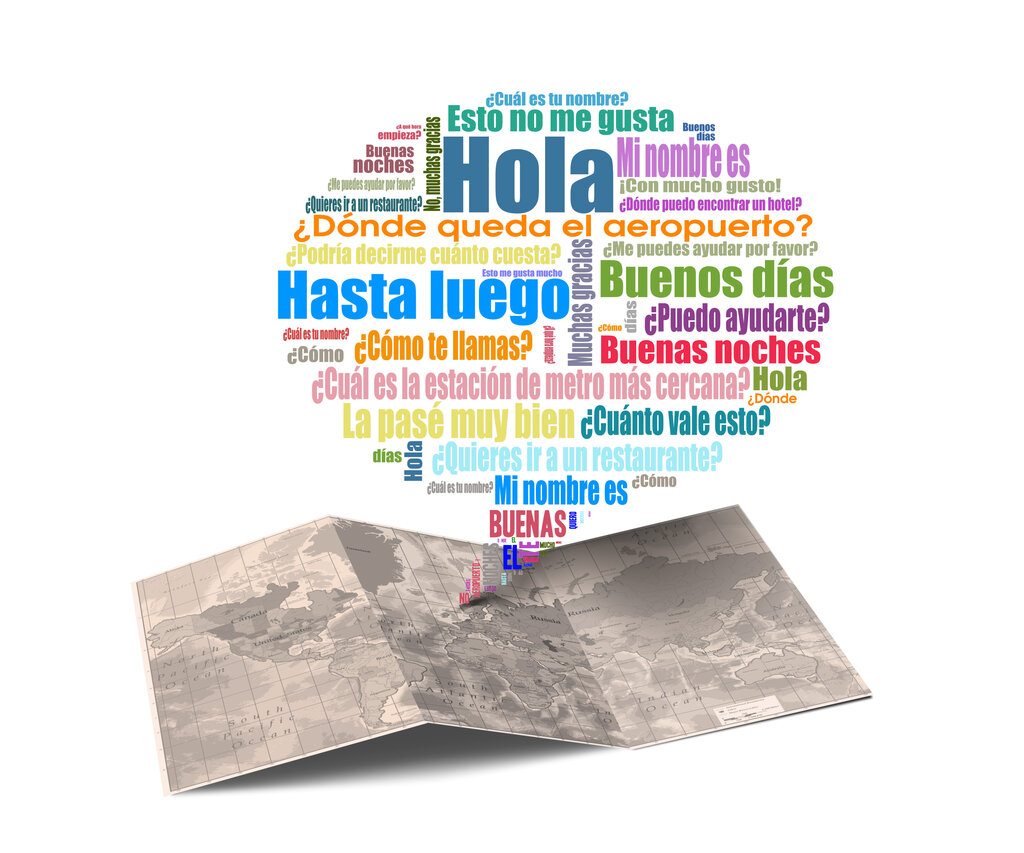
Let's look at some useful adjectives. A key rule in Spanish is that the adjective usually comes after the noun it describes, and it must agree in gender and number. For example, la casa roja (the red house) or los carros rojos (the red cars).
| English | Spanish (Masc./Fem.) |
|---|---|
| good | bueno / buena |
| bad | malo / mala |
| big | grande |
| small | pequeño / pequeña |
| new | nuevo / nueva |
| old | viejo / vieja |
Now for some adverbs that will immediately expand what you can say.
| English | Spanish |
|---|---|
| here | aquí |
| there | allí |
| now | ahora |
| always | siempre |
| never | nunca |
| very | muy |
| well / good | bien |
| bad / poorly | mal |
You can combine these easily. Muy bien means "very well." Estoy aquí ahora means "I am here now."
Putting It All Together
The fastest way to start speaking is by learning complete, useful phrases. These are conversational shortcuts you can use right away without having to build a sentence from scratch. They are the building blocks of everyday interaction.
Hello
Let's learn a few more.
| English Phrase | Spanish Phrase |
|---|---|
| Good morning. | Buenos días. |
| How are you? | ¿Cómo estás? |
| Thank you (very much). | (Muchas) gracias. |
| Please. | Por favor. |
| Yes / No. | Sí / No. |
| I don't understand. | No entiendo. |
| Goodbye. | Adiós. |
Memorizing these phrases will give you a confident start in basic conversations. Time to review what we've covered.
Ready to check your understanding?
When beginning to learn Spanish, what is the most effective initial strategy for building vocabulary?
What is the basic, unconjugated form of a verb called, such as 'hablar' (to speak) or 'comer' (to eat)?
By focusing on these high-frequency words and phrases, you're building a strong and practical foundation for speaking Spanish.