High Performance Computing Architecture
HPC Interconnect Fabrics
The Fabric of Supercomputing
In a high-performance computing (HPC) cluster, thousands of processors work in parallel on a single, massive problem. This is like having thousands of brilliant mathematicians in a room, all trying to solve one equation together. For them to succeed, they need to communicate instantly and constantly. If they have to shout across a noisy, crowded room, they'll spend more time waiting than calculating. The network that connects these processors, known as the interconnect fabric, is the room's acoustics. In HPC, this fabric must be pristine.
Standard Ethernet, the kind that runs in offices and most data centers, is like that crowded room. It's designed for reliability over raw speed, handling a chaotic mix of web browsing, email, and file transfers. But HPC workloads are different. They are tightly coupled, meaning each node's progress depends on receiving updates from many other nodes. A tiny delay, or latency, can cascade through the system, leaving expensive processors idle. This is why HPC relies on specialized interconnects like InfiniBand and high-performance Ethernet variants such as RoCEv2 (RDMA over Converged Ethernet).
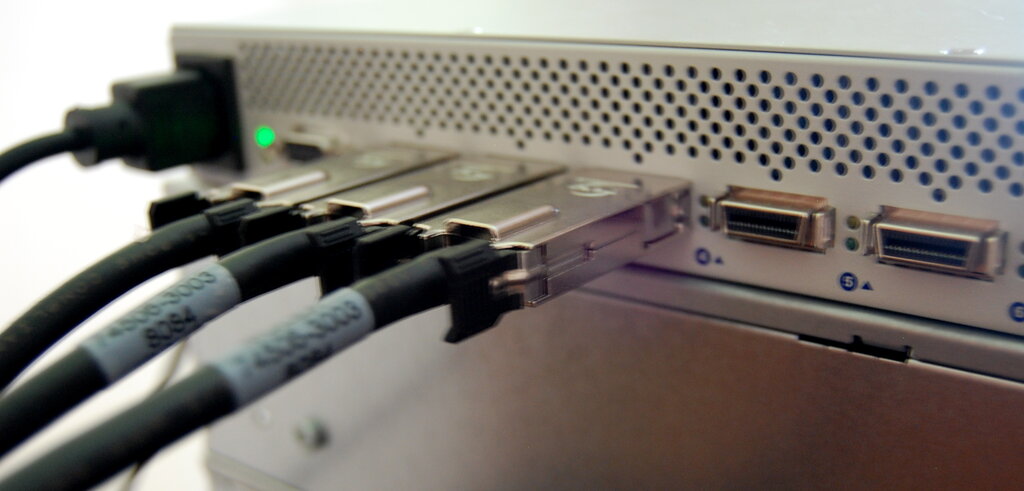
High-bandwidth, low-latency networks form the connective tissue of AI infrastructure.
The core difference lies in their design philosophy. InfiniBand was built from the ground up for HPC. It's a switched fabric with its own protocol stack, designed to be lossless and provide extremely low latency, often below a microsecond. RoCEv2, on the other hand, is an effort to bring the key advantage of InfiniBand—Remote Direct Memory Access (RDMA)—to the ubiquitous Ethernet. It wraps InfiniBand transport packets inside standard IP/UDP packets, allowing them to traverse Ethernet networks. This makes it more compatible with existing infrastructure but introduces overhead that InfiniBand avoids.
The Power of Direct Access
The magic behind these high-performance fabrics is RDMA (Remote Direct Memory Access). In a traditional TCP/IP network, when Server A wants to send data to Server B, the process is heavy. The data is copied from the application's memory into the operating system's kernel space on Server A. The kernel then processes it, packages it into TCP packets, and sends it over the network. On Server B, the kernel receives the packets, reassembles the data, and copies it from its own kernel space into the target application's memory. Each copy and kernel intervention adds latency.
RDMA changes the game by enabling zero-copy communication. It allows an application on one server to directly read from or write to the memory of another server without involving either machine's operating system. The network interface card (NIC) handles the entire transfer. This hardware offloading bypasses the CPU and the kernel's network stack, slashing latency and freeing up the CPU for actual computation. This is especially critical for the (MPI), the standard communication model for parallel applications. MPI operations like MPI_Send and MPI_Recv become dramatically faster with RDMA.
Think of it this way: TCP/IP is like sending a package through the postal service, with multiple stops and processing centers. RDMA is like having a dedicated pneumatic tube directly connecting your desk to your colleague's.
Some advanced fabrics even support in-network computing. Technologies like NVIDIA's SHARP (Scalable Hierarchical Aggregation and Reduction Protocol) offload collective MPI operations, such as summing numbers from all nodes, directly onto the network switches. Instead of each node sending its data to a central root node, the switches themselves perform the calculation as the data flows through them. This drastically reduces the amount of data traversing the network and cuts the time for collective operations from being proportional to the number of nodes to being nearly constant.
Network Shape and Scale
The way nodes are connected, the network's topology, is just as important as the protocol. The goal is to minimize the number of "hops" a message must take to get to any other node and to provide high bisection bandwidth, which measures the total bandwidth between two halves of the network. A low network diameter—the maximum number of hops between any two nodes—is crucial for performance at scale.
Common topologies include:
-
Fat-Tree: A multi-layered, hierarchical network. Just like a real tree, the connections (branches) get thicker—higher bandwidth—as you move up from the compute nodes (leaves) to the core switches (trunk). This provides uniform bandwidth between any two nodes.
-
Torus: Nodes are arranged in a multi-dimensional grid (e.g., 3D) where the edges wrap around. A node in a 3D torus is connected to its six neighbors. This structure is excellent for applications where communication patterns are mostly local, common in physical simulations.
-
Dragonfly: A newer topology that tries to balance cost and performance for massive systems. It uses a two-level structure: nodes are locally connected in fully-meshed groups, and these groups are then sparsely connected to each other via long-distance "global" links. This reduces the total cabling and cost compared to a full Fat-Tree while maintaining a low network diameter.
The choice of topology deeply impacts how well MPI collective operations perform. An MPI_Alltoall operation, where every node sends a unique message to every other node, is brutal on the network. A high-bandwidth Fat-Tree handles this well, but a Dragonfly's performance might depend on how many messages need to cross between groups.
Choosing an interconnect is a series of trade-offs. InfiniBand offers raw performance but requires a specialized ecosystem. RoCEv2 promises RDMA on familiar Ethernet hardware but can be harder to tune and more sensitive to congestion. The topology, in turn, is a trade-off between cost, cabling complexity, and the specific communication patterns of the intended workloads.
Time to check your understanding of these high-speed networks.
What is the primary reason standard Ethernet is generally unsuitable for tightly-coupled HPC workloads?
The technology that allows an application on one server to directly write data to the memory of another server without involving the operating system's kernel is known as:
Ultimately, the interconnect is not just plumbing; it's a critical component of the computer itself, defining the scale and types of problems that a supercomputer can effectively solve.