High Impact Political Giving for Visionary Leaders
Tax Exempt Giving Vehicles
The Right Tools for the Job
When structuring a philanthropic portfolio of $10-20 million, think of your giving vehicles as tools. A 501(c)(3) is like a screwdriver: precise, reliable, and perfect for long-term construction. It’s the ideal tool for building non-partisan movements, conducting voter education, and performing charitable work. The big draw is that donations are tax-deductible for the donor.
However, its primary constraint is a strict prohibition on partisan political activity. A (c)(3) cannot endorse or oppose a candidate for public office. That’s where the wrench comes in: the 501(c)(4). It’s designed for applying torque to the political system. Donations aren't tax-deductible, but a (c)(4) can engage in substantial legislative lobbying and a limited amount of partisan political advocacy. It offers a more direct way to influence policy and elections, often with the benefit of donor anonymity.
| Feature | 501(c)(3) Public Charity | 501(c)(4) Social Welfare Org. |
|---|---|---|
| Primary Purpose | Charitable, educational, religious | Promotion of social welfare |
| Tax Deductibility | Yes, for donors | No, for donors |
| Partisan Activity | Strictly prohibited | Permitted, but not as primary activity |
| Lobbying | Limited | Substantial lobbying permitted |
| Donor Disclosure | Required (on Form 990) | Generally not required |
Maximizing (c)(3) Influence
While a 501(c)(3) can't campaign, it can lobby. The default IRS rule for this is the vague “substantial part” test, which leaves many organizations hesitant to engage in advocacy for fear of crossing an undefined line. This is where the provides a critical safe harbor. By filing a simple form, a (c)(3) opts into a clear, expenditure-based test for its lobbying activities. This replaces ambiguity with a mathematical formula, allowing the organization to lobby up to a defined financial limit without jeopardizing its tax-exempt status.
Making the 501(h) election is a strategic move for any (c)(3) that wants to influence policy. It allows the organization to budget for advocacy with precision and defend its activities to the IRS with concrete numbers.
The (c)(4) and Its Political Power
A 501(c)(4) operates under a different set of rules. Its purpose is to promote “social welfare,” a term the IRS interprets broadly. This allows a (c)(4) to engage in unlimited lobbying and also participate in partisan politics, as long as that political activity is not its primary activity. This is determined by the , a facts-and-circumstances analysis of the organization's expenditures and focus. To remain a (c)(4), more than 50% of its activities must be dedicated to social welfare.
Failing this test could force the organization to be reclassified as a 527 political organization, triggering donor disclosure requirements. This is a critical distinction. The ability of (c)(4)s to shield their donors' identities in most jurisdictions is what has led to their association with so-called “dark money” in politics. For donors who prioritize privacy while funding politically potent work, the (c)(4) is an indispensable tool.
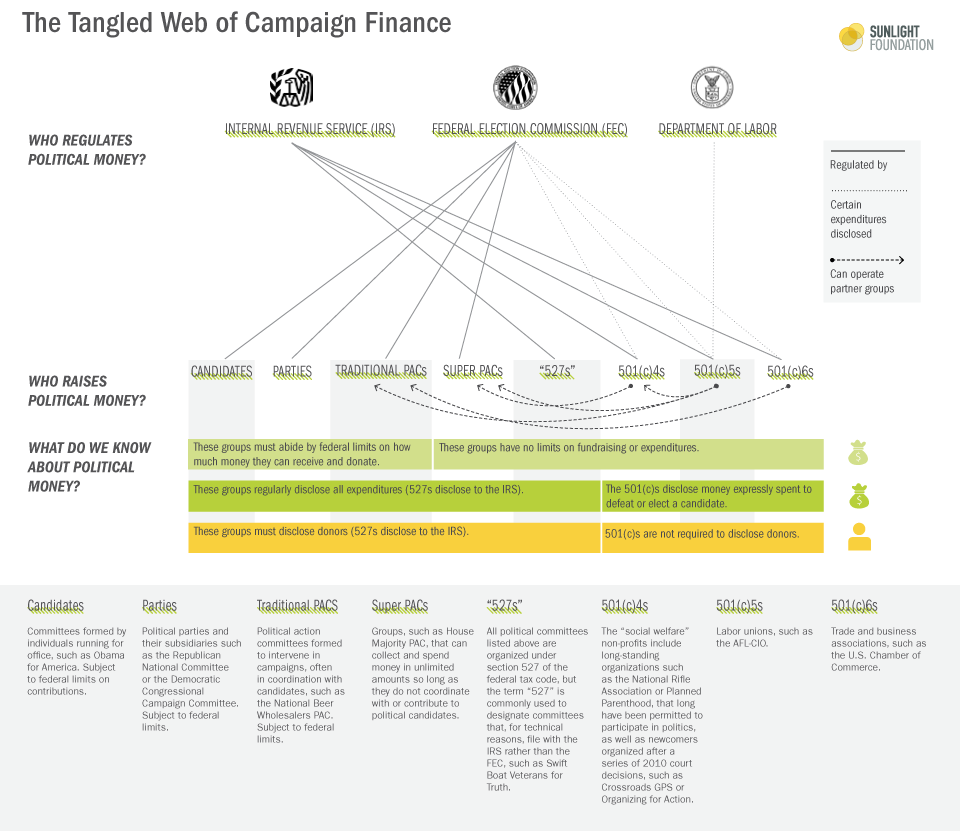
A sophisticated strategy often involves using both types of organizations in tandem. For example, the Movement Voter Project (MVP) operates a 501(c)(3) arm that focuses on non-partisan civic engagement and voter registration, allowing donors to receive a tax deduction for supporting this foundational work.
Simultaneously, its 501(c)(4) arm, MVP Action Fund, can engage in more direct advocacy and support specific policy outcomes. This dual-entity structure allows donors to allocate capital strategically. They can direct tax-deductible funds to the (c)(3) for general movement building and non-deductible funds to the (c)(4) for more pointed, high-impact political work, achieving a balance of tax efficiency and political effectiveness.
The choice between a 501(c)(3) and a 501(c)(4) isn't about which is better, but which is right for the specific goal. One builds the foundation, the other applies direct pressure.
Here's a quick way to test your understanding.
A donor wants to fund a campaign that directly opposes a specific candidate for public office, but also wants their donation to be tax-deductible. Which vehicle should they use?
What is the primary purpose of a 501(c)(3) making the 501(h) election?