Heuristic Evaluation for Usability
Introduction to Usability
What Makes a Design Usable?
Have you ever used an app or a website and felt completely lost? Maybe you couldn't find the menu, or a button did something you didn't expect. That feeling of confusion is the opposite of usability. It’s a sign that the design wasn't built with you, the user, in mind.
Usability
noun
The ease with which a user can interact with a product or service to achieve specific goals effectively, efficiently, and with satisfaction.
Think of usability as the invisible bridge between a user's goal and the product's function. A well-designed bridge is sturdy, easy to cross, and gets you exactly where you want to go without any trouble. A poorly designed one might be confusing, unstable, or lead to a dead end. When a digital product has high usability, it feels intuitive and effortless. You don't have to think about how to use it; you just use it.
One of the key objectives of a user interface with the aim of providing a good experience is to make the lives of users easy, less frustrating, and simple.
Why Usability Matters
Good usability isn't just a 'nice to have' feature. It's crucial for a product's success. If a website is hard to navigate, people will leave. If an app is confusing, they'll delete it. In a competitive market, users have plenty of other options. A smooth, frustration-free experience is what keeps them coming back.
Good usability leads to higher user satisfaction, increased engagement, and better business outcomes. For a company, this means more sales, more sign-ups, and a stronger brand reputation. For the user, it means less time wasted and less stress. It's a win-win.
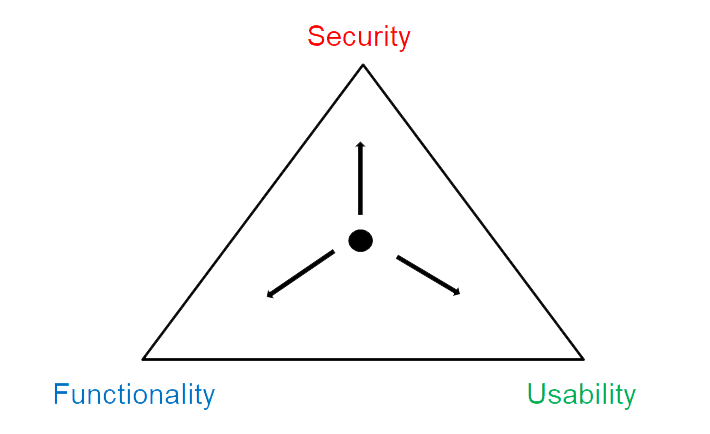
The goal is to find a sweet spot. A product that's very secure but impossible to use is a failure. Likewise, a product with amazing features that no one can figure out is equally useless. Usability is the key that unlocks the value of the other two.
The User-Centered Approach
So, how do designers create usable products? The secret is a philosophy called user-centered design (UCD). Instead of building something and hoping people like it, UCD puts the user at the heart of the design process from the very beginning.
User-centered design isn't about asking users what they want. It's about understanding their needs, limitations, and context, and then designing to meet those realities.
This means designers spend a lot of time learning about their audience. They conduct research, create user personas, and map out user journeys. They build prototypes and test them with real people, gathering feedback and making improvements in a continuous cycle. The entire process revolves around empathy for the end user.
This iterative process helps ensure the final product is not just functional, but genuinely useful and easy to interact with.
Measuring Success
How do we know if a design is usable? We can measure it. Usability isn't just a feeling; it can be quantified through specific goals and metrics. These help teams track progress and identify areas for improvement.
| Goal | Description | How to Measure It |
|---|---|---|
| Effectiveness | Can users successfully achieve their goals? | Completion rate (e.g., % of users who complete a purchase). |
| Efficiency | How much effort does it take? | Time to complete a task, number of clicks or steps. |
| Satisfaction | How does the user feel about the experience? | Surveys, user feedback ratings (e.g., on a scale of 1-5). |
| Learnability | How easy is it for new users to get started? | Time taken to complete a task on the first attempt. |
| Memorability | Can users remember how to use it after time away? | Success rate for returning users. |
By focusing on these concrete metrics, designers and developers can move beyond guesswork and make data-driven decisions to improve the user experience. This foundation in usability is the first step toward creating products that people not only use, but love.
Ready to check your understanding? Let's see what you've learned about the fundamentals of usability.
What is the primary goal of usability in product design?
According to the text, what is a likely consequence of poor usability in a competitive market?
Understanding these core concepts is the first step. Next, we'll explore how to systematically evaluate a design's usability.