HER2 Positive Breast Cancer Treatment and Pathology
HER2 Signaling Pathway
The HER2 Receptor at Work
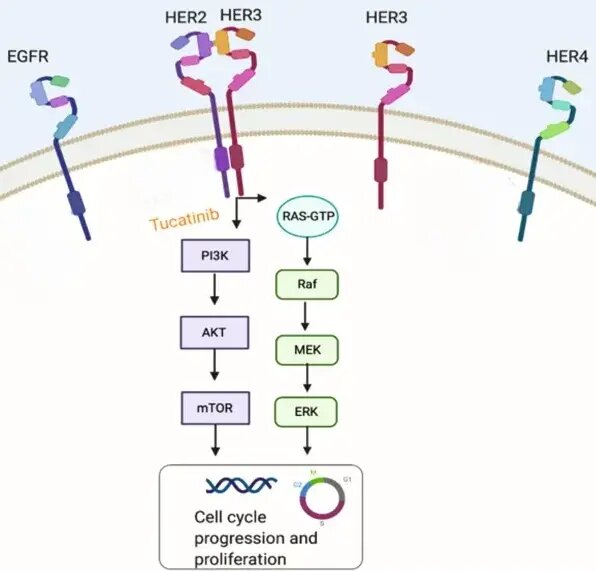
The Human Epidermal Growth Factor Receptor 2, or HER2, is a protein that sits on the surface of cells, spanning the cell membrane. It belongs to a family of four related receptors (HER1-HER4) that act like antennas, waiting for specific signals called growth factors. In a healthy cell, these receptors play a crucial role in normal growth, division, and repair. When a growth factor binds to a HER receptor, it causes the receptor to pair up with another HER receptor. This pairing is called dimerization.
Dimerization activates the receptors' internal machinery, specifically their kinase domains, which triggers a cascade of signals inside the cell, telling it to grow and divide. Think of it like two people needing to turn keys at the same time to launch a missile; one key turn does nothing. The HER2 receptor is unique because it doesn't need a specific growth factor to bind to it. Instead, it's the preferred dimerization partner for the other HER family members, especially and HER1 (also known as EGFR). This makes it a powerful amplifier of growth signals.
HER2 can pair with itself (homodimerization) or with other HER family members (heterodimerization). Heterodimers, especially with HER3, tend to send the most powerful signals.
When Signals Go Haywire
In some cancers, particularly a subset of breast cancers, the gene for HER2 is amplified. This leads to a massive overproduction of the HER2 protein on the cell surface, a state known as HER2 overexpression. With so many HER2 receptors crowded together, they no longer need a growth factor signal to dimerize. They begin pairing up spontaneously and constantly.
This ligand-independent signaling means the growth switch is permanently stuck in the 'on' position. The cell is bombarded with relentless instructions to divide, leading to uncontrolled proliferation. This continuous signaling activates two main downstream pathways that are critical drivers of cancer growth: the PI3K/Akt/mTOR pathway and the MAPK/ERK pathway.
Ligand
noun
A molecule that binds to another, usually larger, molecule to form a complex and serve a biological purpose. In this context, growth factors are the ligands for the HER family receptors.
The PI3K/Akt/mTOR pathway is a crucial regulator of cell survival. When activated by the HER2 dimer, it essentially tells the cell to ignore signals that would normally trigger apoptosis, or programmed cell death. This allows cancer cells to survive and thrive in conditions where normal cells would die.
Simultaneously, the gets activated. This cascade is a primary driver of cell proliferation, pushing the cell through its division cycle. The combined effect of these two pathways is a perfect storm for cancer: cells that not only divide relentlessly but are also highly resistant to dying. This aggressive phenotype is what makes HER2-positive cancers a significant clinical challenge, and it's why the HER2 receptor itself is such a critical target for therapy.
The PI3K-Akt signaling pathway is essential for numerous cellular functions and is abnormally activated in cancers (77), and the Ras signaling pathway is critical for cellular processes including cell growth, survival, and differentiation (78).
Let's test your understanding of these pathways.
What is the primary role of the HER family of receptors in a healthy, normal cell?
What makes the HER2 receptor unique among the HER family members?
Understanding the mechanics of HER2 signaling—from dimerization to the activation of downstream survival and proliferation pathways—reveals precisely why it's such a potent oncogene. This detailed molecular picture provides the rationale for developing targeted therapies designed to shut down this overactive receptor.