Heliosphere Dynamics and the Interstellar Frontier
Solar Wind and Magnetism
The Sun's Expanding Atmosphere
The Sun constantly sheds its outer atmosphere, a searing hot layer called the corona. This isn't a gentle process. The corona's extreme temperature, reaching over a million degrees Kelvin, gives particles enough energy to escape the Sun's immense gravity. This outflow of plasma—a mix of protons, electrons, and heavier ions—is the solar wind.
This plasma doesn't just drift away; it accelerates to supersonic speeds, traveling between 300 to 800 kilometers per second. As this material streams outward, it carries a piece of the Sun with it: its magnetic field. Because plasma is an excellent electrical conductor, the Sun's magnetic field lines are essentially locked, or 'frozen-in,' to the flow. The plasma drags the magnetic field along for the ride, filling the entire solar system.
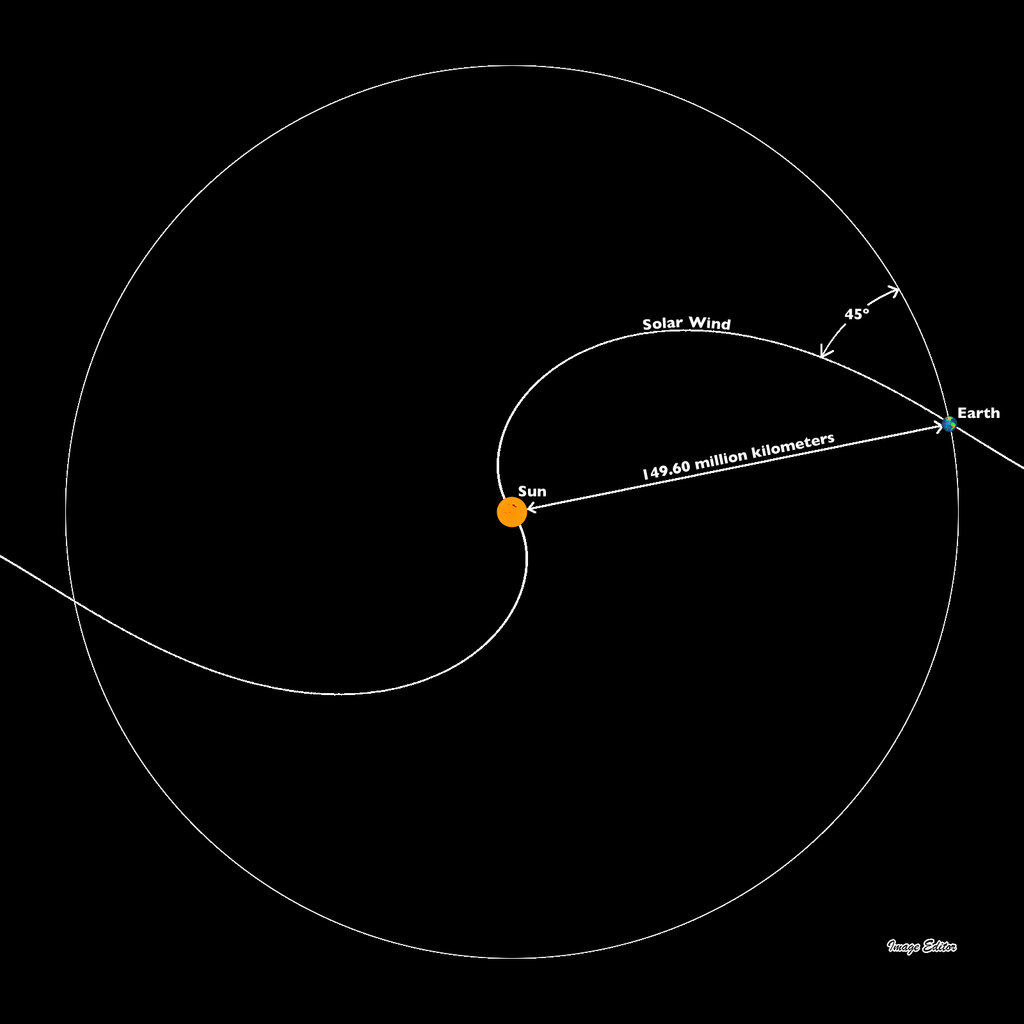
A Cosmic Pinwheel
If the Sun didn't rotate, its magnetic field would stretch out in straight lines, like spokes on a wheel. But the Sun does rotate, completing a turn roughly every 27 days at its equator. This rotation twists the base of the magnetic field lines as the plasma flows radially outward.
The result is a grand, archimedean spiral structure known as the Parker Spiral. Near the Sun, the field lines are mostly radial. But farther out, as the rotational speed becomes more significant relative to the outward flow speed, the field lines curve more and more, creating a pattern resembling the spray from a spinning lawn sprinkler.
This spiral structure has real consequences. By the time the solar wind reaches Earth's orbit, the magnetic field lines are angled at about 45 degrees to the direct Sun-Earth line. This orientation plays a crucial role in how solar storms and cosmic rays travel through the solar system.
Picking Up Hitchhikers
The solar wind isn't the only thing moving through our solar system. Our entire heliosphere is plowing through the interstellar medium, a thin soup of gas and dust that exists between stars. This medium is mostly composed of neutral atoms, like hydrogen and helium, which are unaffected by magnetic fields and can drift deep into the Sun's domain.
Eventually, these neutral atoms get too close to the Sun. They are then ionized, either by absorbing ultraviolet sunlight (photoionization) or by swapping an electron with a passing solar wind ion (charge exchange). Once an atom loses an electron and becomes an ion, it is no longer neutral. It immediately feels the force of the solar wind's magnetic field and is swept up into the outflow.
These newly incorporated particles are called pickup ions. Because they start from a near standstill and are suddenly accelerated to hundreds of kilometers per second, they introduce a tremendous amount of energy into the solar wind. They are much heavier than the protons that make up the bulk of the wind, so they significantly alter its properties as it travels into the outer solar system.
Pressure and Balance
The addition of pickup ions has a profound effect on the thermodynamics of the solar wind. While the original solar wind plasma cools as it expands, the pickup ions act as a significant heat source. They are born with high energy relative to the surrounding flow and eventually share that energy, raising the overall temperature and pressure of the solar wind in the outer heliosphere.
The stability of the heliosphere depends on a balance of pressures. The total outward pressure of the solar wind must balance the inward pressure of the surrounding interstellar medium. This total pressure has three main components: the thermal pressure of the original solar wind, the thermal pressure contributed by pickup ions, and the magnetic pressure from the frozen-in field.
In the inner solar system, the pressure from the original solar wind dominates. But beyond the orbit of Mars, the contribution from pickup ions becomes increasingly important. In the distant outer heliosphere, the pressure from pickup ions is the largest component, single-handedly keeping the bubble inflated against the crush of interstellar space.
Let's check your understanding of these dynamic forces.
What is the solar wind primarily composed of?
The Sun's magnetic field forms a spiral shape (the Parker Spiral) throughout the solar system because...
Understanding these mechanisms is key to grasping how our Sun shapes its environment, creating a protected, albeit dynamic, home for the planets.