Hedge Fund Evaluation for Allocators
Hedge Fund Basics
What Is a Hedge Fund?
A hedge fund is a private investment partnership that uses a pool of capital from a limited number of accredited investors. Its main goal is to generate high returns, regardless of whether the overall market is moving up or down. The term "hedge" refers to the practice of trying to reduce risk, but many hedge funds use complex and often risky strategies to chase those high returns.
Unlike mutual funds, which are available to the general public and are heavily regulated, hedge funds operate with more freedom. This allows them to invest in a wider range of assets, including stocks, bonds, currencies, commodities, and derivatives. They can also use techniques that are off-limits to mutual funds, like short selling and borrowing money to make bigger bets (leverage).
Think of it this way: A mutual fund is like a commercial airliner, following a set flight path with many passengers. A hedge fund is more like a fighter jet—nimble, fast, and capable of complex maneuvers, but with higher risks and for a select few.
| Feature | Hedge Funds | Mutual Funds |
|---|---|---|
| Investors | Accredited investors (high net worth) | General public |
| Regulation | Lightly regulated | Heavily regulated (e.g., by the SEC) |
| Strategies | Flexible; can use leverage, short selling, derivatives | Restricted; typically long-only in stocks/bonds |
| Fees | Performance-based (e.g., "2 and 20") | Management fee based on assets |
| Liquidity | Limited; may have lock-up periods | High; can usually sell shares daily |
Common Strategies
Hedge funds aren't a single type of investment; they are defined by their strategies. A fund's approach dictates how it tries to make money. While there are countless variations, most strategies fall into a few broad categories.
Long/Short Equity
other
This is one of the most classic hedge fund strategies. The fund manager buys stocks they believe will increase in value (going long) and sells stocks they expect to fall in value (going short). The goal is to profit from both good and bad company performance, reducing overall market risk.
Global Macro funds make bets on broad economic trends. Managers analyze macroeconomic factors across the world, such as interest rate changes, currency fluctuations, or political events. They might buy the currency of a country with a strengthening economy or short the government bonds of a nation they believe is in trouble.
Event-Driven strategies focus on specific corporate events. This could be a merger, an acquisition, a bankruptcy, or a corporate restructuring. The fund manager tries to predict the outcome of the event and invests accordingly. For example, if Company A announces it will acquire Company B, a fund might buy shares of Company B, betting that its stock price will rise to the acquisition price.
Structure and Key Players
A hedge fund is typically set up as a limited partnership. This structure involves two main types of participants: the General Partner (GP) and the Limited Partners (LPs).
- General Partner (GP): This is the hedge fund manager or management firm. The GP is responsible for making all investment decisions, managing the fund's operations, and taking on the performance risk.
- Limited Partners (LPs): These are the investors who provide the capital for the fund. They are "limited" because their liability is restricted to the amount of money they've invested. They play a passive role and do not participate in day-to-day investment decisions.
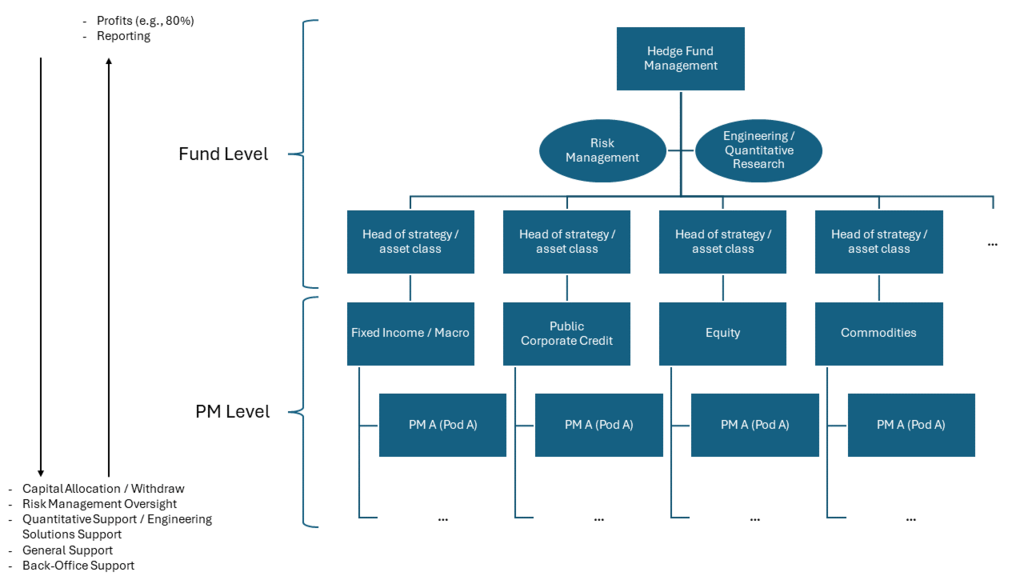
Beyond the GP and LPs, hedge funds rely on several external service providers. A prime broker (usually a large investment bank) provides a range of services, including trade execution, clearing, and lending money for leverage. A fund administrator handles the fund's accounting, calculates its Net Asset Value (NAV), and processes investor subscriptions and redemptions. These partners are crucial for the fund's daily operations.
The most common fee structure for hedge funds is known as "2 and 20." This means the fund charges a 2% management fee on total assets annually and takes 20% of any profits it generates.
Ready to test your knowledge? Let's see what you've learned about the fundamentals of hedge funds.
What is the primary objective of most hedge funds?
A key difference between hedge funds and mutual funds is that hedge funds typically...
Understanding these core concepts—what hedge funds are, their common strategies, and how they are structured—is the first step in analyzing this complex corner of the investment world.