Heart's Electrical Conduction System
Heart Electrical Conduction
The Heart's Electrical System
Your heart doesn't need your brain to tell it to beat. It has its own internal electrical system that sets the pace and coordinates every contraction. This system ensures blood is pumped efficiently through your body, beat after beat. It's a precise sequence of events, starting with a natural pacemaker and branching out through a network of specialized fibers. Let's trace the path of a single heartbeat.
The Spark Plug
The journey begins in the sinoatrial (SA) node, a small cluster of specialized cells located in the upper wall of the right atrium. Think of the SA node as the heart's natural pacemaker. It has the unique ability to generate electrical impulses automatically and rhythmically, without any external stimulation. This is what sets your resting heart rate.
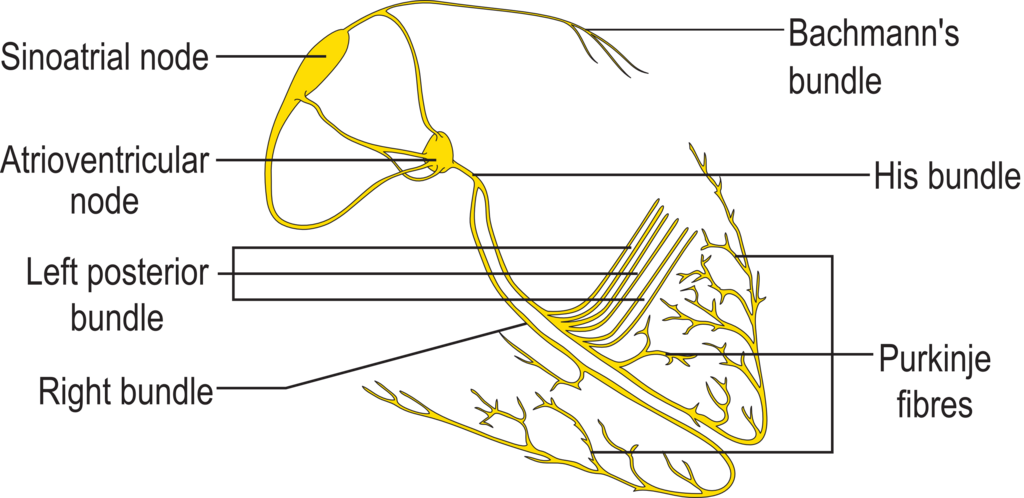
When the SA node fires, it sends out an electrical wave that spreads across both atria, much like ripples in a pond. This electrical signal causes the atrial muscle to contract, pushing blood down into the ventricles.
The Gatekeeper
Before the signal can reach the ventricles, it must pass through the atrioventricular (AV) node. Located near the center of the heart, between the atria and ventricles, the AV node acts as a critical gatekeeper. Its primary job is to briefly delay the electrical impulse.
This delay is crucial. It gives the atria enough time to finish contracting and completely empty their blood into the ventricles before the ventricles are signaled to pump.
Without this pause, the atria and ventricles would contract at nearly the same time, making the pump much less effective. The AV node ensures the heart's chambers work in a coordinated, two-step motion: atria first, then ventricles.
Spreading the Signal
Once the signal is released by the AV node, it travels down a high-speed pathway. First, it enters a bundle of fibers called the bundle of His. This bundle quickly splits into two main branches: the right bundle branch, which goes to the right ventricle, and the left bundle branch, for the left ventricle.
These branches then divide into a vast network of tiny fibers called Purkinje fibers that spread throughout the walls of the ventricles. This network is like an electrical superhighway, delivering the impulse to all parts of the ventricles almost simultaneously.
This rapid, widespread signal triggers a powerful, coordinated contraction of the ventricles, starting from the bottom and squeezing upwards. This motion is perfect for ejecting blood out of the heart and into the aorta and pulmonary artery, sending it to the rest of the body and the lungs.
Ready to test your knowledge?
What is considered the heart's natural pacemaker?
What is the primary purpose of the delay at the atrioventricular (AV) node?
From the initial spark at the SA node to the final squeeze of the ventricles, this elegant electrical sequence ensures your heart functions as a reliable and efficient pump, powering every moment of your life.