Healthcare Analytics with Python
Healthcare Data Ecosystem
The Clinical Data Landscape
Healthcare data isn't like other data. While you might be familiar with relational databases holding customer information or sales transactions, clinical data captures the complexity of human health. The backbone of this system is the (EHR). Think of it as a digital version of a patient's chart, but it's much more than that. It's a real-time record that follows a patient through their healthcare journey.
However, this digital transformation created a new problem: data silos. Different hospitals and clinics use different EHR systems, each with its own proprietary structure. Data from the emergency room might not speak the same language as data from the pharmacy or the lab. This lack of interoperability makes it incredibly difficult to get a complete picture of a patient's health or to analyze data across entire populations.
The integration of diverse data types (e.g., structured data like electronic health records, claims, unstructured sources like clinical notes, genomic data, and medical imaging) into a comprehensive view of patient information will grow increasingly more common.
Creating a Common Language
To solve the silo problem, the industry developed Common Data Models (CDMs). A CDM is a standardized structure for organizing healthcare data, regardless of its original source. By mapping data from various EHRs to a single, consistent format, we can aggregate and analyze it on a massive scale. Two dominant models have emerged: FHIR and OMOP.
The (Fast Healthcare Interoperability Resources) model is designed for real-time data exchange. It breaks down health data into modular components called "Resources," like Patient, Observation, or MedicationRequest. This makes it ideal for building applications that need to pull specific information quickly, such as a mobile app for a diabetic patient to track their blood sugar readings from a connected device.
The (Observational Medical Outcomes Partnership) Common Data Model, on the other hand, is optimized for large-scale observational research. It standardizes data into a person-centric format, making it easier to run studies across millions of patient records from different institutions. Its goal is to enable reproducible research by ensuring that an analysis run on data from one hospital yields the same results as the same analysis on data from another.
The Codes That Define Care
Underpinning these data models are clinical coding systems. These are massive, standardized vocabularies used to represent diagnoses, procedures, lab tests, and medications. Instead of writing "Type 2 diabetes mellitus without complications" in a free-text field, a clinician assigns it a specific code. This ensures consistency and allows for powerful analysis. A few of the most important systems are ICD, SNOMED CT, LOINC, and CPT.
| Code System | Full Name | What it Codes | Example Use Case |
|---|---|---|---|
| ICD-10 | International Classification of Diseases, 10th Revision | Diseases, signs, symptoms | Billing insurance for a patient visit diagnosed with E11.9 (Type 2 diabetes). |
| SNOMED CT | Systematized Nomenclature of Medicine—Clinical Terms | Comprehensive clinical concepts | Documenting a patient has a 391040000 (History of myocardial infarction). |
| LOINC | Logical Observation Identifiers Names and Codes | Laboratory tests and clinical observations | Identifying a 2345-7 (Glucose level in serum or plasma) test result. |
| CPT | Current Procedural Terminology | Medical, surgical, and diagnostic procedures | Billing for a 99213 (Office outpatient visit, established patient, 15 minutes). |
Putting It All Together
So, how does this look in practice? Publicly available datasets like MIMIC-III provide a real-world example. MIMIC is a large, de-identified database containing health data from patients admitted to intensive care units. The data is stored in a relational format that you're likely familiar with, using tables like PATIENTS, ADMISSIONS, LABEVENTS, and DIAGNOSES_ICD.
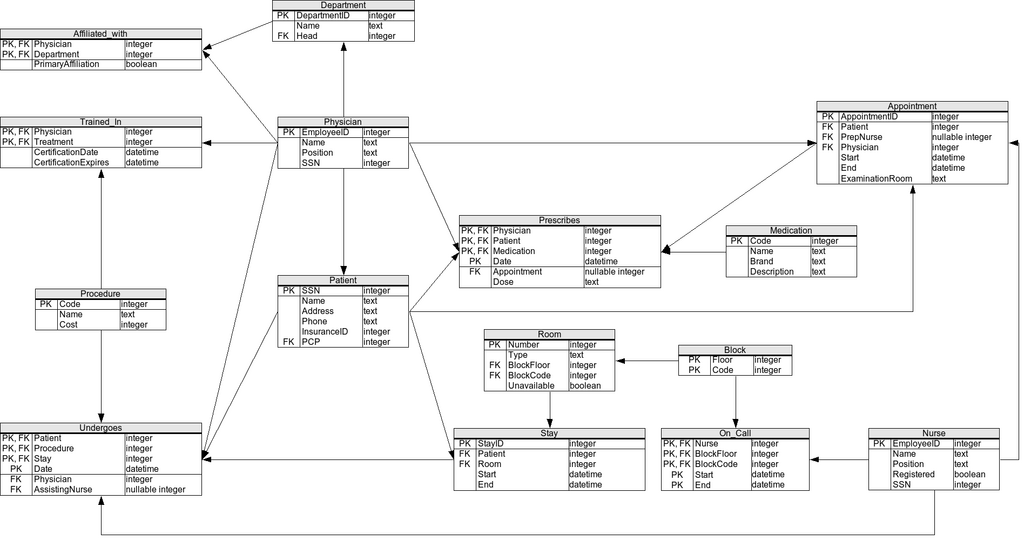
In this structure, a single patient in the PATIENTS table can have multiple hospital stays in the ADMISSIONS table. Each admission can have thousands of entries in the LABEVENTS table, each one a specific test result identified by a LOINC code. Their diagnoses are stored in DIAGNOSES_ICD using ICD codes. By joining these tables, you can reconstruct a detailed clinical timeline for each patient. This is the fundamental skill required to work with healthcare data: understanding how these standardized codes and relational tables come together to tell a complex medical story.
What is the primary problem that Common Data Models (CDMs) like FHIR and OMOP were designed to solve in healthcare?
A team of researchers wants to study the long-term effects of a specific medication by analyzing data from millions of patients across several different hospital networks. Which data model is specifically optimized for this type of large-scale observational research?