Headphone Technology Explained
Sound Waves
What is Sound?
Sound begins with a vibration. When you clap your hands, the sudden movement pushes the air molecules around them. Those molecules then push the ones next to them, which push the ones next to them, and so on. This chain reaction creates a wave of pressure that travels through the air.
A sound wave is essentially an invisible, traveling vibration.
Think of it like ripples in a pond. When you toss a stone into the water, it creates waves that spread out from the impact point. A sound wave is similar, but it travels through a medium like air, water, or even solid objects. These are mechanical waves, meaning they need a substance to travel through. That's why there's no sound in the vacuum of space, there's nothing for the vibrations to move through.
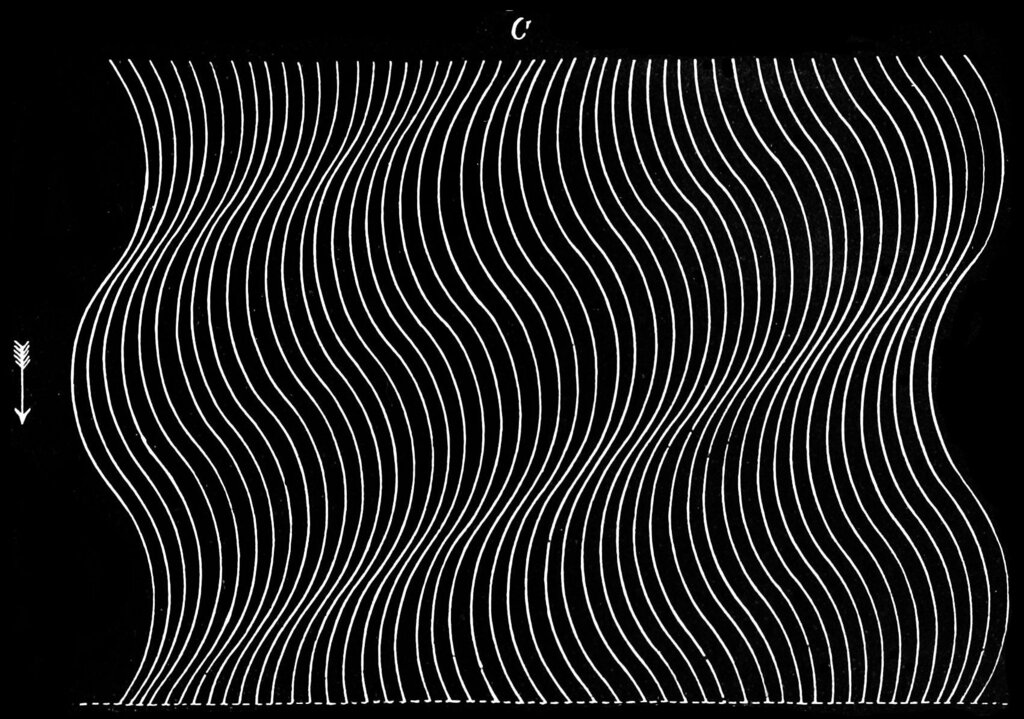
The Anatomy of a Wave
To understand how we hear different sounds, from the deep rumble of a bass drum to the high-pitched chirp of a bird, we need to look at the properties of these waves. The three most important are frequency, amplitude, and wavelength.
Frequency
noun
The number of full wave cycles that pass a point in one second. It's measured in Hertz (Hz).
Frequency determines the pitch of a sound. A low-frequency sound wave, like a tuba, has fewer vibrations per second and sounds deep. A high-frequency sound, like a whistle, has many vibrations per second and sounds high. Humans can typically hear frequencies between 20 Hz and 20,000 Hz (or 20 kilohertz, kHz).
Amplitude
noun
The maximum displacement or distance moved by a point on a vibrating body or wave measured from its equilibrium position. It corresponds to the sound's intensity.
Amplitude determines the loudness of a sound. It's the "height" of the wave. A wave with a large amplitude carries a lot of energy, creating a loud sound. A wave with a small amplitude has less energy and produces a quiet sound. Loudness is often measured in decibels (dB).
More amplitude means more volume. More frequency means a higher pitch.
Finally, there's wavelength. This is the physical distance between two consecutive points on a wave, for example, from one peak to the next. Wavelength is inversely related to frequency. If the frequency is high, the waves are packed closely together, so the wavelength is short. If the frequency is low, the waves are spread out, and the wavelength is long.
This relationship is described by the formula:
Where is the speed of sound, is the frequency, and (the Greek letter lambda) is the wavelength.
From Wave to Hearing
So how do these vibrating air molecules become the music, speech, and noises we perceive? That's the job of our ears, which are incredible biological instruments for translating pressure waves into information our brain can understand.
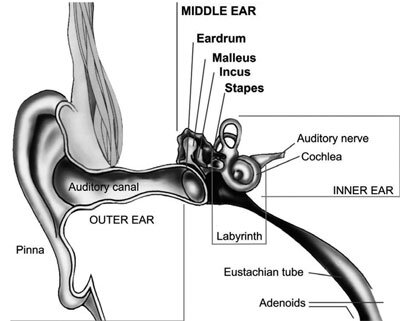
The process happens in a few key steps:
- Capture: The outer ear (the part you can see) acts like a funnel, collecting sound waves and directing them into the ear canal.
- Vibration: The waves travel down the canal and hit the eardrum, a thin membrane that vibrates in response to the pressure changes.
- Amplification: These vibrations are passed to three tiny bones in the middle ear, the smallest bones in your body. They act as a lever system, amplifying the vibrations.
- Conversion: The amplified vibrations reach the cochlea in the inner ear. The cochlea is a fluid-filled, snail-shaped structure lined with thousands of tiny hair cells. The fluid moves in response to the vibrations, causing the hair cells to bend.
- Signal to Brain: The bending of these hair cells generates electrical signals. These signals are sent along the auditory nerve to the brain, which interprets them as sound.
Different hair cells in the cochlea are sensitive to different frequencies, allowing us to distinguish between various pitches.
Sound is a sequence of waves of pressure that are transmitted mechanically by compression and expansion of air through mediums such as gas, liquids, solids, and plasma.
This entire journey, from a simple vibration in the air to a complex perception in our brain, is the foundation of everything we hear.
Ready to test your knowledge?
Why can't sound travel through the vacuum of space?
A low-pitched sound, like the rumble of a bass drum, has a...
Understanding these core principles of sound waves is the first step toward appreciating how headphones and other audio technologies work.