Hauntology and the Ghosts of Lost Futures
Derridean Spectres
The Spectre's Disruption
In 1993, with the Soviet Union dissolved and commentators proclaiming the final triumph of capitalism, made a startling claim: the world was more haunted than ever. His book, Specters of Marx, introduced a way of thinking he called hauntology. This isn't about ghosts in the supernatural sense. It's about the unsettling persistence of ideas and futures that were supposed to be dead and buried.
Traditional philosophy, or ontology, likes clear categories: something either is or is not. It is present or it is absent. A spectre, however, breaks these rules. It is a presence that is also an absence. It's not a being, but it's not nothing either. Think of the phantom limb sensation—a leg that has been amputated can still itch. The leg is not there, but its presence is intensely felt. The spectre occupies this same paradoxical space, disrupting our sense of a stable, self-contained reality.
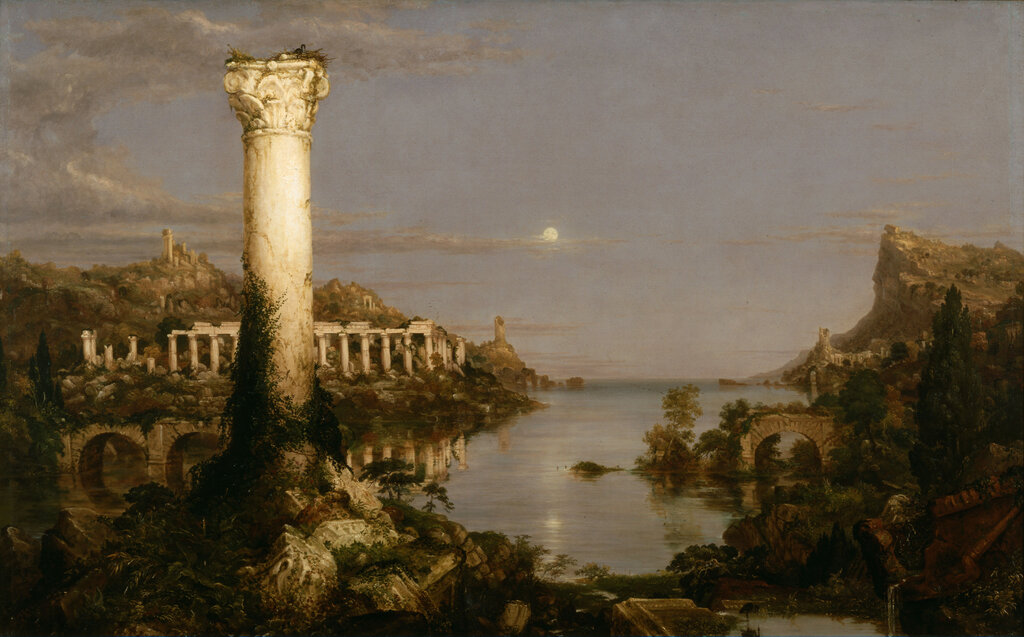
Time Out of Joint
For Derrida, this haunting fundamentally alters our experience of time. The present is never simply 'now'. It is non-contemporaneous with itself, stitched together from traces of the past and promises of the future. He borrows a line from Hamlet: "The time is out of joint." The present is always populated by spectres—the unresolved injustices of the past and the unrealised possibilities of futures that never came to pass.
This creates what Derrida calls a 'messianic' structure, but it's a messianic without messianism. It is a constant state of expectation and openness to a future of justice that is always 'to come' (à-venir). It's not the passive waiting for a specific saviour or a guaranteed utopia. Rather, it's an active responsibility in the present, driven by the promise of a future that has not yet arrived but which haunts our current moment with its potential. We are always waiting for an event that might never happen, but this waiting shapes everything we do.
Inheriting a Haunted House
Specters of Marx was a direct response to the political climate of the early 1990s. Following the collapse of the Berlin Wall, political theorist Francis Fukuyama famously declared the —the idea that humanity's ideological evolution had concluded with Western liberal democracy as its final form. Marxism, he and others argued, was now a dead ideology, a relic for the historical dustbin.
Derrida argued this was a profound mistake. To declare Marx dead was to try and exorcise his spectre. But you cannot simply dismiss an inheritance. We are heirs to Marx, whether we like it or not. This inheritance demands a process of mourning and filtering. We must be critical, acknowledging the disastrous failures of state communism (the 'dead' Marx), while also remaining faithful to the spirit of critique and the promise of justice that continues to haunt our world (the 'spectre' of Marx).
The spectre of Marx is the persistent question of justice that global capitalism claims to have solved, but which returns again and again.
This is the core of hauntology's political power. It's a tool for seeing the absences in our present. In a world celebrating its final victory, Derrida asks us to look for the spectres. What forgotten histories, failed utopias, and unresolved injustices continue to shape our reality? The neoliberal world is haunted by the very alternatives it claims to have defeated.
What is the central idea of Jacques Derrida's 'hauntology'?
Derrida's Specters of Marx was a direct political response to which contemporary idea?