Hash Map Fundamentals
Introduction to Hash Maps
The Instant Filing Cabinet
Imagine you have a massive library of books, but instead of the Dewey Decimal System, you just have one long shelf. To find a specific book, you'd have to start at one end and check every single title until you found it. If the book is at the very end, you're in for a long search. This is similar to how a basic list or array works in programming.
Now, imagine a magic filing cabinet. You tell it a book's title, and it instantly opens the correct drawer and hands you the book. You don't need to know where it is, and it doesn't matter if there are ten books or ten million. The retrieval is practically immediate. This is the core idea behind a hash map.
Hash Map
noun
A data structure that stores information as a collection of key-value pairs. Each key is unique and is used to look up its corresponding value very quickly.
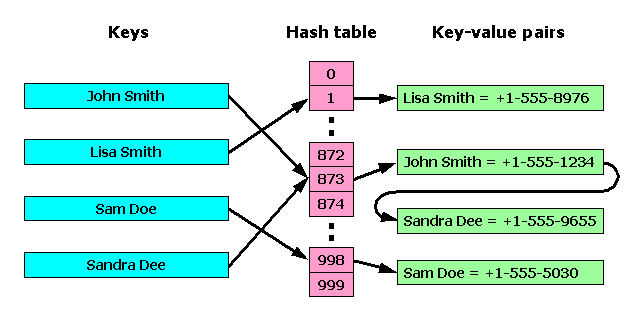
A hash map, sometimes called a dictionary or an associative array, works by linking a unique key to a specific value. Think of your phone's contact list. The key is your friend's name, and the value is all their contact information (phone number, email, etc.). When you want to call them, you search for their name, not their phone number.
The Need for Speed
The primary advantage of a hash map is its speed. It's incredibly efficient at finding, adding, and removing items. Because the key tells the hash map almost exactly where to find the value, it doesn't need to search through other items. Whether you have 100 entries or 100 million, the time it takes to find one item remains nearly constant.
The power of a hash map is that data retrieval is almost instantaneous, regardless of the amount of data stored.
This speed is crucial in countless applications. When you log into a website, the system likely uses a hash map to look up your user profile using your username or email (the key). When a web browser caches data to load pages faster, it might use the page's URL as a key to store the page's content as the value.
Where You'll Find Them
Hash maps are one of the most useful data structures in programming. Once you know what they are, you start seeing them everywhere.
- Dictionaries: A real dictionary is a perfect analogy. The word is the key, and the definition is the value.
- Phone Contacts: The contact's name is the key, and their phone number and other details are the value.
- Website Permissions: A user's ID could be the key, and their access level (like 'admin' or 'guest') could be the value.
- Counting Items: If you wanted to count how many times each word appears in a document, you could use a hash map where the key is the word and the value is its count.
They provide a simple, powerful way to organize data for quick access, making them a fundamental tool for any programmer.
Ready to check your understanding?
What is the primary advantage of using a hash map compared to a simple list or array for looking up data?
If you were building a system to count the occurrences of each word in a book, and you used a hash map, what would the 'key' and 'value' likely represent?