Harvard University Explained
Harvard's Founding and Early History
A College in the Wilderness
In 1636, just sixteen years after the Mayflower landed at Plymouth, the leaders of the Massachusetts Bay Colony made a remarkable decision. They voted to establish a college. This wasn't a luxury. For the Puritan colonists, it was a necessity. Their goal was to build a society guided by their religious beliefs, and that required a steady supply of educated ministers to lead their churches and interpret the scriptures.
They feared an illiterate ministry once their learned leaders, educated back in England, had passed on. So, the Great and General Court of the colony set aside $400 to found a school in Newtowne, a small settlement across the Charles River from Boston. The town was soon renamed Cambridge, in honor of the English university where many of the colony's leaders had studied.
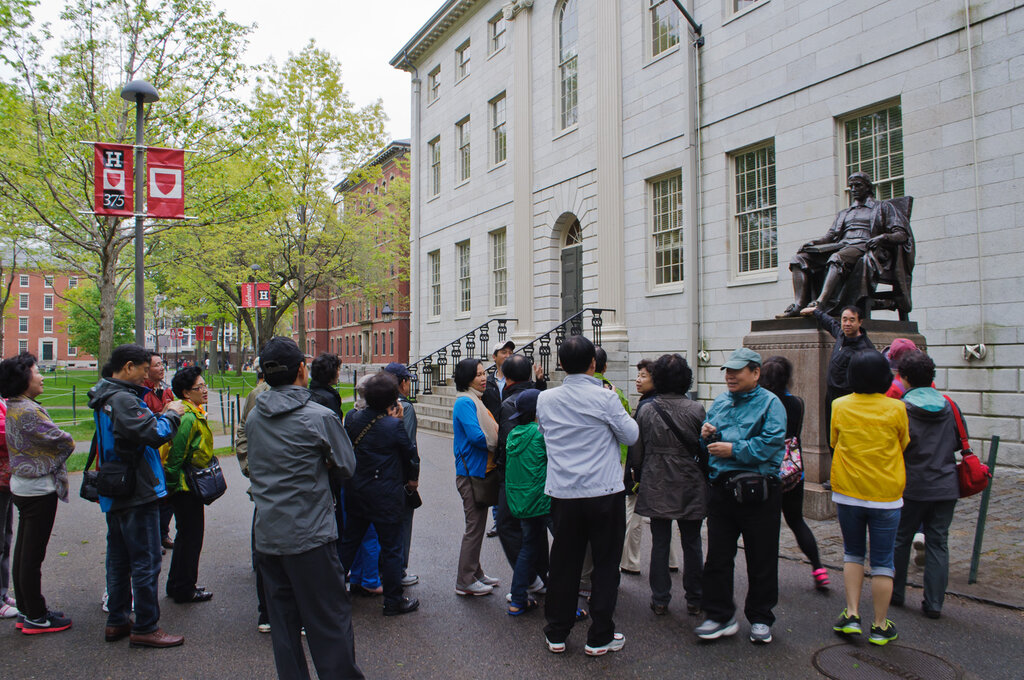
The college itself remained unnamed for two years. Then, in 1638, a young minister named John Harvard died of tuberculosis. In his will, he left the new institution his entire library of about 400 books and half of his estate. It was a transformative gift. In gratitude, the colony's leaders named the school Harvard College in his honor.
The Puritan Curriculum
Life at early Harvard was disciplined and demanding. The curriculum was designed with a single purpose: to train the mind for theological study and ministry. There were no majors or electives. Every student followed the same rigorous path, grounded in the classical tradition.
The entire course of study was conducted in Latin. Prospective students had to prove they could translate Latin and Greek authors on sight before they were even admitted. The daily routine was intense, filled with prayer, recitations, and lectures.
The primary subjects were Latin, Greek, Hebrew, logic, rhetoric, and theology. The goal was to equip students with the linguistic and philosophical tools needed to engage deeply with the Bible and religious doctrine.
Science and mathematics were present but played a minor role. Students studied arithmetic, geometry, and a bit of astronomy, but these subjects were seen as supplements to the core classical and theological education. The overarching theme was
Truth
, the university's motto. This truth was understood to be divine truth, revealed through scripture and reason.
Governing a New College
The college's governance reflected its close ties to the church and the colonial government. Initially, a Board of Overseers was established in 1642. This board consisted of the colony's governor, deputy governor, and local ministers, ensuring that Harvard remained aligned with Puritan orthodoxy.
In 1650, the college received its charter, creating a second governing body known as the Harvard Corporation. This group, consisting of a president, five fellows, and a treasurer, was responsible for the day-to-day management of the college. This two-tiered system, with the Corporation handling internal affairs and the Overseers providing external supervision, created a structure of checks and balances that has evolved but remains in place today.
Harvard was not just an academic institution; it was a cornerstone of the Puritan project in New England. Its founding was an act of faith in the future, a commitment to ensuring that their
city upon a hill
would have the intellectual and spiritual leadership it needed to survive and thrive in the New World.
What was the primary motivation for the Massachusetts Bay Colony to establish a college in 1636?
The town of Newtowne was renamed Cambridge in honor of the English university where many of the colony's leaders had studied.
This foundation set the stage for Harvard's long evolution from a small Puritan college into a world-renowned university.