Harnessing Visual-Spatial Thinking
Understanding Visual-Spatial Thinking
Thinking in Pictures
Have you ever solved a puzzle by picturing how the pieces fit together in your mind? Or given directions by describing landmarks instead of street names? If so, you were using visual-spatial thinking. It's a way of processing information by seeing images, patterns, and relationships in the space around you.
Visual-spatial thinking
noun
The ability to perceive, analyze, and manipulate visual patterns and spatial relationships in one's mind.
This cognitive style isn't just about what you see with your eyes. It’s about creating mental maps and models. Think of assembling furniture. Some people meticulously follow the step-by-step written instructions. Others look at the diagram of the finished product and work backward, mentally rotating the pieces to see how they connect. The second approach is a classic example of visual-spatial reasoning.
Two Styles of Thought
Cognitive styles exist on a spectrum, but a common way to understand visual-spatial thinking is to contrast it with auditory-sequential thinking. Most people use a mix of both, but often lean more toward one style.
Auditory-sequential thinkers process information in a linear, step-by-step way. They thrive on order, logic, and language. They often excel at tasks like following verbal directions, memorizing facts in order, and showing their work in math problems. They hear the world.
Visual-spatial thinkers, on the other hand, are holistic. They grasp the big picture first and then fill in the details. They see the world.
| Visual-Spatial Thinker | Auditory-Sequential Thinker |
|---|---|
| Sees the whole picture first | Focuses on one step at a time |
| Thinks in images and patterns | Thinks in words and sounds |
| Solves problems intuitively | Solves problems with logic and procedure |
| Learns by seeing and doing | Learns by listening and reading |
| May struggle with rote memorization | Excels at memorizing sequential facts |
Neither style is better than the other. They are simply different ways of making sense of the world. A team with both types of thinkers can be incredibly effective, as they approach problems from multiple angles.
The Brain's Visual Pathways
So, what's happening in the brain? Visual-spatial processing is largely, though not exclusively, associated with the brain's right hemisphere. It involves a complex network of regions working together.
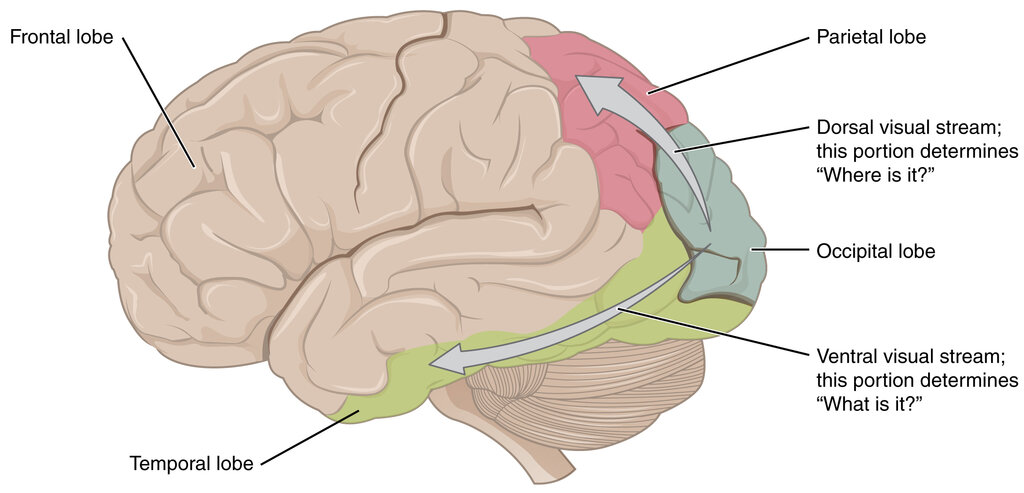
When we see something, the information travels from our eyes to the occipital lobe at the back of the brain. From there, it splits into two main pathways.
The ventral stream helps us identify what we're looking at (like recognizing a face or a chair). The dorsal stream helps us understand where it is in space and how to interact with it (like reaching out to grab a cup).
Visual-spatial thinking relies heavily on these pathways to build and manipulate mental images. This neural architecture allows us to mentally rotate objects, navigate our surroundings without a map, and see how different systems connect.
Learning and Creativity
Understanding your cognitive style has big implications for learning. Visual-spatial learners often thrive when information is presented with diagrams, charts, and hands-on activities. They might find it challenging to sit through long lectures or memorize lists of vocabulary words without visual context.
This thinking style is also a powerhouse for creativity and innovation. Because visual-spatial thinkers see connections and patterns that others might miss, they are often able to come up with novel solutions to problems. They can visualize a complex system, see its weaknesses, and imagine how it could be improved. This ability to synthesize information and see the whole picture is a key ingredient in many creative breakthroughs.
The key neuroscientific insight is that visual information processing is hierarchical and proceeds in stages: The earlier stages process low-level features in the visual field (such as edges, contours, colors and shapes), whereas complex representations, such as whole objects and faces, emerge only later in the inferior temporal cortex.
Recognizing these different ways of thinking helps us appreciate the diverse mental tools we all possess. Whether you think in words or pictures, understanding these processes is the first step toward leveraging your unique cognitive strengths.
Ready to test your knowledge?
Which of the following activities most clearly demonstrates visual-spatial thinking?
How does an auditory-sequential thinker primarily process information?