Harnessing the Power of AI
Introduction to Artificial Intelligence
What Is Artificial Intelligence?
Artificial Intelligence, or AI, is the science of making machines that can think like humans. It's about creating systems that can learn from experience, recognize patterns, solve problems, and understand language. At its core, AI aims to simulate human intelligence in a computer.
Artificial intelligence (AI) is a wide-ranging tool that enables people to rethink how we integrate information, analyze data, and use the resulting insights to improve decision making—and already it is transforming every walk of life.
Think of it this way: when you learn to ride a bike, you're not just following a set of pre-programmed instructions. You adapt, you learn from falling, and you figure out how to balance. AI research is about giving machines that same ability to adapt and learn, rather than just executing commands blindly.
A Brief History of AI
The idea of intelligent machines has been around for centuries, but the modern field of AI got its official start in the summer of 1956. A group of scientists gathered at Dartmouth College for a workshop to explore the idea that "every aspect of learning or any other feature of intelligence can in principle be so precisely described that a machine can be made to simulate it."
It was here that the term "Artificial Intelligence" was first coined.

The years following the Dartmouth Conference saw waves of excitement and funding, followed by periods of disappointment and budget cuts known as "AI winters." Early successes were often limited to solving simple, logical problems. The complexity of real-world challenges proved much harder to crack.
A recent explosion in AI progress has been fueled by two key factors: the availability of massive amounts of data and the development of powerful computers that can process it all. This has led to the powerful AI tools we see today.
The Three Types of AI
When we talk about AI, it's helpful to break it down into three distinct categories based on its capabilities. These stages represent a journey from simple task-based intelligence to something far beyond our own.
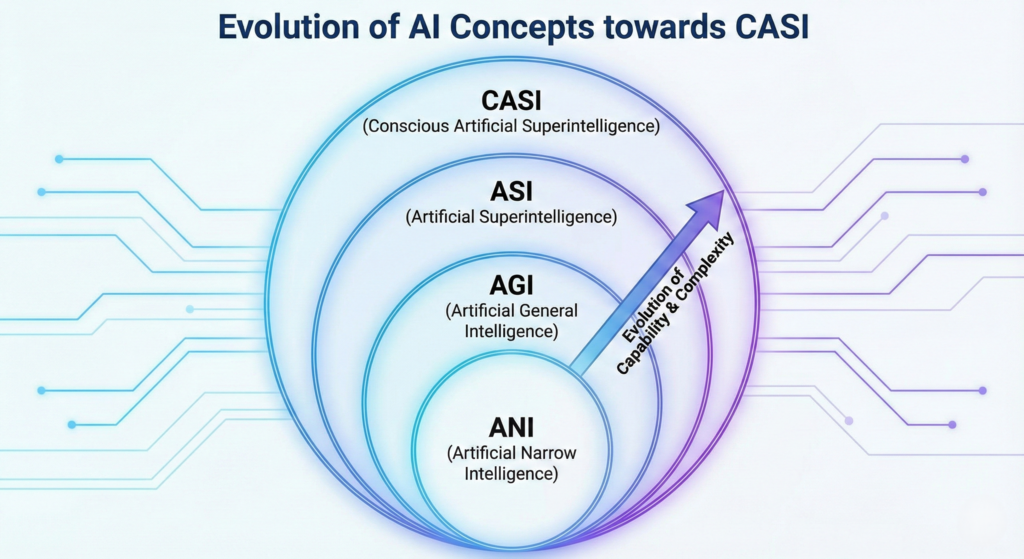
1. Artificial Narrow Intelligence (ANI) Also known as Weak AI, this is the only type of artificial intelligence we have successfully created so far. ANI is designed and trained for one specific task. Your phone's voice assistant, the AI that recommends movies, and language translation apps are all examples of ANI. They are incredibly powerful at their specific job but can't operate outside of it. A chess-playing AI can't start recommending music.
Every AI you interact with today is a form of Artificial Narrow Intelligence.
2. Artificial General Intelligence (AGI) Also called Strong AI, this is the next frontier. AGI would have the ability to understand, learn, and apply its intelligence to solve any problem, much like a human being. It could learn to write a song, then switch to designing a bridge, all without being specifically programmed for those tasks. AGI is the type of AI often seen in science fiction, and it remains a theoretical goal for researchers.
3. Artificial Superintelligence (ASI) This is a hypothetical future stage where AI surpasses human intelligence across virtually every field, from scientific creativity and general wisdom to social skills. The capabilities of an ASI are difficult to predict, but the concept represents the ultimate potential of artificial intelligence.
Goals and Challenges
The ultimate goal of AI research is to create machines that can reason, learn, and perceive the world. This involves several major challenges that scientists are working to overcome.
One of the biggest hurdles is common sense reasoning. Humans have a vast, unspoken understanding of how the world works that's hard to program into a machine. For example, we know that if you let go of a glass, it will fall and likely break. Teaching an AI this kind of intuitive knowledge is incredibly difficult.
Another challenge is creativity. While AI can generate art and music that seems creative, it's typically mimicking patterns from data it was trained on. Achieving true, original creativity that isn't just a remix of existing ideas is a major goal.
Finally, creating AI that can truly understand context and nuance in human language remains a significant obstacle. Sarcasm, humor, and subtle emotional cues are still tough for machines to grasp.
Now, let's test your understanding of these core concepts.
What is the fundamental goal of Artificial Intelligence (AI)?
The term "Artificial Intelligence" was first coined at a 1956 workshop held at which institution?
Understanding these foundational ideas gives you a framework for thinking about the AI technologies shaping our world.