Harmony and Counterpoint Essentials
Introduction to Music Theory
The Musical Alphabet
Music is built from a simple set of twelve notes. The core of this system is the musical alphabet, which consists of just seven letters: A, B, C, D, E, F, and G. After G, the cycle repeats with the next A, which sounds similar but is higher in pitch. This jump to the next letter of the same name is called an octave.
The notes in between these seven letters are called sharps (♯) and flats (♭). A sharp raises a note by the smallest possible step, while a flat lowers it by the same amount. For example, the note between C and D can be called C-sharp (C♯) or D-flat (D♭). These notes are enharmonic, meaning they are the same pitch with different names. Together, the seven letter notes and the five sharp/flat notes create the full twelve-note chromatic scale.
Building Scales
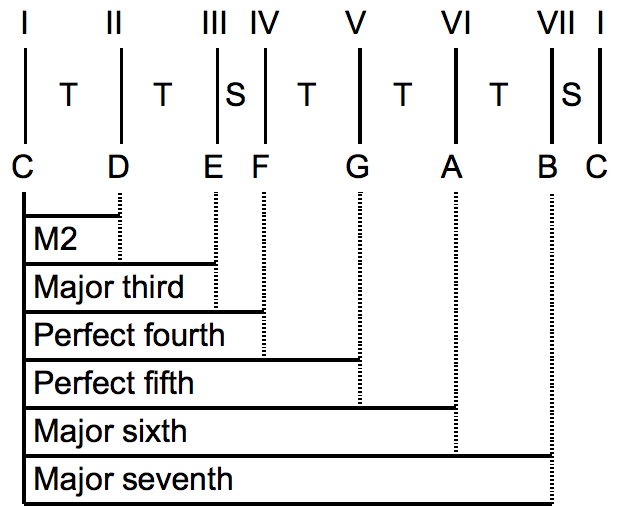
A scale is an organized sequence of notes that serves as the foundation for melodies and harmonies. Scales are built using specific patterns of whole steps and half steps. A half step is the smallest distance between two notes, like from E to F or from C to C♯. A whole step is simply two half steps, like from C to D.
The most common scale is the major scale. It has a bright, happy sound and follows a consistent pattern, no matter which note you start on. The pattern is: Whole, Whole, Half, Whole, Whole, Whole, Half.
Major Scale Formula: W-W-H-W-W-W-H
Let's build a C major scale. Starting on C, we follow the pattern:
- C to D (Whole step)
- D to E (Whole step)
- E to F (Half step)
- F to G (Whole step)
- G to A (Whole step)
- A to B (Whole step)
- B to C (Half step)
The resulting notes are C, D, E, F, G, A, B. Notice how this scale uses only the white keys on the piano. This is why C major is often the first scale musicians learn.
Measuring Intervals
An interval is the distance between any two notes. We measure intervals with a number (2nd, 3rd, 4th, etc.) and a quality (major, minor, perfect). The number comes from counting the letter names from the starting note to the ending note, including the start.
Using our C major scale again, we can find the intervals from the starting note, C. These are called major or perfect intervals.
| Starting Note | Ending Note | Interval Number | Interval Name |
|---|---|---|---|
| C | C | 1st | Perfect Unison |
| C | D | 2nd | Major Second |
| C | E | 3rd | Major Third |
| C | F | 4th | Perfect Fourth |
| C | G | 5th | Perfect Fifth |
| C | A | 6th | Major Sixth |
| C | B | 7th | Major Seventh |
Perfect intervals (unison, 4th, 5th, and octave) are very stable and consonant. Major intervals (2nd, 3rd, 6th, 7th) are also consonant but have a slightly different character. If we lower a major interval by one half step, it becomes a minor interval.
Understanding Key Signatures
What if we want to build a major scale starting on a note other than C? We still use the W-W-H-W-W-W-H pattern, but we'll need to use some sharps or flats to maintain it.
For example, to build a G major scale, we get: G - A - B - C - D - E - F♯. The sixth to seventh notes, E to F, are only a half step apart naturally. To make it a whole step, we must raise the F to F♯. This F♯ will be used throughout any piece of music in the key of G major.
Instead of writing the sharp or flat symbol next to the note every time, musicians use a key signature. This is a collection of all the sharps or flats needed for a particular key, placed at the very beginning of the music staff. When a musician sees an F♯ in the key signature, they know to play every F as F♯, unless told otherwise.
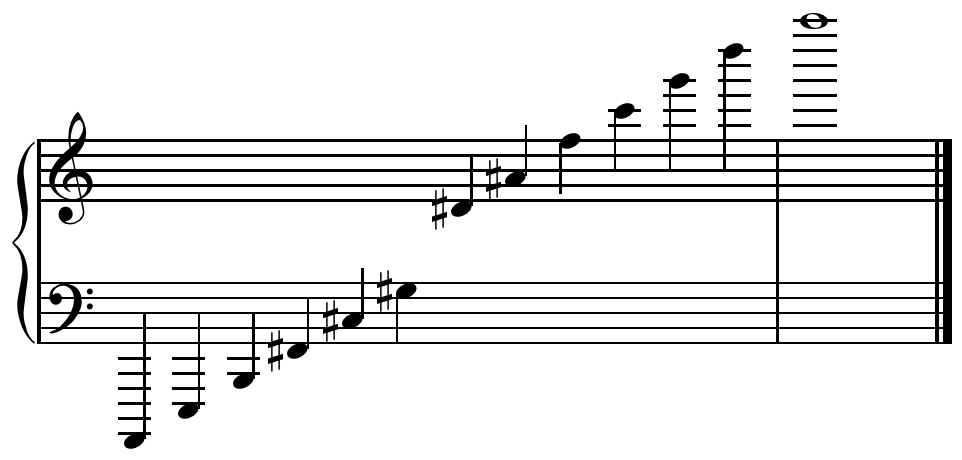
Key signatures are a shorthand that tells you the tonal center of the music. Each major key has a unique key signature, from C major (no sharps or flats) to C♯ major (seven sharps).
Ready to test your knowledge? Let's see what you've learned about the building blocks of music.
How many letters make up the core musical alphabet before it repeats?
Which term describes two notes that have the same pitch but different names, like C♯ and D♭?
Understanding these core concepts—the musical alphabet, scales, intervals, and key signatures—is the first step to unlocking the language of music. They provide the framework for nearly everything that follows in harmony and composition.